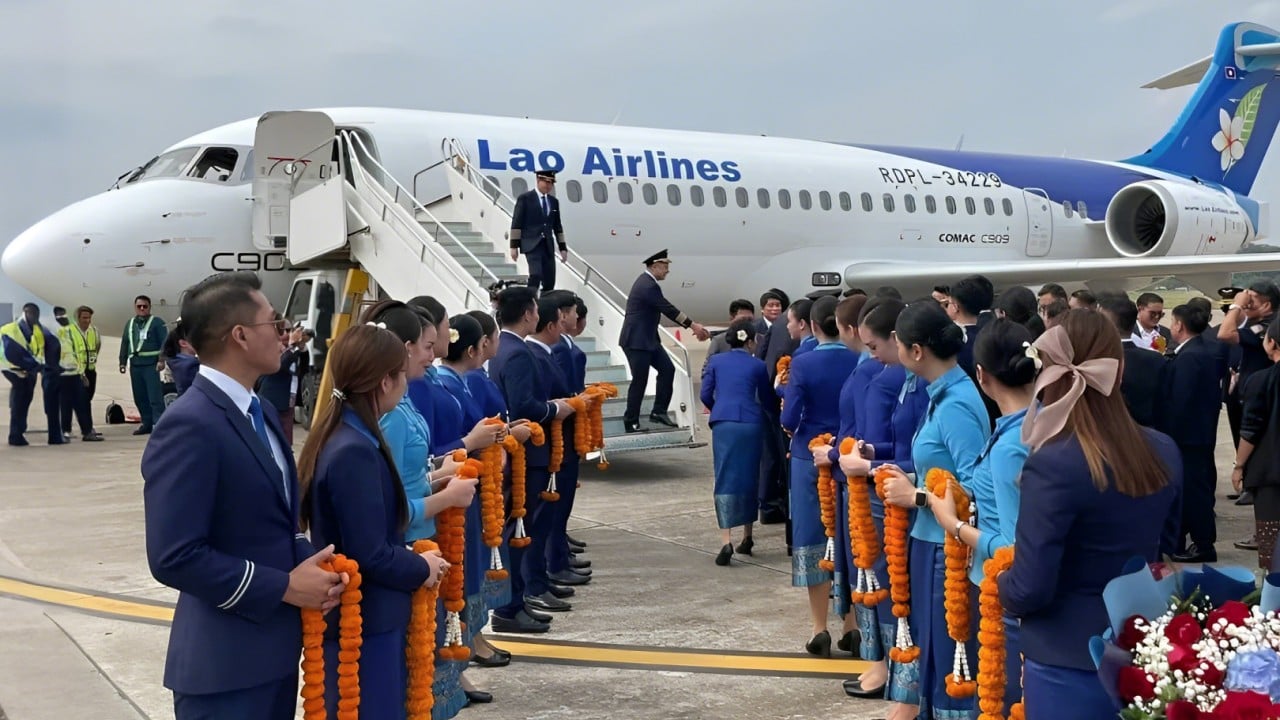
Commercial Aircraft Corporation of China (COMAC) is currently using the rugged terrain of Laos as a high-stakes laboratory for its regional jet, the C909. While Western observers often dismiss Chinese aerospace ambitions as mere vanity projects, the operational shift in Vientiane reveals a much more pragmatic strategy. Beijing is not just selling planes to a neighbor; it is building an end-to-end aviation ecosystem designed to bypass the traditional certification barriers of the FAA and EASA. By establishing a functional, profitable blueprint in a landlocked Southeast Asian nation, COMAC aims to prove that its aircraft can thrive in environments where Boeing and Airbus are either too expensive or too operationally complex to maintain.
The C909, formerly known as the ARJ21, has long struggled with a reputation for being heavy, loud, and restricted in range. However, its recent performance with Ezhou-based carriers and its deployment via Lao Skyway suggest a pivot toward specialized, "thin" routes where high-frequency, low-capacity flights are the only way to turn a profit.
The Laos Proving Ground
Laos serves as the perfect theater for this experiment because it presents every challenge a regional jet might face. The geography is unforgiving. High humidity, high elevations, and short runways are the norm. If a Chinese jet can maintain a reliable dispatch rate in the mountains of Phongsaly or the heat of Pakse, the sales pitch to Africa, Central Asia, and the rest of ASEAN becomes significantly easier.
In Vientiane, the strategy is less about the airframe and more about the umbilical cord of support. COMAC has realized that selling a plane is the easy part. Keeping it in the air is where they have historically failed. To counter this, they have embedded engineers directly into local operations, effectively subsidizing the learning curve of Lao pilots and technicians. This isn't just a purchase agreement; it is a wet-lease of national sovereignty in the skies.
Breaking the Western Certification Stranglehold
For decades, the global aviation market has been a duopoly governed by Western safety standards. If the FAA doesn't bless a plane, most of the world won't fly it. China is tired of waiting for that blessing. Instead of knocking on the door in Washington or Brussels, they are building their own neighborhood.
The C909 operations in Laos are intended to create a body of "validated hours." When COMAC eventually approaches regulators in Indonesia, Malaysia, or Vietnam, they won't just bring blueprints. They will bring five years of daily flight data from a climate identical to the customer’s. This is an end-run around the colonial structures of aviation law. It creates a "Sinosphere" of aviation where Chinese standards are the default, not the alternative.
The Problem of Weight and Efficiency
It would be dishonest to suggest the C909 is a world-beater. It isn't. The aircraft is significantly heavier than its direct competitors from Embraer or the now-defunct Mitsubishi SpaceJet project. That weight translates directly to higher fuel burn. In a vacuum, no rational CFO would choose the C909 over an E175 based purely on seat-mile costs.
But aviation doesn't exist in a vacuum. It exists in a world of geopolitics and financing. China offers "policy banking" that Western manufacturers cannot match. When the Export-Import Bank of China offers a package that includes the planes, the hangers, the runway upgrades, and the pilot training at interest rates that defy market logic, the fuel inefficiency of the jet becomes a rounding error on the balance sheet.
The Maintenance Nightmare and the Solution
The biggest hurdle for the C909 has always been the supply chain. If a sensor fails in Luang Prabang, the plane sits on the tarmac for three weeks waiting for a part from Shanghai. That kills an airline.
To fix this, China is establishing regional parts hubs that look less like traditional warehouses and more like strategic military outposts. By positioning "hot-swappable" engines and avionics suites in proximity to the Mekong delta, they are attempting to mirror the logistics prowess of Boeing’s AOG (Aircraft On Ground) teams. The success of the Laos experiment hinges entirely on whether a C909 can be fixed in 24 hours. If they achieve that, the perceived risk of buying Chinese hardware evaporates.
A Blueprint for the Global South
The C909 is the scout. It is the rugged, slightly unrefined vehicle sent ahead to clear the path for the C919—China’s true narrow-body challenger to the 737 and A320. If COMAC can show that they can manage the complexities of international operations with the C909 in a developing economy, the trust deficit for their larger jets will shrink.
We are seeing the birth of a tiered aviation market. The "Gold Standard" will remain the Western-certified corridors of the North Atlantic and Western Europe. However, a "Secondary Standard" is forming across the Global South. This market doesn't care about the prestige of an FAA type certificate; it cares about whether the plane shows up on time and whether the financing keeps the national carrier solvent.
The Pilot Shortage and the Training Pipeline
China is also addressing the human element. They aren't just sending planes; they are building flight schools. By training Lao and Indonesian pilots in Kunming and Zhuhai, they are ensuring that the next generation of aviators is native to Chinese cockpits. A pilot who learns to fly on a COMAC glass cockpit is unlikely to lead an airline's transition to Airbus a decade later. It is a long-term play for brand loyalty that begins at the cadet level.
The Harsh Reality of the Secondary Market
There is, however, a glaring flaw in the C909 plan: resale value. A Boeing 737 is a liquid asset; you can sell it to almost any leasing company in the world. A C909 is currently a dead-end asset. Once you buy it, you own it until it goes to the scrap heap because there is no secondary market for Chinese jets.
This lack of liquidity makes the aircraft a "hard sell" for private airlines that need to keep their balance sheets flexible. Consequently, COMAC is forced to target state-owned flag carriers or heavily subsidized startups where the government holds the risk. Until a C909 can be traded as easily as an Embraer, it will remain a tool of statecraft rather than a purely commercial product.
Moving Beyond the "Made in China" Stigma
The flight decks of these jets are surprisingly modern, featuring suites from Honeywell and GE. This creates a strange hybrid: a Chinese shell with Western guts. This "Trojan Horse" strategy allows COMAC to benefit from established reliability while they slowly work to replace those Western components with domestic alternatives like the CJ-1000A engine.
The goal is total vertical integration. By the time the C909 is a common sight in Southeast Asian skies, the "Western guts" will likely have been swapped for "Made in China" internals. Laos is the first step in proving that this transition won't result in planes falling out of the sky.
Aviation history is littered with the corpses of regional jets that tried to challenge the status quo. The difference here is the sheer scale of the state backing. China is willing to lose money on every flight in Laos for a decade if it means they own the infrastructure of the next century. They are playing a game of attrition against Western market dominance, and Vientiane is the opening move.
Watch the tail numbers in Southeast Asia. If the C909 fleet grows by even five percent next year, it won't be because the plane got better, but because the Chinese ecosystem got stronger. The hardware is just the lure; the system is the product.
.png?itok=_JNETlVL)