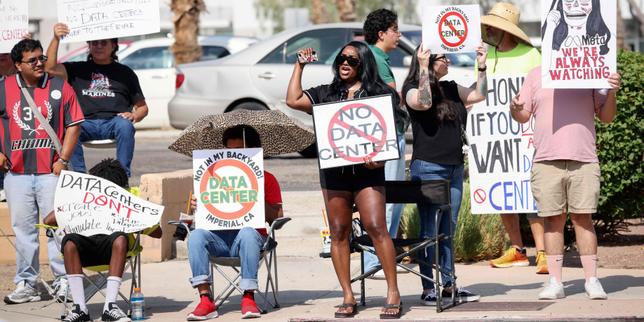
The physical footprint of the artificial intelligence boom is colliding with hard domestic limits, turning quiet municipal zoning hearings into ideological battlefields across the United States. Billions of dollars in server farm proposals are currently stalled, delayed, or outright canceled as a broad coalition of citizens and local officials reject the digital expansion. Behind this friction lies a simple, sobering truth: hyperscale server compounds demand an unprecedented share of local municipal water supplies and electrical grid capacity, leaving surrounding residents to foot the bill.
For years, digital infrastructure lived quietly in the background of American commerce. Low-profile tilt-up concrete buildings hummed near highway corridors, processing cloud traffic and streaming packets with minimal local friction. Generative artificial intelligence shattered that invisibility. Training next-generation models requires immense clusters of specialized processors working in parallel, pulling megawatt loads that rival heavy manufacturing plants or small cities.
Municipalities from suburban Indiana to rural Arizona are finding themselves unprepared for the sheer physical scale of modern data facilities. A single campus can consume millions of gallons of water daily for evaporative cooling loops while demanding dedicated high-voltage transmission lines. When local utility boards realize that residential ratepayers risk subsidizing industrial power upgrades through escalating monthly bills, community consensus fractures instantly.
Bipartisan alignment has emerged in places where political labels usually dictate opposing views. Conservative property owners worried about rural land values and state-level tax subsidies find themselves standing side-by-side with progressive environmental activists concerned about carbon emissions and resource depletion. This rare convergence has turned a technical infrastructure question into a potent electoral flashpoint.
Take the recent legislative maneuvers in states like New York and Wisconsin, where provisional moratoriums on new commercial data developments have gained traction. Lawmakers are responding to constituents who feel completely excluded from the windfall profits of big tech. Job creation figures touted by developers rarely match the reality on the ground. Once construction finishes, automated server complexes employ a tiny fraction of the permanent workforce required by a factory or a logistics hub of equivalent square footage.
The economic mismatch fuels deep-seated resentment. Communities trade away their quiet vistas, accept constant construction noise, and risk local grid reliability for a handful of maintenance positions and modest tax increments. Developers offering multi-billion-dollar investments are learning that community consent cannot be bought with corporate philanthropy or empty promises of future technological prestige.
Infrastructure analysts tracking project pipelines note that billions of dollars in planned builds face structural delays entirely due to local pushback. Corporations accustomed to fast-tracking permits through compliant state legislatures are discovering that municipal planning commissions hold unexpected teeth. When hundreds of angry homeowners pack a county council chamber to demand impact studies, traditional real estate development models break down.
Resolving this gridlock requires a complete overhaul of how digital utilities integrate with local municipal planning. Tech giants can no longer treat municipal water and power as infinite externalities. Closed-loop liquid cooling systems, direct financial contributions to grid hardening, and dedicated green-energy generation built entirely off-grid represent the minimum cost of entry for future expansion. Until developers internalize those true operational costs, every new server farm will face an uphill battle against the very communities powering the digital economy.