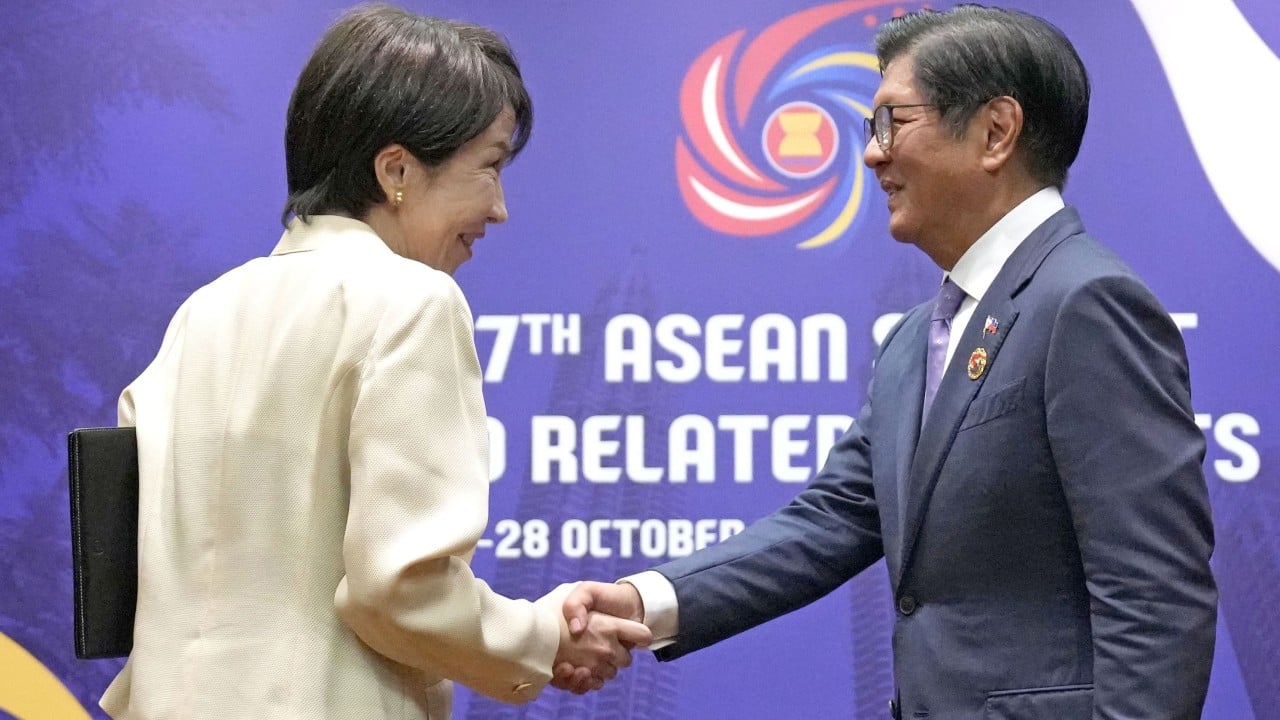
The air inside the Prime Minister’s official residence in Tokyo carries a specific kind of silence. It is the quiet of calculated diplomacy, where every nod is measured and every pause is negotiated weeks in advance. When Philippine President Ferdinand Marcos Jr. steps into this environment, he isn't just a state leader on a routine diplomatic junket. He carries the weight of an archipelago that sits precisely where the geopolitical tectonic plates of Asia are grinding against one another.
Across the table sits Sanae Takaichi, a political figure whose reputation is built on steel, traditionalism, and an unyielding stance on national defense.
To understand what is happening here, step away from the podiums and teleprompters. Look instead at a map of the South China Sea through the eyes of a single, hypothetical fisherman aboard a wooden outrigger near Ayungin Shoal. Let's call him Eduardo. For generations, Eduardo’s family tracked the monsoons, cast their nets, and returned with hulls full of round scad. Today, Eduardo watches the horizon not for weather patterns, but for the looming gray hulls of foreign coast guard vessels. His livelihood depends on decisions made in wood-paneled rooms thousands of miles away.
Marcos is in Japan because the old ways of keeping Eduardo safe are fracturing. The bilateral relationship between Manila and Tokyo is undergoing a profound mutation, transforming from economic assistance into something far more muscular.
The Weight of the Horizon
For decades, the bond between the Philippines and Japan was defined by a quiet ledger of development aid, bridges, and subway loans. Japan was the benevolent benefactor helping an emerging economy build its infrastructure. That ledger has changed color. It is now shaded in the stark tones of maritime security.
The immediate objective of the Philippine delegation centers on securing advanced defense equipment and finalizing frameworks that allow for closer military cooperation. Manila needs eyes on the water. It needs radar systems that can pierce the tropical haze to track unauthorized maritime movements. It needs patrol vessels that can withstand the aggressive maneuvering of larger, more aggressive fleets.
But the technical specifications of a radar system or the displacement tonnage of a patrol boat are merely placeholders for the real currency being traded: deterrence.
Consider the mathematics of isolation. The Philippines possesses a modest military budget, tasked with defending a coastline longer than that of the continental United States. It cannot match the sheer industrial output of a neighbor intent on rewriting maritime borders. By aligning more tightly with Japan, Marcos is attempting to alter that math. He is signaling that an aggressive move in the West Philippine Sea is no longer a localized dispute; it is an issue that vibrates through the entire chain of island democracies stretching up to Hokkaido.
The Architect of the New Defense
This brings us to Takaichi. To understand what Marcos seeks from her, one must understand her trajectory within Japanese politics. She represents a faction that believes Japan can no longer afford the luxury of passive pacifism. For her, constitutional constraints on the military must be interpreted through the lens of modern survival.
When Marcos speaks with Takaichi, he is not talking to a bureaucrat who views foreign policy through the lens of trade balances. He is talking to a strategist who views the defense of the first island chain—the line running from Japan down through Taiwan to the Philippines—as a single, interconnected security architecture.
Manila wants Japan to accelerate the deployment of the Official Security Assistance framework. This isn't the standard aid meant for roads or hospitals. This is funding explicitly earmarked for the militaries of like-minded nations. The Philippines was the inaugural recipient of this program, a fact that underscores the urgency felt in both capitals.
The conversation is also about access. The Reciprocal Access Agreement simplifies the legal hurdles required for troops to move between the two nations for joint training. For the Philippines, this means learning the art of island defense from a nation that has perfected it. For Japan, it means gaining operational familiarity with the waters that control the vital sea lanes feeding its economy.
The Friction of Memory and Reality
Navigating this alignment requires a delicate balance. History casts a long shadow across Southeast Asia, and the memory of the mid-twentieth century is not entirely erased. A generation ago, the idea of Japanese military assets operating near Philippine waters would have sparked deep unease.
The shift we are witnessing is driven by a very modern form of anxiety that eclipses historical ghosts. The contemporary threat feels closer, louder, and more immediate than the past.
This reality introduces a distinct vulnerability to the proceedings. Marcos must convince his domestic audience that this tightening embrace with Tokyo does not compromise Philippine sovereignty, nor does it drag the country unnecessarily into a broader conflict between superpowers. It is a tightrope walk. One misstep, or one overly aggressive statement from either side, can alienate a domestic populace that is fiercely protective of its independent foreign policy.
The complexity deepens when considering the economic reality. China remains a massive trading partner for both Manila and Tokyo. Neither nation can afford a complete decoupling. Therefore, the strategy cannot be one of open confrontation. It must be a subtle, persistent tightening of knots—strengthening alliances so quietly and thoroughly that any potential adversary calculates the cost of aggression and decides it is too high.
What Lies Beneath the Agreements
Beyond the visible handshakes and signed memoranda, the true objective of this summit is the synchronization of technology and intelligence. The modern maritime border is not just patrolled by steel hulls; it is monitored by data streams.
The Philippines desperately needs integrated satellite communication networks and real-time maritime domain awareness tools. When a swarm of foreign vessels anchors at a disputed reef, the time it takes to detect, verify, and publicize that movement dictates the diplomatic outcome. If it takes days, the occupation becomes a fait accompli. If it takes minutes, the international community can be mobilized.
Japan possesses the satellite infrastructure and the electronic warfare capabilities that the Philippines lacks. Marcos is seeking a seamless pipeline of information. He wants Philippine commanders to see the ocean with the same clarity that Japanese self-defense forces do.
This exchange is not a one-way street. The Philippines offers Japan something it cannot buy: geography. The Batanes islands sit just a stone's throw from Taiwan's southern coast. A Philippines that is capable, secure, and aligned with Tokyo acts as a vital anchor for Japan's own southern flank.
The Unspoken Calculation
The true measure of success for this historic trip will not be found in the immediate press releases. It will be found in the subtle shifts in behavior on the water over the coming months.
If the agreements reached in Tokyo translate into faster deployment of radar stations along the Philippine eastern and western seaboards, the mission succeeds. If it results in more frequent, complex naval drills that force opposing fleets to think twice before initiating water-cannon incidents, the mission succeeds.
But the stakes remain incredibly volatile. Diplomacy of this scale is an exercise in managing risk, not eliminating it. Every agreement signed with Japan risks provoking a sharp economic or gray-zone countermeasure from Beijing. It is a game of geopolitical chess where the board is fluid and the rules are rewritten in real time.
As the meetings conclude and the delegations prepare to return home, the focus shifts back to the coastlines. The treaties will be bound in leather and filed away in archives. The true test of their validity belongs to the people who inhabit the margins of this conflict.
The wooden outrigger rides the swells of the South China Sea, its hull lifting and dropping with the rhythm of the tide. Eduardo checks his lines. The gray ships are still there on the horizon, silent and watchful. But now, the space between his small boat and those imposing hulls is occupied by an invisible network of international treaties, shared radar data, and the quiet, collective resolve of two nations determined to ensure the ocean remains free.