Two blocks from the North Lawn, the city still smells like roasted nuts and exhaust.
Tourists angle their phones to catch the white portico behind black wrought-iron bars. Coffee cups sweat on the hood of a food truck. A courier leans against a parking meter, scrolling through a dispatch app while sirens wail three avenues away and fade into the hum of a Tuesday afternoon.
Everything looks completely ordinary.
Until you notice the men in dark windbreakers who never check their phones.
When news breaks that Secret Service officers discovered a man parked near the White House with multiple firearms in his vehicle, the public usually consumes the headline in four seconds flat. A blurb on a phone screen. A brief alert between weather updates and sports scores. Arrested. Charged. Crisis averted. Next story.
We treat these moments like routine traffic stops with better lighting. We miss the invisible machinery that stood between a routine afternoon in Washington, D.C., and a catastrophe that never got the chance to happen.
The Anatomy of a Four-Block Radius
To understand what actually happens when an armed vehicle rolls into the shadow of 1600 Pennsylvania Avenue, stop thinking about fences and start thinking about concentric circles.
Picture a pebble dropped into a still pond, except the ripples move inward instead of out. At the center sits the Executive Mansion—a historic residence, a working command center, and a symbol that carries the weight of global stability. Surrounding it is a layered grid of physical barriers, behavioral detection, license-plate readers, bomb-sniffing canines, and plainclothes officers trained to spot the micro-behaviors that betray a hidden intent.
In Washington, gun laws are among the strictest in the United States. Carrying an unregistered firearm or transporting weapons without a local permit isn't a technicality; it is a felony that immediately triggers federal scrutiny when it occurs inside the District's security buffer.
Consider a hypothetical scenario—call him Arthur, a composite drawn from dozens of real federal affidavits filed in D.C. Superior Court over the past decade.
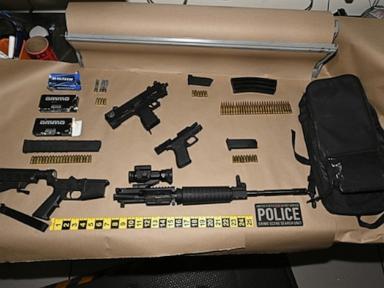
Arthur drives six hundred miles overnight. His dashboard is cluttered with fast-food wrappers and handwritten notebooks. In his trunk, wrapped in blankets, sit two rifles, a handgun, and several boxes of ammunition. He isn't screaming slogans out his window. He isn't ramming a barricade. He simply pulls into a metered space along 17th Street, kills the engine, and sits there, staring toward the iron fence.
To a passing pedestrian, Arthur is just another out-of-state driver looking for directions or waiting for a friend.
To a Uniformed Division officer walking a foot beat, Arthur is an anomaly.
Why Stillness Raises the Alarm
Most people assume security threats announce themselves with noise. Movies have trained us to expect screeching tires, shouted warnings, and dramatic standoffs.
Reality is quieter. Reality is a stationary sedan with fogged windows and an out-of-state plate lingering twenty minutes past the meter limit in a restricted zone.
I spent years covering federal courthouses and walking those exact blocks around Lafayette Square, watching how protective details operate when cameras aren't rolling. You learn quickly that the sharpest tool in a protective agent's kit isn't a weapon—it is baseline observation. Every street around the White House has a pulse. Morning commuters walk briskly with lanyards bouncing against their coats. Tourists stop abruptly, point upward, and cluster near crosswalks. Delivery drivers double-park with hazard lights blinking, sprinting toward lobby doors.
A parked car where the driver doesn't get out, doesn't check a map, and doesn't reach for a phone breaks the rhythm of the block.
Officers approach not with drawn guns, but with practiced, conversational calm. A tap on the glass. A routine inquiry about parking regulations or vehicle registration. It is a diagnostic test disguised as small talk. Does the driver's voice tremble? Are the eyes darting toward the perimeter checkpoints? Is there a rifle case partially visible beneath a jacket on the back seat?
In dozens of documented cases around the White House complex, that casual conversation is the exact hinge on which history turns. A glimpse of a magazine on the floorboard. An admission during questioning that weapons are inside the trunk. Within seconds, calm turns into choreography. Backup units seal the block. Bomb technicians sweep the undercarriage. The driver is placed in handcuffs before most tourists across the street even realize their selfie background has changed.
The Human Weight Behind the Badge
We rarely pause to consider what that thirty-second interaction demands of the person wearing the badge.
Every vehicle stop near the White House carries an impossible asymmetry. Ninety-nine times out of a hundred, the driver is a lost tourist from Ohio, a stressed contractor, or someone experiencing a quiet mental health crisis who drove to the capital looking for answers no building can provide.
The hundredth time, the trunk holds an arsenal.
If an officer approaches with hair-trigger aggression, an innocent or vulnerable citizen gets hurt, and public trust fractures. If the officer approaches with complacency, the person inside the car reaches between the seats.
Walking that razor's edge eight hours a day, five days a week, leaves a mark you don't see in press releases. You stand in the freezing rain of January and the suffocating humidity of August, scanning thousands of faces an hour, knowing that your single moment of distraction could become the opening line of a history book nobody wants to read.
And what about the person behind the wheel?
Court records from similar arrests near the White House reveal a sobering pattern. Rarely are these individuals masterminds executing a complex geopolitical plot. Far more often, federal complaints describe isolated people unraveling under the pressure of personal loss, untreated paranoia, or online radicalization—individuals who packed their belongings and drove toward Washington because the White House represents the ultimate stage for their pain.
Recognizing that human reality doesn't excuse the danger. Loaded firearms in a congested capital city pose a lethal threat to officers, bystanders, schoolchildren on field trips, and the protectees inside the complex. Accountability under federal and D.C. firearms statutes is non-negotiable. Yet acknowledging the fragility behind the wheel helps explain why early interception matters so deeply. Catching a threat at the curb saves lives on both sides of the window.
What Happens After the Sirens Fade
When authorities announce that a suspect has been arrested near the White House with multiple firearms, the public story usually ends right there. In truth, the legal and investigative work has barely begun.
First comes the sweep. Even when no explosives are found, technicians examine every inch of the vehicle—door panels, spare tire wells, electronic wiring—to ensure the car isn't a secondary device. Traffic reroutes around the block, snarling downtown commutes while investigators photograph the interior and catalog serial numbers.
Next comes the trace. Agents from the Bureau of Alcohol, Tobacco, Firearms and Explosives run every recovered weapon through national databases to determine where it was purchased, whether it was stolen, and whether it has been linked to other crimes. Simultaneously, the Secret Service's Protective Intelligence and Assessment Division digs into the suspect's digital footprint, travel logs, and financial records.
The central question isn't just what the suspect had. It is why they came.
Did they make prior threats against protected officials? Did they drive straight to Washington from another state with a specific timeline, or did they wander into the restricted perimeter by chance? Those answers determine whether the case stays in D.C. Superior Court on local gun possession charges or escalates to federal court with charges involving threats against the President or unlawful entry into a restricted building or grounds.
For residents and visitors, the visible footprint vanishes within hours. The yellow tape comes down. The food trucks return to their corners. Tourists press their faces back against the iron fence to snap photos of the Rose Garden.
The Illusion of Effortless Safety
There is a quiet paradox at the heart of modern protective security: the better it works, the less anyone notices it.
When a breach occurs—when someone scales a fence or drives through a checkpoint—the public demands congressional hearings, perimeter redesigns, and accountability. When an officer notices a parked car on a side street, asks the right questions, and quietly removes multiple firearms from the heart of the capital before a single shot is fired, the event shrinks to a three-paragraph wire story.
Success looks like nothing happening at all.
We live in an era that rewards spectacle and overlooks prevention. We measure danger by smoke and broken glass, forgetting that the most consequential moments in public safety happen in silence, long before a trigger is pulled or a crowd begins to run.
Next time you see a brief headline about a man arrested near the White House with weapons in his car, resist the urge to scroll past it as background noise. Picture the street corner. Picture the ordinary afternoon sun glinting off windshields, the parents pushing strollers past the Treasury building, the office workers hurrying toward the Metro.
Then picture the officer stepping off the curb, knocking gently on a rolled-up window, and stepping between an ordinary day and everything that could have shattered it.