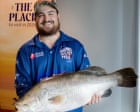
In the humid darkness of Australia’s Northern Territory, a routine evening of brotherly conversation ended with one of the most lucrative fishing catches in modern Australian recreational history. A Darwin local landed a tagged barramundi worth one million Australian dollars while casually fishing at night with his brother, proving that the Territory’s famous Million Dollar Fish competition does not favor elite tournament anglers over everyday locals. While standard news coverage celebrates the wholesome luck of two brothers passing time by the water, the deeper story reveals a massive economic gamble, precise biological tracking, and the calculated mechanics behind a tourism campaign designed to keep visitors spending money during the region's brutal wet season.
The surface narrative is undeniably charming. Two brothers head out after sunset, lines in the water, trading stories in the tropical night air until a heavy strike bends the rod. When the fish comes aboard, a distinct red tag protruding from its dorsal fin transforms an ordinary catch into a seven-figure windfall. Yet beneath that romantic snapshot lies a tightly engineered state-backed enterprise. The Northern Territory government, operating through Northern Territory Major Events Company and backed by major corporate underwriters, did not create this prize out of pure generosity. They built a high-stakes financial engine disguised as a fishing derby.
The Economics of the Wet Season Gamble
To understand why a single barramundi carries a seven-figure bounty, you have to look at a calendar and a balance sheet. From October through March, the Top End of Australia experiences the tropical wet season, locally known as the Build-Up and the Monsoon. Humidity climbs past eighty percent. Afternoon thunderstorms roll across Darwin with violent regularity, and many iconic national parks close their unsealed roads due to flooding. Historically, tourism numbers fell off a cliff during these months, leaving hotels, charter operators, tackle shops, and pubs bleeding cash until the dry season returned in May.
The Million Dollar Fish campaign was engineered specifically to reverse that seasonal collapse. By releasing over a hundred tagged barramundi across five major fishing regions—Darwin, Kakadu, Arnhem Land, Katherine, and the Tiwi Islands—organizers created a lottery ticket swimming through public waterways. Most tags carry a ten-thousand-dollar payout, while a select few hold the headline-grabbing million-dollar prize.
The financial math behind the promotion is ruthless and effective. Insurance underwriters calculate the exact statistical probability of an angler landing the specific million-dollar fish within the competition window. Because the Top End spans hundreds of thousands of square kilometers of winding tidal rivers, mangrove creeks, and floodplains, the odds of any single tagged fish meeting a hook remain extraordinarily low. Organizers pay a fraction of the headline prize in insurance premiums while reaping tens of millions of dollars in documented visitor expenditure, media exposure, and local retail stimulation. When a Darwin local actually beats those astronomical odds—especially on a casual night out rather than a chartered expedition—the publicity value instantly eclipses the payout.
Why Night Fishing Changes the Equation
Most casual observers assume the Darwin brothers simply stumbled into blind luck. Veteran Territory anglers know better. Fishing at night during the warmer months is not an afterthought; it is a deliberate tactical adjustment dictated by tropical biology and tidal physics.
Barramundi are ambush predators whose feeding patterns shift dramatically with water temperature and light levels. During the blazing heat of a Northern Territory afternoon, water temperatures in shallow creeks can exceed thirty-two degrees Celsius, pushing large fish into deep, shaded holes where they become sluggish and reluctant to chase lures. Once the sun drops, surface temperatures cool rapidly, and baitfish move out of deep cover onto shallow mudflats and rocky points.
Darkness strips away the visual advantage of wary, older barramundi. A fish that has grown large enough to be selected for a tagging program has survived years of crocodiles, sharks, and fishing pressure. In bright daylight, these mature fish inspect lures closely and frequently reject artificial presentations. Under cover of night, barramundi rely heavily on their lateral line system—a sensitive network of mechanoreceptors running down their flanks that detects minute pressure waves and vibrations in the water.
When the brothers dropped their lines at night, they entered an environment where sensory reliance shifts from sight to vibration. Furthermore, night sessions eliminate the relentless glare of the tropical sun, reduce boat traffic on popular Darwin waterways, and allow anglers to fish incoming or outgoing tides in relative peace. Sitting quietly and talking isn't a distraction from serious angling; in estuarine waters, minimizing heavy footsteps on aluminum boat hulls and keeping deck lights off prevents sound waves from traveling through the water and spooking predatory fish.
Inside the Tagging and Verification Protocol
Landing a tagged fish is only the beginning of a strict forensic verification process. Because a million dollars sits on the line, competition officials treat a red tag with the same scrutiny a bank applies to a high-value bearer bond. Over the years, fisheries scientists and event organizers have refined a multi-layered protocol to prevent fraud, poaching, or tampering.
Before the season begins, trained fisheries technicians capture wild barramundi using electrofishing boats or net surveys. Each selected fish is measured, weighed, and assessed for overall health before receiving a specialized dart tag anchored securely into the musculature beneath the dorsal fin. The tag displays a unique serial number, a hotline phone number, and specific color coding that corresponds to the active competition season.
Crucially, the public never knows which serial number corresponds to the million-dollar prize until after a fish is caught and verified. Even the technicians inserting the tags do not know which number holds the grand prize; that mapping remains locked inside an encrypted database managed by independent auditors and the underwriting insurance firm.
When an angler lands a tagged fish, strict rules govern what happens next:
- Immediate photographic evidence must be captured showing the fish on a brag mat with the tag clearly visible and legible.
- The tag must remain intact or be carefully removed according to official catch-and-release guidelines if the angler chooses to return the fish to the water.
- Verification interviews require the angler to provide exact GPS coordinates or waterway details, timestamped photos, and confirmation of prior free registration in the competition.
- Polygraph and metadata checks are standard clauses in the terms and conditions for major prize payouts, ensuring the fish was caught legally within competition boundaries and timeframes.
If an angler forgets to register online before casting their line, the million-dollar tag becomes worthless—a brutal administrative trap that has caught out unlucky fishermen in past seasons.
The Reality of Tournament Pressure Versus Casual Patience
There is a persistent myth in recreational fishing that expensive gear, high-powered sonar, and rigid tournament schedules guarantee success. Watching two brothers pull off a historic catch while simply talking in the dark exposes the flaw in that mindset.
Modern sportfishing has become heavily commercialized. Anglers routinely spend upwards of eighty thousand dollars on center-console boats equipped with forward-facing live sonar, lithium battery banks, and custom carbon-fiber rods. While technology undeniably helps locate structure and bait schools, it often induces a form of hyper-kinetic fishing. Anglers motor rapidly from spot to spot, firing hundreds of casts an hour, churning the water with electric trolling motors, and burning through spots before predatory fish ever settle back into feeding rhythms.
A relaxed night session operates on the exact opposite principle. By anchoring or drifting quietly and holding a conversation, the brothers allowed the waterway to return to its natural acoustic baseline. Baitfish resumed normal movement around submerged snags and rock bars. Scent trails from natural baits or slow-worked lures dispersed naturally with the tidal current.
In estuarine environments around Darwin Harbor, Bynoe Harbor, and the Adelaide River, tidal flow dictates everything. A stationary boat positioned correctly along a current seam lets the tide deliver food directly to waiting predators. Patience outperforms aggression because barramundi conserve energy; they prefer to hold behind a submerged log or ledge and inhale prey swept past their noses rather than burning calories chasing fast-moving targets across open water.
Hidden Risks of Night Fishing the Top End
Romanticizing a quiet night on the water ignores the very real hazards inherent to Northern Territory waterways. Fishing Darwin at night is not like casting into a quiet suburban lake in Europe or North America. Every mangrove bank and tidal creek sits inside the territory of Crocodylus porosus, the estuarine saltwater crocodile.
Since federal protections took effect in the early 1970s, saltwater crocodile populations across the Northern Territory have rebounded dramatically, reaching an estimated one hundred thousand animals in the wild. Large males routinely exceed four meters in length and hunt primarily between dusk and dawn. At night, crocodiles become virtually invisible, gliding silently beneath the surface with only their eyes reflecting red in a flashlight beam.
Anglers fishing after dark face compounding dangers that require constant discipline:
- Shoreline vulnerability makes land-based night fishing extraordinarily dangerous, as crocodiles ambush prey at the water's edge where footsteps create predictable vibrations.
- Small vessel exposure increases when anglers lean over gunwales to net a thrashing barramundi, placing hands and heads within easy striking distance of a lurking reptile attracted by the struggling fish.
- Extreme tidal swings in Darwin Harbor regularly exceed seven meters between low and high water, capable of stranding boats on mudflats or creating violent standing waves over submerged reefs in pitch darkness.
- Marine stingers such as box jellyfish and Irukandji inhabit coastal waters during the warmer wet-season months, turning an accidental fall overboard into a life-threatening medical emergency within minutes.
For locals, managing these risks becomes second nature—keeping limbs inside the boat, using long-handled landing nets, monitoring tide charts religiously, and shining spotlights along the banks before retrieving gear. To an unprepared visitor lured north by headlines of easy million-dollar payouts, those same dark waters present unforgiving hazards.
What Happens After the Check Clears
Winning a million dollars in a close-knit community like Darwin brings immediate social and financial fallout that rarely makes the initial press release. Unlike anonymous lottery winners in sprawling metropolises, a successful Million Dollar Fish angler becomes an instant local celebrity before the fish is even filleted or released.
Under Australian tax law, windfall gains from recreational competitions and lotteries are generally tax-free, meaning the winner keeps the full million-dollar sum rather than losing nearly half to government withholding as happens in the United States. However, sudden wealth in a small capital city of roughly one hundred fifty thousand residents attracts relentless attention. Local radio stations, television crews, tackle sponsors, and distant acquaintances appear overnight.
Past winners have used their payouts to pay off mortgages, buy new boats, fund family businesses, or invest in property across the Territory. Yet the true long-term beneficiary remains the Northern Territory's promotional machine. Every time a local wins, the story ricochets across national and international news wires, cementing Darwin’s reputation as the undisputed barramundi capital of the world.
For two brothers sitting in the dark, sharing quiet conversation over fishing rods, the night began with zero expectations beyond good company and maybe a fresh fillet for dinner. By dawn, their catch had validated a multi-million-dollar tourism strategy, rewarded local patience over high-tech aggression, and turned a routine Darwin evening into permanent Territory folklore.