The espresso machine in a private banking lounge does not hiss. It whispers.
Step off the street in Hong Kong’s Central district, pass through double-paned acoustic glass, and the city’s frantic metallic clatter vanishes. For more than half a century, that silence was the undisputed sound of Asian money. If you built a manufacturing empire in Dongguan, a shipping dynasty in Kowloon, or a software unicorn in Shenzhen, your wealth eventually migrated to a narrow strip of reclaimed land between Victoria Harbour and the Peak. You took the ferry, or you sat in cross-harbor tunnel traffic, and you signed papers in towers where the air smelled faintly of cedarwood and old carpet.
Now, look across the water. Look west.
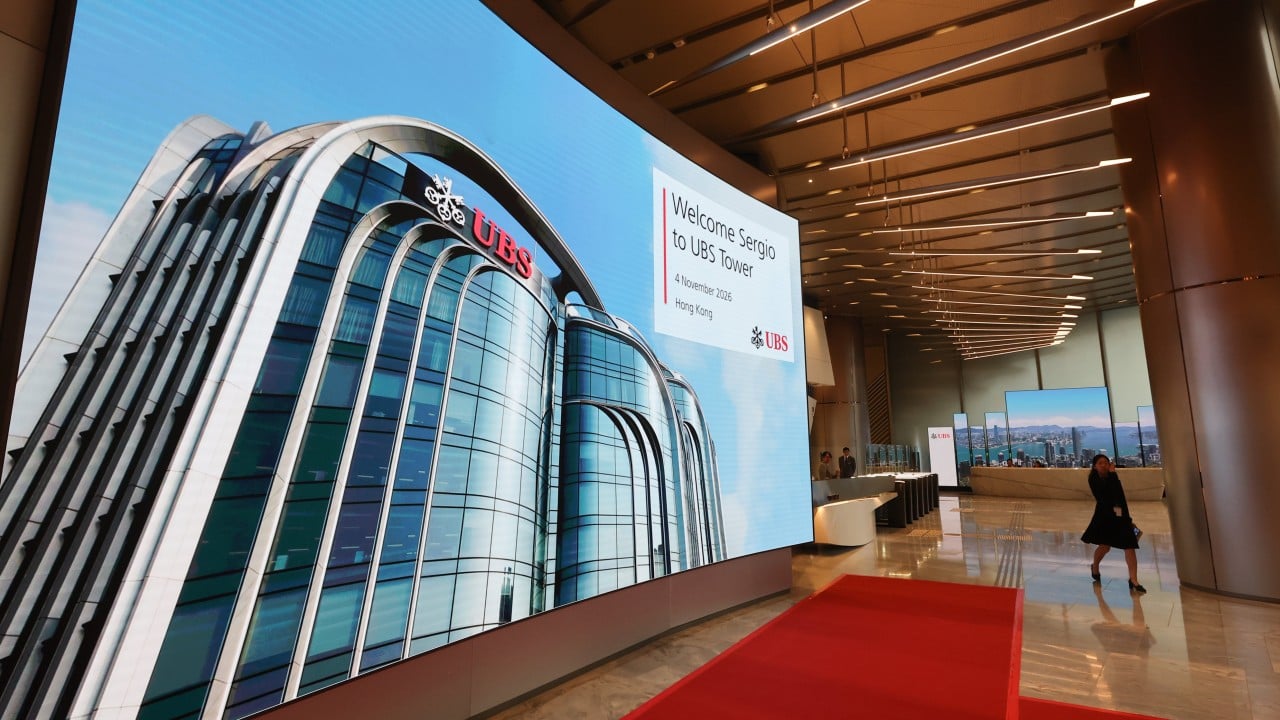
Above the subterranean throat of the West Kowloon High-Speed Rail terminus, steel and glass have risen to meet the clouds. When UBS formally committed to consolidating its Hong Kong workforce into a massive, purpose-built hub atop the International Gateway Centre in West Kowloon—a move years in the making that anchors roughly 460,000 square feet of prime space—the financial press treated it like a real estate transaction. They wrote about square footage, lease expirations in Central, and consolidation efficiencies. They missed the pulse entirely.
Real estate is never just concrete. In banking, a floor plan is a confession of what an institution fears and what it covets.
The Geography of a New Kind of Anxiety
To understand why a 160-year-old Swiss banking giant would pull thousands of its bankers out of their traditional Central stronghold and plant them directly over a train station, you have to understand what keeps a first-generation founder awake at three in the morning.
Consider a hypothetical scenario. Picture a man named Kenji—though in Shenzhen or Guangzhou, his name might be Wei, or Lin. Let us call him Wei. Wei is fifty-four. In 1998, he owned two injection-molding machines in a leased warehouse with a corrugated tin roof. Today, his company supplies precision components for electric vehicle batteries across three continents. On paper, Wei is worth four hundred million dollars.
In reality, Wei is exhausted, and he is quietly terrified.
For twenty-five years, Wei’s wealth existed in one form: equity locked inside factories, inventory, and machinery. He knew how to negotiate with raw material suppliers in Foshan and how to read a balance sheet at midnight. He did not know how to structure a cross-border family trust, how to hedge currency exposure when the yuan fluctuates, or how to prevent his two children—one studying design in London, the other running an AI startup in Hangzhou—from tearing the business apart when he steps down.
Wealth, when it arrives in a single generation, does not feel like freedom. It feels like carrying a crate of nitroglycerin across a gravel parking lot.
Multiply Wei by tens of thousands, and you have the demographic reality of the Guangdong-Hong Kong-Macao Greater Bay Area. This eleven-city cluster—encompassing Hong Kong, Macao, and nine mainland cities including Shenzhen, Guangzhou, Dongguan, and Foshan—is home to roughly eighty-six million people. Its combined economic output rivals that of South Korea or Canada. Over the past decade, it has functioned as the most ferocious wealth-creation engine on earth.
Yet for years, an invisible friction separated the money from the people trained to protect it.
If Wei wanted to meet his private banker in Hong Kong’s Central district, the trip was an expedition. He had to cross the border, navigate immigration, catch a car or the Airport Express, and carve an entire day out of his schedule just to sit across a mahogany table for ninety minutes. For a man who measures his life in production cycles, a wasted day feels like a physical injury.
Fourteen Minutes Under the Pearl River Delta
Walk down into the concourse of the West Kowloon Station, and the geometry of that problem collapses.
The station is an architectural cathedral of brushed steel and curved glass, plunging four levels underground. Beneath its sweeping roof, high-speed trains slip out of the tunnels and accelerate northward at speeds pushing two hundred miles an hour. Futian—the beating financial heart of Shenzhen—is fourteen minutes away. Guangzhou South is less than forty-five minutes up the line.
Stop and let that number sit in your chest. Fourteen minutes.
A founder in Shenzhen can finish a morning board meeting, walk into Futian station with a briefcase, clear co-located immigration checkpoints in a single sweep, and step off the train in West Kowloon before his coffee goes cold. He does not need a chauffeur. He does not need to cross Victoria Harbour. He takes an elevator straight from the rail terminus up into the UBS tower.
When UBS decided to anchor its Hong Kong operations in Sun Hung Kai Properties’ landmark development above the West Kowloon terminus—becoming the largest office tenant in the project and uniting staff previously scattered across Central, Kowloon, and Kwun Tong—it was making a physical bet on human impatience.
I have watched major institutional shifts in Asian finance for years, and the pattern is always the same: capital flows along the path of least psychological resistance. You can build the finest algorithmic trading desk in the world, and you can hire armies of compliance officers, but private wealth management remains stubbornly, anciently human. Nobody hands over their life’s work to a voice on an encrypted video call. They want to look into the eyes of the person holding the pen. They want to see the weight of the building. They want to feel that the institution is permanent, yet close enough to touch between lunch and a four o'clock flight.
By planting its flag directly atop the high-speed rail artery, UBS turned Hong Kong from an offshore island into a commuter stop for mainland enterprise.
Why Consolidation Is Actually a Survival Strategy
Of course, bankers rarely admit to poetry. If you ask an executive in Zurich or Hong Kong why the West Kowloon hub matters, they will talk about operational efficiency and bringing teams under one roof. And they are telling the truth—just not the whole truth.
To see the full picture, you have to remember what happened to the banking world in the spring of 2023. When UBS absorbed Credit Suisse in a historic, state-brokered rescue, it did not merely acquire assets; it inherited an overlapping, sprawling, sometimes redundant empire. Overnight, UBS became an undisputed titan in Asian wealth management, managing hundreds of billions of dollars in invested assets across the Asia-Pacific region, yet its people were fractured across different buildings, different systems, and different corporate cultures.
Fragmentation is poison to a private bank.
Think of a modern family office as a symphony orchestra playing a piece that has never been rehearsed. The founder wants to take his tech company public in Hong Kong; that requires investment bankers. Simultaneously, he wants to borrow against his existing shares to buy commercial real estate in Tokyo; that requires credit specialists. Meanwhile, his spouse wants to establish a philanthropic foundation for marine conservation; that requires wealth planners and legal architects.
When those specialists sit in separate buildings twenty minutes apart by taxi, they operate like rival fiefdoms. They guard their client lists. They miss cues. The client ends up explaining his life story four times to four different strangers.
When you put the investment bank, the wealth management division, and the asset management teams inside the same vertical village in West Kowloon—connected by internal staircases, shared trading floors, and open collaboration zones—you force them to collide. An equity capital markets banker grabs lunch beside a private wealth advisor. Two sentences exchanged over soup solve a problem that would have taken six weeks of internal memos.
This is the quiet secret behind the West Kowloon move. It is not just about being closer to Shenzhen; it is about healing the internal distance inside the bank itself.
The Invisible Stakes of the Great Asian Handover
There is a deeper, quieter drama playing out beneath the glass ceilings of West Kowloon, one that has nothing to do with train schedules or office leases.
We are living through the largest intergenerational transfer of wealth in human history, and nowhere is the cliff steeper than in southern China. In the West, fortunes often mellow over three or four generations. Families develop institutional memory. They learn, sometimes through painful mistakes, how to separate family emotion from corporate governance.
In the Greater Bay Area, the vast majority of private wealth is less than forty years old.
Let us return to Wei, our hypothetical battery-component founder from Shenzhen. Wei grew up eating rice out of an enamel bowl during lean years. His children grew up flying business class to boarding schools in Switzerland and New England. They speak effortless English, care deeply about climate metrics, and have zero desire to spend their Saturdays inspecting injection-molding tolerances on a factory floor in Dongguan.
When Wei sits down in a conference room overlooking Victoria Harbour in West Kowloon, what is he actually buying?
He is not buying a mutual fund. Anyone with a smartphone can buy an index fund in three seconds.
Wei is buying a translator. He needs someone who understands both the grit of mainland manufacturing and the cold precision of international fiduciary law. He needs an advisor who can sit between him and his twenty-six-year-old daughter without flinching when they argue about what the family name should stand for after he is gone.
This is where the human risk enters the room—and where even the grandest towers can falter.
I will be candid about something that wealth managers rarely say aloud: scale can suffocate intimacy. When a bank grows as vast as the post-merger UBS, the greatest danger is that it becomes a bureaucracy disguised as a boutique. A founder who built his company by trusting his gut can smell a scripted sales pitch from across a boardroom. If the bankers in West Kowloon treat Greater Bay Area entrepreneurs like metrics on a quarterly dashboard, no high-speed train on earth will keep those clients from walking out the door toward Singapore, Dubai, or boutique multi-family offices.
The architecture gives UBS proximity. It does not guarantee trust. Trust is earned in the unscripted moments—when a market crashes at two in the afternoon, when a regulatory rule shifts overnight, or when a patriarch admits he is afraid his children are not ready.
How a Skyline Rewrites a City's Center of Gravity
Stand on the waterfront promenade of the West Kowloon Cultural District at dusk, and you can feel the tectonic plates of Hong Kong shifting beneath your shoes.
For generations, Kowloon was the working-class twin across the harbor—the place of neon-lit markets, garment factories, and Kai Tak airport approaches where planes skimmed rooftops like giant silver sharks. Central was the citadel of suits, colonial stonework, and old money.
Look at that skyline now.
The International Commerce Centre—the tallest skyscraper in Hong Kong—anchors the western edge like a sheer cliff of blue glass. Beside it, the M+ museum glows with shifting digital art, and the Hong Kong Palace Museum curves upward in sweeping golden tiles. And rising right beside the station, the new commercial towers form a dense, interlocking district designed from the ground up for cross-border velocity.
By choosing West Kowloon, UBS validated a geographic revolution that has been building for twenty years. Other global institutions—from Morgan Stanley and Deutsche Bank to Credit Suisse before the merger—had already staked claims in the ICC next door. Yet UBS’s move to consolidate its entire Hong Kong footprint into the new West Kowloon hub signals that the transition is no longer an experiment. The center of gravity has permanently crossed the harbor.
Consider what happens next in the ecosystem around a flagship tenant of that size.
Law firms follow the banks. Accounting partnerships follow the law firms. Boutique family offices, art appraisers, aviation brokers, and luxury hospitality brands cluster around the same square kilometer because convenience is the ultimate luxury for people whose time is worth ten thousand dollars an hour. Within a few years, a founder stepping off the high-speed train from Guangzhou will be able to restructure a corporate holding company, finalize a charitable trust, review a private equity allocation, and view an exhibition of contemporary ink paintings without ever stepping into a taxi.
The Architecture of Endurance
There is an old Swiss banking habit that survives even in the hyper-modern towers of Asia: an obsession with permanence.
In Zurich, bank vaults are carved directly into bedrock beneath cobblestones that have witnessed centuries of European wars, currency collapses, and political upheavals. The message of the stone is unmistakable: Empires rise and panic; we remain.
Hong Kong does not have Alpine granite beneath its waterfront. West Kowloon sits on reclaimed harbor bed, earth dredged from the sea and compacted by engineers to hold weight that nature never intended. Everything here is motion—tides, container ships, high-speed trains roaring beneath concrete slabs, capital pulsing through fiber-optic cables at the speed of light.
And yet, inside that new West Kowloon hub, the fundamental bargain between banker and client remains unchanged since merchants first weighed silver coins in Venetian counting houses.
Every afternoon, as the sun drops behind Lantau Island and turns Victoria Harbour into hammered copper, a train glides out of the subterranean station below the tower. Inside carriage number one, a founder leans his head against the cool window glass, watching the lights of Kowloon blur into the tunnels heading north toward Shenzhen. In his leather portfolio rests a newly signed trust deed—forty pages of dense legal clauses that will govern his grandchildren’s lives long after his factories have been torn down and rebuilt.
Fourteen minutes later, the doors hiss open on the other side of the border, and he steps back into the noise.


