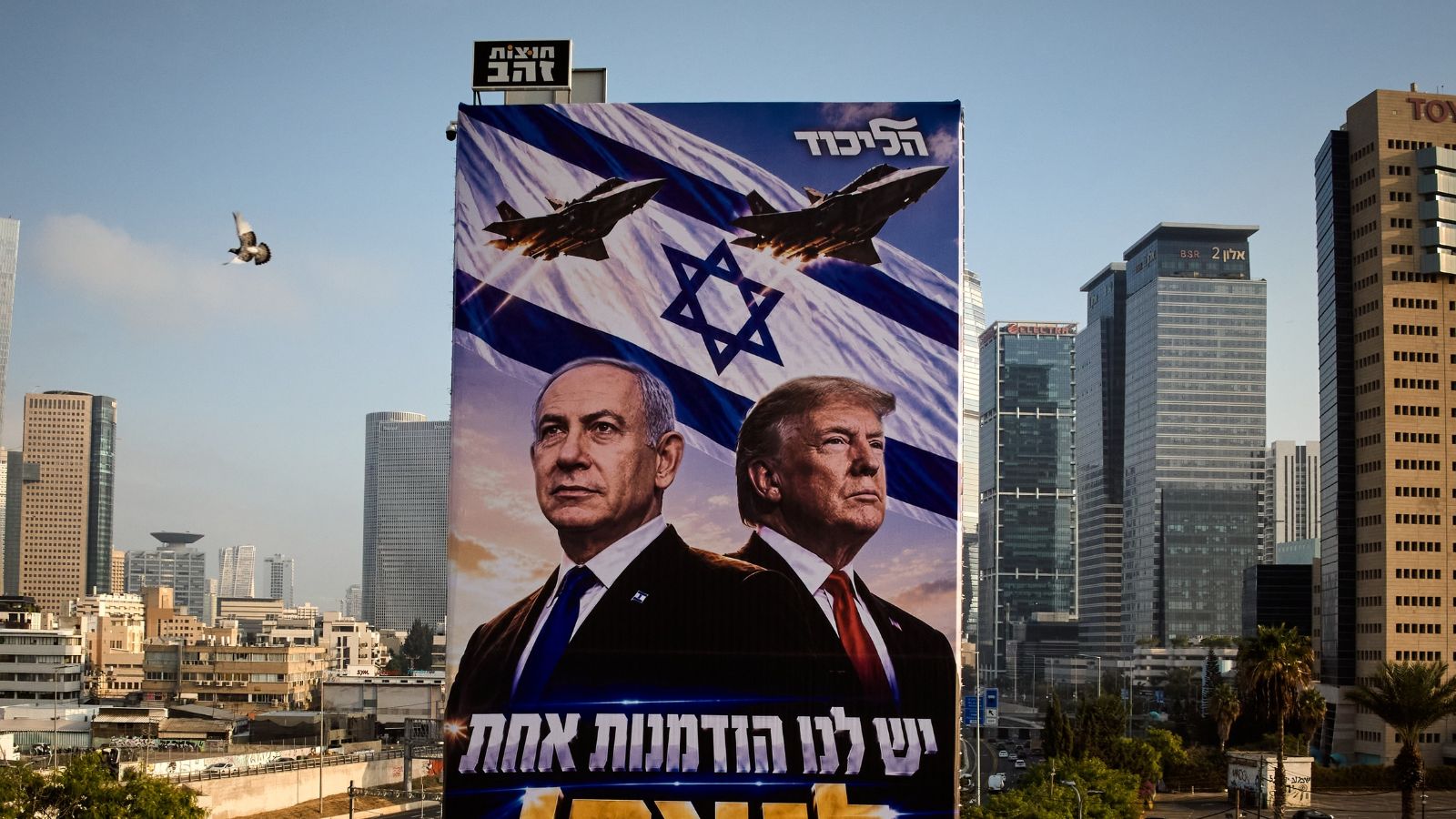
The red phone on the desk does not actually ring. That is a Hollywood invention, a piece of Cold War theater designed to make nuclear brinkmanship look like a scene from a thriller. In reality, when the alliance between the United States and Israel begins to fray, the sound is much quieter. It is the hum of an encrypted line going dead after eleven minutes instead of an hour. It is the subtle, icy pause before a press secretary answers a question about munitions shipments. It is the sudden, inexplicable delay of a routine diplomatic cable between Foggy Bottom and the Kirya in Tel Aviv.
Silence.
For decades, the bond between the White House and the Prime Minister’s Office in Jerusalem operated on a kind of muscle memory, a shared strategic reflex forged in the aftermath of 1967 and hardened through half a century of regional crises. Presidents and prime ministers fought, certainly—men like Menachem Begin and Ronald Reagan, or Barack Obama and Benjamin Netanyahu, traded sharp words behind closed doors and occasionally in front of cameras—yet the underlying architecture always held because both capitals agreed on the basic boundaries of the board. That consensus is gone now, shattered by a widening confrontation with Iran that has pushed Benjamin Netanyahu into a lonely corner and left Washington wondering whether its closest Middle Eastern ally is still listening.
To understand how an ironclad partnership arrives at estrangement, you have to step away from the podiums and look at the human geometry of power.
The Architecture of a Broken Promise
Consider a hypothetical scenario—a composite drawn from the real testimonies of former National Security Council staffers and Israeli defense officials who have watched this relationship curdle over the past two years. Picture a senior Pentagon planner sitting in a windowless room in Arlington, Virginia, at three in the morning. On his screen is a satellite feed showing Israeli strike aircraft refueling over the eastern Mediterranean, heading east toward Iranian missile production facilities. His phone did not buzz until the jets were already airborne. Not a request for coordination. Not a consultation on air defense contingencies for the forty thousand American troops scattered across bases in Iraq, Syria, Jordan, and the Gulf. Just a courtesy notification delivered twenty minutes before impact.
That is not an alliance. That is a fait accompli.
When I first covered diplomatic breakdowns in the region years ago, a veteran Israeli diplomat pulled me aside in a Jerusalem café, stirring his Turkish coffee until the grounds settled like dark silt at the bottom of the cup. He told me that American presidents always think they own the steering wheel because they pay for the gas, while Israeli prime ministers believe they own the car because they are the ones sitting in the driver's seat when the road turns off a cliff. For years, that tension was manageable. Washington provided billions in military aid—anchored by the ten-year, $38 billion Memorandum of Understanding—and diplomatic cover at the United Nations, while Israel calibrated its military operations to avoid dragging the United States into another full-scale Middle Eastern land war.
Israel’s escalating war with Iran tore up that unwritten contract.
By choosing direct, high-stakes military confrontation with Tehran—striking deep into Iranian territory, eliminating senior Islamic Revolutionary Guard Corps commanders, and trading ballistic missile volleys across sovereign borders—Netanyahu crossed a threshold that Washington had spent twenty years trying to reinforce. American officials, from the White House Situation Room to the State Department’s seventh floor, viewed the shadow war between Israel and Iran as a dangerous but containable pressure valve. Once Netanyahu turned a covert struggle into an open aerial war, the calculus in Washington shifted overnight from unwavering support to frantic containment.
Two Clocks Ticking at Different Speeds
Why would a leader risk alienating the single superpower guaranteeing his nation’s qualitative military edge? The answer lies in the simplest, most terrifying analogy in statecraft: two men locked in a room with a ticking bomb, wearing watches set to different hours.
In Washington, the clock is measured in global bandwidth and domestic exhaustion. American strategists look at a map of the world and see a finite pool of interceptor missiles, aircraft carriers, and political capital. Every Patriot battery diverted to the Levant is a battery unavailable for Eastern Europe or the Indo-Pacific. Every billion dollars spent shooting down Iranian drones over the Red Sea or the Negev desert drains stockpiles meant to deter a crisis in the Taiwan Strait. Furthermore, the American public—scarred by two decades of wars in Iraq and Afghanistan—has zero appetite for another open-ended conflict in the Middle East. From Washington’s perspective, an all-out war with Iran is a strategic trap that threatens global energy markets, endangers American service members, and fractures domestic coalitions.
In Jerusalem, the clock is measured in existential survival.
Since the trauma of October 7 shattered Israel’s long-held doctrine of deterrence, the tolerance for living beside loaded weapons has vanished. For Netanyahu and his war cabinet, watching Iran edge closer to nuclear threshold capability while funding a ring of proxies on Israel’s borders ceased to be a manageable risk. To Israeli eyes, Washington’s obsession with "de-escalation" sounds dangerously close to asking Israel to accept permanent vulnerability. If you live in Haifa or Tel Aviv, you do not care about Washington’s carrier deployment schedules in the South China Sea; you care about whether the ballistic missiles sitting in underground silos outside Isfahan will be launched at your children’s school tomorrow morning.
This divergence explains the profound estrangement between Netanyahu and the White House. Neither side is acting irrationally within its own frame of reference. Yet when two allies operate on fundamentally incompatible timelines, every conversation becomes an exercise in mutual incomprehension.
The Cost Measured in Interceptor Missiles
Numbers rarely convey emotion, yet in modern warfare, logistics tell a brutally intimate story. When Iran launched massive barrages of drones, cruise missiles, and ballistic missiles directly at Israel, the resulting sky-wide interception became a historic display of integrated air defense. American, British, French, and regional partners worked alongside Israel’s Arrow and David’s Sling systems to knock down incoming threats before they could flatten apartment blocks.
Behind that triumph, however, lay a sobering reality that quietly horrified Pentagon planners.
Defending against a single night of high-intensity ballistic missile fire burns through years of precision manufacturing. An Arrow-3 interceptor costs roughly $2 million to $3 million per shot. American Standard Missile-3 interceptors fired from Navy destroyers in the eastern Mediterranean run upwards of $10 million to $20 million apiece. You cannot simply walk into a warehouse and pull a thousand of them off a shelf; their microchips, solid-fuel rocket motors, and infrared seekers take months of specialized labor to assemble.
Washington realized that while it had built a shield to save Israeli lives, Netanyahu was using that shield as a springboard to escalate further, confident that the United States would always rush in to catch the falling debris.
That realization bred a cold resentment in Washington. Senior American officials began to feel less like strategic partners and more like an insurance company forced to underwrite a client who insists on playing with matches inside a fireworks factory. The diplomatic pushback followed swiftly: pointed leaks to major newspapers about American frustration, public warnings from the Pentagon that the United States would not participate in offensive strikes against Iran, and deliberate delays in delivering certain heavy munitions.
The Domestic Trap
It is impossible to separate this geopolitical rupture from the deeply personal, political survival instincts of Benjamin Netanyahu himself. Even sympathetic observers in Washington have struggled to disentangle Israel’s genuine national security imperatives from the Prime Minister’s domestic political math.
Netanyahu has spent his entire career cultivating the image of "Mr. Security"—the indispensable statesman fluent in American politics, capable of lecturing Congress while securing unprecedented military aid. Yet his coalition relies on far-right nationalist partners who view any concession to American pressure as weakness, and his personal political survival depends on delaying a reckoning over the intelligence and security failures that allowed the worst massacre of Jews since the Holocaust to occur on his watch.
Escalation with Iran achieved something politically miraculous for Netanyahu at home: it changed the subject. It transformed him from a beleaguered leader facing fierce domestic protests and calls for resignation into a wartime commander confronting an ancient, existential foe.
Washington saw right through it. And nothing erodes trust between allies faster than the suspicion that one leader is risking the lives of your soldiers to save his own political skin.
I remember standing outside the State Department late one evening during a particularly tense round of shuttle diplomacy, watching exhausted aides file out toward waiting black SUVs. One of them—a career civil servant who had spent twenty years working on Middle East peace and security—looked up at the gray Washington sky and let out a laugh that had no humor in it. "We spend sixteen hours a day trying to keep the region from burning down," he said quietly, "and we find out what our ally is actually doing by refreshing a news ticker on our phones."
That vulnerability—the admission that the world’s sole superpower had lost leverage over a country reliant on its weapons—is what makes this moment so dangerous.
When Deterrence Becomes Isolation
Critics of Washington’s approach argue, with considerable force, that American hesitation only emboldens Tehran. They point out that Iran’s regime understands only raw power, that decades of sanctions and diplomatic half-measures failed to stop Tehran from building a vast arsenal of missiles and drones, and that Israel’s willingness to strike Iranian air defenses and leadership exposed the regime’s surprising fragility. In this telling, Netanyahu is doing the dirty work that Washington lacks the courage to do itself.
There is truth in that argument. Israel’s military operations demonstrated that Iran’s air defense network was far more vulnerable than many Western analysts believed, and that Tehran’s ability to project power across the region had severe limits.
Yet military dominance without a political endgame is a mirage.
By prosecuting a multi-front war while alienating the White House, Netanyahu has driven Israel into a level of diplomatic isolation unseen since the 1970s. Major European allies have suspended arms export licenses. Regional normalization agreements—the crown jewel of the Abraham Accords, which promised to integrate Israel into a broader Middle Eastern security and economic architecture—have been frozen in amber. Arab states that quietly despise Iran refuse to publicly align with an Israeli government that ignores American counsel and leaves Gaza in ruins.
Even more perilous is the erosion of bipartisan support inside the United States itself. For generations, pro-Israel consensus was the third rail of American politics, untouchable by either party. By repeatedly defying Democratic administrations, aligning himself overtly with Republican partisan politics, and turning a strategic alliance into a domestic wedge issue, Netanyahu has accelerated a generational shift in Washington. Younger lawmakers and voters no longer view unconditional aid to Israel as an automatic moral or strategic imperative. Once that bipartisan bedrock cracks, no amount of lobbying can easily put it back together.
The Empty Chair at the Table
What happens when the crisis inevitably reaches its next crescendo?
Imagine a moment six months or a year from now. Iran, humiliated by military setbacks and cornered economically, decides its only remaining deterrent is a sprint toward a nuclear weapon. Intelligence agencies in Washington and Tel Aviv detect unusual activity at deep underground enrichment facilities near Fordow. To destroy targets buried beneath hundreds of feet of solid rock requires massive bunker-busting munitions—specifically, the GBU-57 Massive Ordnance Penetrator—and the B-2 stealth bombers capable of carrying them. Israel does not possess either. Only the United States does.
At that exact second, the true price of estrangement comes due.
A joint military operation of that magnitude requires absolute, skin-to-skin trust between a president and a prime minister. It demands months of shared intelligence, synchronized war gaming, mutual confidence that neither side will leak operational details for political gain, and a shared vision for what the Middle East looks like the morning after the bombs fall.
Right now, that trust does not exist.
Instead, there is a ledger of grievances kept carefully in both capitals. In Jerusalem, officials nurse bitterness over withheld bombs, public lectures from American officials, and what they perceive as Washington’s willingness to restrain Israel while allowing Iran’s proxies to fire rockets at northern towns. In Washington, officials nurse anger over broken assurances, surprise escalations, civilian casualties that stain America’s global standing, and a prime minister who treats the President of the United States less like a vital protector and more like an obstacle to be outmaneuvered.
Alliances rarely collapse in a single dramatic explosion. They hollow out from the inside, like an old wooden beam eaten away by termites while the paint on the outside still looks pristine. From a distance, the joint press releases still use words like "unbreakable" and "ironclad." The cargo planes still land at Nevatim Airbase. The diplomats still shake hands in front of matching flags.
Up close, however, the room has gone cold. Two men sit across a polished table, speaking the same language, looking at the same maps, and realizing they no longer inhabit the same world.