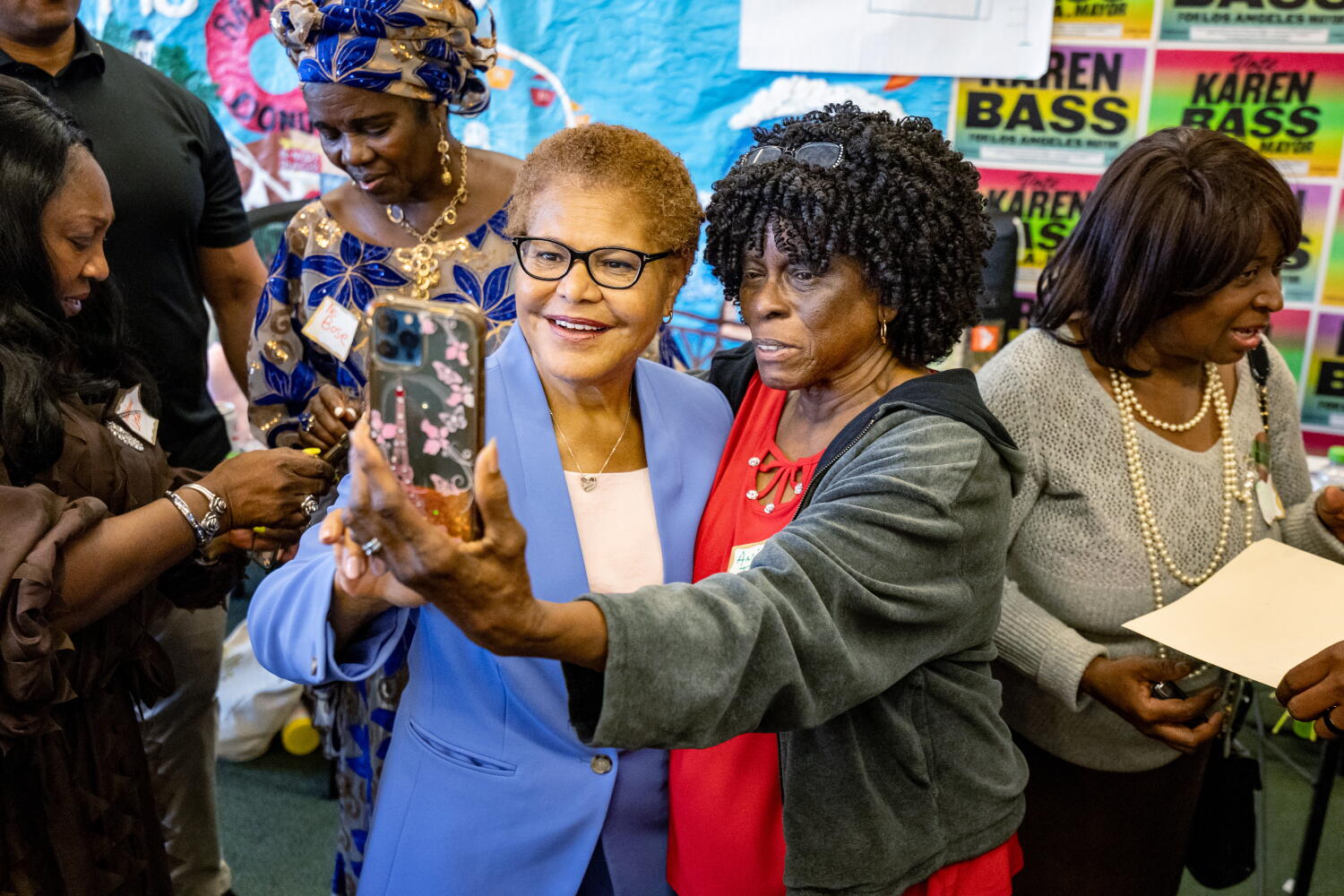
Walk down a sun-bleached sidewalk in Silver Lake on a Saturday morning, and you will smell expensive espresso, damp concrete from overnight sprinklers, and the sharp, metallic tang of political certainty. Drive twenty minutes south into Crenshaw, past the palm trees that look like frayed paintbrushes against a hazy sky, and the air changes. The coffee is cheaper. The history is heavier. The certainty is just as absolute.
On paper, the political clash between Los Angeles Mayor Karen Bass and City Councilmember Nithya Raman looks like a routine municipal dispute—a clash of styles between a seasoned political operator and an insurgent progressive organizer. Pundits love to frame elections and policy battles around the elusive "undecided voter," that mythical creature sitting at a kitchen table with a highlighter, weighing white papers and municipal budgets.
They do not exist here.
Not in this fight. Not when the sidewalks themselves have become battlegrounds over what a city owes its people, and who gets to decide what compassion looks like in practice.
To understand why Bass backers are dug in like concrete pilings and why Raman supporters are burning with an almost evangelical urgency, you have to stop looking at polling spreadsheets. You have to look at the people living inside the friction.
The Weight of the Keys
Consider a hypothetical scenario—a composite of a dozen conversations held across kitchen tables from Baldwin Hills to West Adams. Meet Marcus, a 58-year-old retired postal worker who bought his stucco bungalow in 1994. Marcus remembers when his neighborhood was written off by City Hall, when streetlights stayed broken for months and police sirens were the only reliable municipal service.
For Marcus, politics is not an abstract debate about late-stage capitalism or housing-first theory. It is about survival, stability, and the hard-won dignity of owning a piece of the city that once tried to lock him out.
When Marcus looks at Karen Bass, he does not just see a mayor. He sees a social worker who spent decades building community coalitions in South Los Angeles before ever stepping foot in Sacramento or Washington. He sees someone who understands the delicate, terrifying fragility of working-class Black homeownership. When Bass launched Inside Safe—her signature initiative to move unhoused residents out of encampments and into motel rooms—Marcus felt a surge of relief he hadn't experienced in years.
"She didn't just talk about the problem," Marcus would tell you, his hands wrapped around a chipped ceramic mug. "She got the keys. She got people off the concrete."
That is the emotional bedrock of the Bass coalition. It is rooted in pragmatism, institutional memory, and a deep, visceral exhaustion with chaos. Backers like Marcus have lived through the consequences of ideological purity tests that leave streets impassable and small businesses boarded up. To them, Bass represents adulthood in the room—a leader willing to spend political capital, twist arms in Sacramento, and use executive power to deliver visible, immediate relief. They are on board because they believe the house is on fire, and you do not debate the architectural flaws of the hallway while the roof is caving in.
The View From the Tent
Now, shift the lens five miles north and east.
Imagine another composite figure—let's call her Elena, a 29-year-old public school teacher renting a rent-stabilized one-bedroom in Los Feliz. Every morning on her drive to work, Elena passes the same underpass. For three years, she has watched the city execute "sweeps"—sanitation trucks rolling in at dawn, yellow tape stretching across the concrete, bulldozers scooping up tents, family photos, and insulin coolers into the compactor. And every single time, within seventy-two hours, the tents return. Like tidewater coming back over sand.
Elena looks at the city's approach to homelessness and housing not as a rescue mission, but as a shell game.
When Nithya Raman burst onto the Los Angeles political scene in 2020, defeating an entrenched incumbent to win Council District 4, she did not run on incrementalism. An urban planner with a background in grassroots organizing, Raman spoke a language that resonated deeply with renters, young workers, and tenant unions: the crisis on the streets is not a law-enforcement problem, nor is it simply a matter of temporary motel vouchers. It is a math problem rigged against the poor.
To Elena and the fiercely mobilized base behind Raman, moving people into motels without a guaranteed pipeline of permanent, deeply affordable housing is like bailing out a sinking boat with a teaspoon while refusing to plug the hole in the hull. Worse, they argue, pairing outreach with enforcement—criminalizing sitting, sleeping, or lying down in public spaces—pushes vulnerable people deeper into the shadows, severing their ties to caseworkers and healthcare.
Raman's fans are fired up because they feel the system itself is the emergency. They see a city council historically dominated by real estate developers and cautious moderates, and they view Raman as a rare voice willing to name the structural rot out loud. When she votes against expanding anti-camping ordinances or pushes aggressively for tenant protections and mansion taxes, her supporters do not see obstructionism. They see moral clarity.
Two Maps of the Same City
I have spent years walking these corridors, listening to the low hum of frustration that vibrates beneath every neighborhood council meeting in Los Angeles. You start to realize that both sides are staring at the exact same crisis, yet they are reading entirely different maps.
Think of the city as a failing bridge.
One group—the Bass coalition—is standing on the deck watching cars teeter over the edge. Their instinct is immediate stabilization: throw down steel plates, reroute traffic, reinforce the pilings right now before anyone else falls. To hesitate, to spend six months redesigning the foundation while traffic backs up for miles, feels like gross negligence.
The other group—the Raman movement—is standing underneath the bridge, looking up at the rusted, fractured girders. They know that throwing steel plates over the top only hides the decay, and that the extra weight might actually accelerate the collapse. They want to halt the patching, strip down the corroded structure, and rebuild the foundation from scratch, no matter how disruptive the construction becomes.
Neither side is lying about what they see. That is why there are no undecideds left.
When your worldview is shaped by the fear of losing the neighborhood you spent thirty years building, a progressive critique of policing and encampment sweeps sounds like an invitation to anarchy. Conversely, when your reality is defined by watching your rent consume sixty percent of your paycheck while billionaires lobby against transfer taxes, a pragmatic focus on clearing sidewalks sounds like sweeping human beings out of sight to protect property values.
The Machinery of Conviction
This ideological split is not merely philosophical; it plays out in the gritty mechanics of governance, turning routine council votes into referendums on the soul of Los Angeles.
Look at the numbers that fuel both camps. Under Bass, the city celebrated bringing thousands of people indoors during her first year in office—a genuine logistical feat in a city notorious for bureaucratic paralysis. Her supporters point to those figures as proof that coordinated executive action works. They see a mayor who successfully courted federal funding, aligned county supervisors, and broke through decades of turf wars between city agencies.
Yet Raman's supporters look at the ledger right beside it. They point to the staggering cost of motel leases, the low percentage of temporary residents successfully transitioning into permanent apartments, and the sobering reality that for every person housed, more than one falls into homelessness due to eviction or stagnant wages. To them, the math is unforgiving. Until Los Angeles radically changes its zoning laws—opening up single-family neighborhoods to multi-family housing—and aggressively regulates corporate landlords, every celebratory press conference is premature.
There is an honesty in admitting how terrifying this stalemate is. Anyone who claims to have an effortless fix for a metropolitan region of four million people—burdened by a legacy of redlining, Proposition 13 tax constraints, and decades of underbuilding—is selling snake oil. Governance here is messy, slow, and often heartbreaking. Even the most well-intentioned policies leave casualties in their wake.
The Pulse on the Pavement
And yet, the certainty persists.
Spend an afternoon at a tenant union rally in Koreatown or a neighborhood watch meeting in the San Fernando Valley, and you will witness something rare in modern civic life: total engagement. People are not tuning out. They are showing up at City Hall at nine in the morning on a Tuesday, clutching handwritten index cards, waiting three hours for sixty seconds at the public comment microphone.
They are angry. They are hopeful. They are exhausted.
What makes this dynamic so electric—and so volatile—is that both factions believe history is watching them. Bass supporters believe they are defending the viability of the multiracial, working-class city against ideological drift that could drive families and businesses out for good. Raman supporters believe they are dragging an outdated political establishment into the twenty-first century, fighting for a city where housing is treated as a human right rather than a speculative asset.
There is no quiet middle ground left to occupy because the stakes are written directly onto the geography of daily life. You cannot ignore a crisis you have to step over on your way to buy groceries. You cannot stay neutral when the eviction notice taped to your neighbor's door is printed in bright red ink.
Late at night, after the city council chambers empty out and the microphones are switched off, the two sides retreat to their respective corners of the basin. The streetlamps flicker on along Wilshire Boulevard, casting long, amber pools of light over empty bus benches and locked storefronts. Beneath a concrete overpass near the Los Angeles River, a battery-powered lantern glows softly inside a nylon tent, its silhouette trembling slightly against the wall every time a freight train rumbles past in the dark.