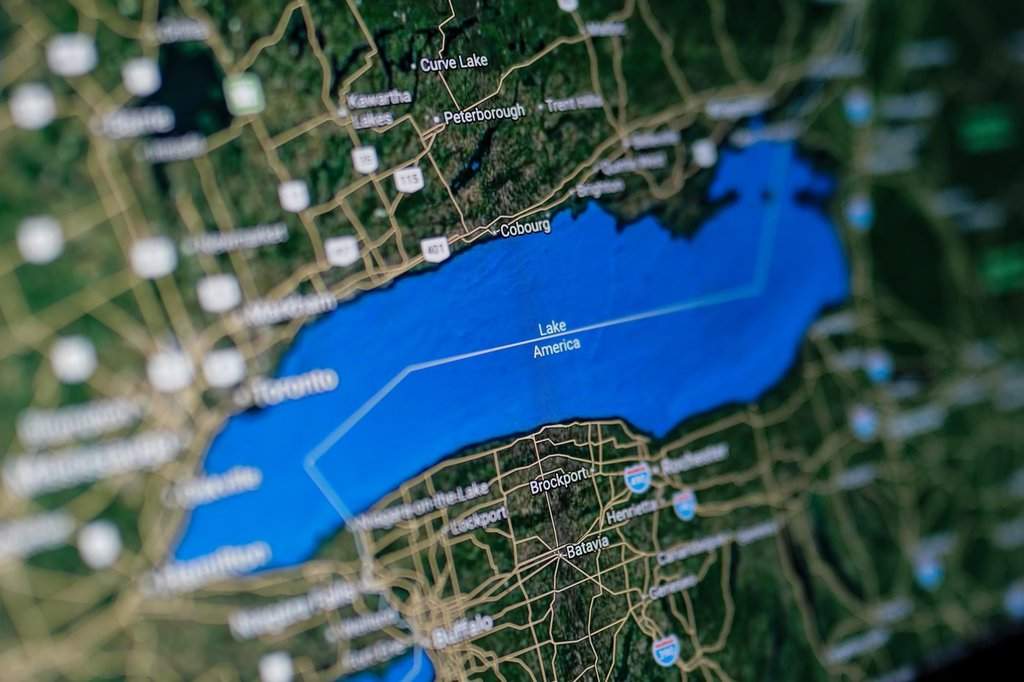
Water remembers. Even when maps are redrawn, when ink dries on federal decrees, and when bureaucrats decide that centuries of lived history can be edited with a keystroke, the shoreline holds onto its truth.
Stand on the southern edge of Lake Ontario on a gray November morning, and you can feel that weight in your bones. The wind comes off the freshwater like an iron blade, carrying the sharp, metallic scent of cold stone and deep silt. Waves slap against the weathered limestone with a steady, rhythmic insistence that has not changed since long before European ships ever navigated the St. Lawrence River. For thousands of years, the Haudenosaunee—the People of the Longhouse—watched this water, fished its shallows, and steered their elm-bark canoes along its vast, unpredictable expanse. They knew its moods. They gave it its name.
Oniatarí:io. Beautiful lake.
Yet today, that very name—and the federal recognition of the people who belong to it—sits at the center of a quiet, ferocious tug-of-war in Washington. Recently, the National Congress of American Indians, the oldest and largest organization representing tribal governments across the United States, issued an urgent call to President Donald Trump. Their demand was deceptively simple on paper, yet seismic in its cultural implications. They asked the administration to reverse a sudden, controversial change regarding Lake Ontario—a shift in federal policy and geographic designation that threatens to erase Indigenous stewardship and bypass tribal consultation in the governance of one of North America's greatest freshwater bodies.
To an outsider scrolling past a news alert, a dispute over Lake Ontario policy might look like dry administrative housekeeping. A footnote. A minor jurisdictional quarrel between federal agencies and tribal leaders.
It is anything but.
The Weight of a Name
Consider a hypothetical scenario to understand what happens when a government alters the official story of a place without asking the people who lived it first. Suppose a stranger walks into your family home, takes down the photographs from the hallway wall, and replaces the deed in the safe with a new document that omits your family’s name entirely. The house still stands. The roof still leaks in the same corner when it rains. The floorboards still creak on the third step. Physically, nothing has changed. Yet legally and spiritually, you have been turned into a ghost in your own living room.
That is precisely how federal geographic and policy reversals land on Indigenous nations.
When the National Congress of American Indians (NCAI) stepped forward to challenge the Trump administration's handling of Lake Ontario, they were reacting to a pattern that tribal leaders know all too well. Federal decisions affecting the Great Lakes—whether involving water management plans, environmental protections, boundary designations, or official naming protocols—carry immense legal power. Under the United States Constitution, treaties with tribal nations are the supreme law of the land. Alongside those treaties stands a long-established federal trust responsibility, a solemn legal obligation requiring the United States government to consult with sovereign tribal nations before making decisions that affect their lands, waters, and cultural resources.
When an administration alters Lake Ontario's status or rolls back collaborative frameworks without meaningful tribal consultation, it breaks more than a procedural rule. It fractures a promise.
I remember the first time I stood near the mouth of the Niagara River, watching the turquoise current churn into the darker, deeper waters of Lake Ontario. An elder from the Seneca Nation stood beside me, his hands tucked deep into the pockets of a faded wool coat. He did not talk about maps or federal statutes. He talked about the sturgeon. He talked about how his grandfather knew the exact week the fish would run simply by watching the buds swell on the black ash trees along the creek beds. To him, the lake was not a resource to be managed by an agency in Washington or Ottawa. It was a relative. When policies shift without warning, when protections are stripped or historical acknowledgments are quietly shelved, that elder does not read a press release. He feels a coldness in the water.
How Federal Erasure Works
To grasp why the NCAI reacted with such urgency, we have to look closely at the mechanics of federal policy around the Great Lakes. Lake Ontario is the smallest of the five Great Lakes by surface area, spanning roughly 7,340 square miles, yet it holds nearly four times the volume of Lake Erie. It is the final link in the Great Lakes chain before the water rushes out through the St. Lawrence River to the Atlantic Ocean. Everything that happens upstream—every agricultural runoff plume from Michigan, every industrial discharge from Ohio, every shipping lane dispute in Huron—eventually funnels into Ontario.
Because of its position, Lake Ontario has always been a battleground of competing interests. Shipping conglomerates want deep, predictable channels. Shoreline property owners in New York and Ontario want stable water levels that do not flood their docks or erode their lawns. Conservationists want natural seasonal fluctuations that allow coastal wetlands to breathe, filter toxins, and shelter spawning fish.
And then there are the original stewards.
For generations, the Haudenosaunee Confederacy—comprising the Mohawk, Oneida, Onondaga, Cayuga, Seneca, and Tuscarora nations—alongside the Mississauga and Anishinaabe peoples on the northern shore, were pushed to the margins of Great Lakes decision-making. Even when the United States and Canada signed the Boundary Waters Treaty of 1909, creating the International Joint Commission to manage shared waters, Indigenous voices were largely absent from the table.
Over the past few decades, tribal nations fought tirelessly to claw back a seat in those rooms. They pushed for recognition of their treaty rights, their ecological knowledge, and their historical presence. Slowly, painfully, federal agencies began integrating tribal consultation into Great Lakes restoration initiatives, water level regulation boards, and official geographic records.
Then came the reversal.
Under the Trump administration, a broad push to roll back environmental regulations, streamline federal oversight, and revise historical and geographic designations swept across executive agencies. In the case of Lake Ontario, changes affecting how the lake's governance, historical recognition, or regulatory oversight were framed set off immediate alarms across Indian Country. Whether the alteration involved stripping away specific Indigenous recognitions, altering collaborative management rules, or bypassing required consultation protocols, the message received by tribal leaders was unmistakable: your voice is optional.
The Invisible Stakes Beneath the Surface
Why does a policy shift or a change in federal recognition matter if the water itself keeps flowing?
Think of the Great Lakes ecosystem like a complex, finely tuned suspension bridge. From the highway above, drivers only see the smooth asphalt and the sweeping steel cables. They rarely think about the anchorages buried deep in the bedrock on either shore. Those anchorages are invisible, unglamorous, and largely forgotten—until someone decides they are unnecessary and starts chipping away at the concrete.
Tribal treaty rights and federal consultation mandates are the bedrock anchorages of environmental protection in North America.
When the National Congress of American Indians calls on the White House to reverse a change on Lake Ontario, they are defending far more than pride or historical accuracy. In federal law, recognition shapes regulation. If a federal agency diminishes the formal acknowledgment of tribal ties to a body of water, or alters the regulatory framework governing that water without tribal input, it weakens the legal standing tribes use to halt destructive projects.
Consider what happens next:
- Environmental Enforcement Weakens: Tribal nations frequently hold stricter water quality standards and deeper ecological baselines than state or federal agencies. Removing or sidelining tribal oversight opens the door for looser industrial discharge permits, weaker wetland protections, and rushed infrastructure approvals along the shoreline.
- Treaty Rights Face Erosion: Many Haudenosaunee treaties explicitly reserve the right to hunt, fish, and gather in usual and accustomed places. When federal policies ignore or rewrite the historical and legal relationship between tribes and Lake Ontario, state regulators and private developers gain ammunition to challenge those treaty rights in court.
- Intergovernmental Trust Collapses: Effective management of a binational waterway requires decades of painstakingly built trust. When an administration unilaterally reverses agreed-upon frameworks, it signals to every tribal government in the country that federal commitments expire with every election cycle.
It is easy to feel confused by the dense web of jurisdictional acronyms—NCAI, IJC, EPA, DOI—that surround Great Lakes governance. Even seasoned policy analysts admit that untangling federal-tribal water law requires navigating a labyrinth of nineteenth-century treaties, twentieth-century court rulings, and twenty-first-century executive orders. That complexity is precisely why unilateral changes are so dangerous. They happen in the quiet corners of the Federal Register, far away from public headlines, while the real-world consequences ripple outward for decades.
A History Written in Water and Stone
To understand the emotional core of the NCAI's demand, you have to step back from modern politics and look at the long arc of Lake Ontario's history.
Long before the lake became a commercial shipping corridor or a border dividing the United States and Canada, it was the northern heartland of the Haudenosaunee. Along its southern bays—Irondequoit, Sodus, Oswego, and Henderson—thrived bustling villages surrounded by vast fields of corn, beans, and squash. The lake was a highway of diplomacy and trade. Peacemakers traveled its waters to unite warring nations under the Great Law of Peace, establishing a participatory democracy that would later inspire the architects of the American Constitution.
When European powers arrived, Lake Ontario became a theater of imperial war. French, British, and later American forces built stone fortresses at the mouths of its rivers—Fort Niagara, Fort Oswego, Fort Frontenac—each seeking to control the liquid artery into the continent's interior. During the American Revolution and the War of 1812, Haudenosaunee communities were burned, displaced, and forced onto shrinking reservations through coercive treaties and land speculators' schemes.
Yet the people never left.
Drive along Route 104 in upstate New York today, past the apple orchards of Wayne County and the rugged bluffs of Oswego, and you are traveling over ancient footpaths worn down by generations of Indigenous travelers. The towns bear names adapted from their languages, even as official policies often struggled to honor the living nations just miles away.
When the National Congress of American Indians was founded in 1944, it was created specifically to stop this cycle of quiet erasure. Back then, the federal government was actively pursuing "termination" policies designed to dissolve tribal nations, strip away their lands, and assimilate their citizens by force. Tribal leaders from across the nation banded together in Denver, Colorado, determined to speak with one unified voice whenever Washington attempted to rewrite their existence without their consent.
More than eighty years later, that mission remains unchanged. When the NCAI challenges President Trump over Lake Ontario, it is acting on the exact same instinct that brought those founders together in 1944: the refusal to let a federal pen erase an Indigenous reality.
The Dangerous Illusion of Permanence
There is a peculiar arrogance in modern politics—the belief that whoever holds power today owns the definition of the land tomorrow.
Administrations change every four or eight years. Executive orders are signed with thick black markers, photographed for the evening news, and just as quickly rescinded by the next occupant of the Oval Office. Naming boards revise maps. Agencies rewrite mission statements. Politicians treat geography and history like clay to be molded to fit the ideological mood of the moment.
Water does not care about election cycles.
Lake Ontario operates on geological time. The basin was carved by massive glaciers retreating north roughly twelve thousand years ago, leaving behind towering drumlins, sandy barrier beaches, and deep abyssal plains that plunge more than eight hundred feet below the surface. The water molecules cycling through the lake today are the same ones that carried birchbark canoes in the seventeenth century, the same ones that froze solid during the brutal winters of the nineteenth century, and the same ones that will lap against the limestone cliffs centuries after every current politician is forgotten.
When federal leaders make abrupt changes to how Lake Ontario is recognized or governed, without listening to the people who have maintained an unbroken relationship with that water for millennia, they are trading deep wisdom for short-term political theater.
Indigenous stewardship is not a sentimental relic. It is a rigorous, time-tested science of survival. Traditional Ecological Knowledge—built through thousands of years of close observation—recognizes that human survival is inseparable from the health of the water. You cannot poison the lake and expect the people on its shore to thrive. You cannot silence the caretakers and expect the house to stand.
What Reversal Really Means
So what happens if the White House heeds the call of the National Congress of American Indians and reverses the Lake Ontario change?
First, it restores procedural integrity. Reversing the decision affirms that the federal trust responsibility is not a partisan talking point, but a binding legal duty. It tells sovereign tribal nations that when Washington makes a commitment to consult, to collaborate, and to honor historical truth, that word means something.
Second, it protects the ecological future of millions of people. Nearly nine million people across the United States and Canada rely on Lake Ontario for their drinking water, their livelihoods, and their way of life. Every major effort to restore the lake's damaged ecosystems—from cleaning up toxic sediment in Rochester's harbor to bringing back native lake trout and Atlantic salmon—succeeds only when federal agencies, state governments, Canadian partners, and tribal nations work in concert. Pushing tribal nations out of the process weakens the entire coalition.
Third, it heals a quiet wound. Respect in public policy is rarely dramatic. Often, it looks like simply leaving intact what was painstakingly built—honoring a name, keeping a seat open at the table, listening before acting.
But if the administration refuses to budge, the struggle will not end. Tribal nations have outlasted empires, broken treaties, forced removals, and centuries of bureaucratic neglect. They know how to fight in federal courtrooms, in congressional hearings, and in the court of public opinion. They know how to wait.
The Shoreline at Dusk
Go back to that southern shore of Lake Ontario just as the sun drops below the horizon.
The sky turns a bruised purple, bleeding into streaks of copper and slate gray across the water. The wind dies down to a low murmur. Out on the open lake, the blinking red light of a distant buoy rises and falls with the swell, marking a channel invisible to the naked eye.
On the beach, smooth flat stones—worn round by ten thousand years of relentless surf—click softly against one another as each wave pulls back into the dark. No decree signed in a marble building hundreds of miles away can change the weight of those stones, or the pull of the current, or the old name that still echoes across the bay.
Oniatarí:io.
The water remembers who belongs to it, even when Washington forgets.