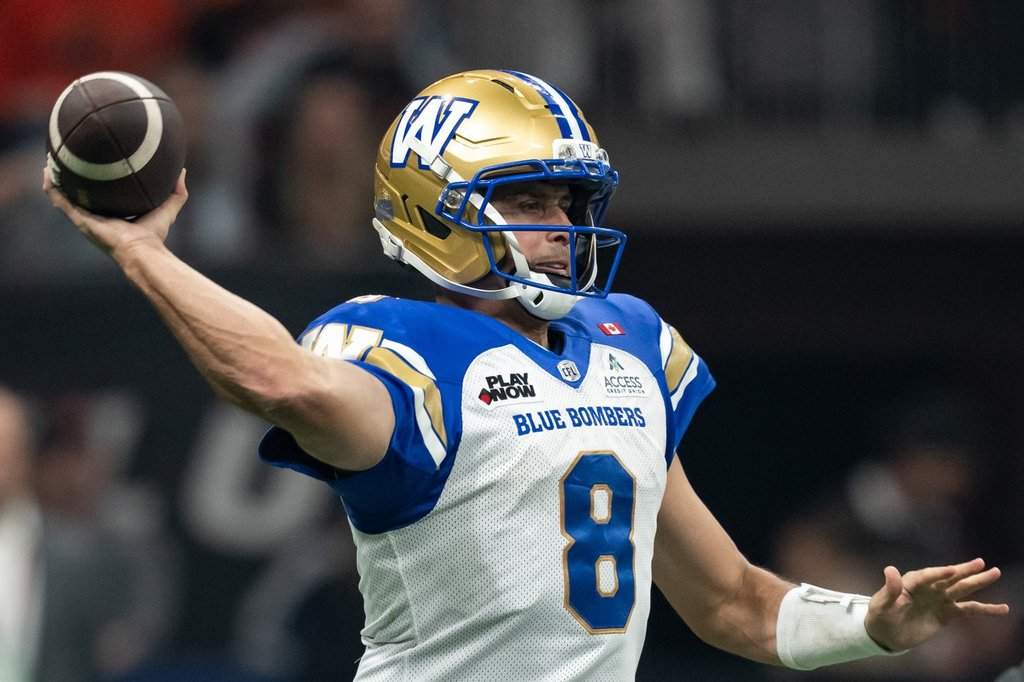
In professional gridiron football, the starting quarterback is the single point of failure around which offensive architecture, defensive scheming, and market expectations revolve. When the availability of a franchise quarterback—specifically Winnipeg Blue Bombers starter Zach Collaros ahead of a matchup against the Toronto Argonauts—remains undisclosed, the resulting information vacuum triggers a cascading set of operational adjustments across both organizations. Standard sports journalism treats an undisclosed injury status as a binary curiosity: either the player takes the field, or a backup steps in. This framing misses the underlying game theory, roster economics, and tactical preparation dynamics that govern Canadian Football League (CFL) operations during an injury uncertainty window.
To evaluate the operational impact of Zach Collaros’s unknown status against Toronto, one must deconstruct the mechanisms of CFL injury reporting, the structural differences between Winnipeg’s primary and secondary offensive packages, and the defensive preparation costs imposed on the Argonauts' coaching staff.
The Architecture of CFL Information Asymmetry
Information asymmetry occurs in competitive environments when one party possesses superior or more timely data than its counterparty. In the CFL, teams are required to submit daily injury reports during the game week, categorizing players by participation level (Full, Limited, Did Not Participate) and game status (Available, Questionable, Doubtful, Out). However, the League’s enforcement mechanisms allow coaching staffs substantial latitude to obscure true operational readiness until the mandatory 46-man game-day roster is finalized, typically 24 hours prior to kickoff, or even until the final pre-game warmups when a dressed quarterback is relegated to emergency duty.
When Winnipeg withholds clarity on Collaros, they are actively weaponizing information asymmetry. The strategic objective is not merely to keep fans or oddsmakers guessing; it is to force the Toronto Argonauts to split their finite practice repetitions and film-study bandwidth across two fundamentally divergent offensive profiles.
The Practice Bandwidth Tax
A CFL coaching staff operates under strict Collective Bargaining Agreement (CBA) time limits for on-field practice and meeting room instruction. During a standard six-day turnaround between games, a defensive coordinator has roughly 12 to 15 hours of total installation and walk-through time to prepare the unit for an opponent.
- Baseline Preparation: Under normal conditions, 85% to 90% of defensive installation focuses on the opponent's primary quarterback, analyzing his specific pre-snap cadence, pocket drift tendencies, hot-route triggers against blitz looks, and arm-strength thresholds on boundary throws. The remaining 10% to 15% accounts for short-yardage packages or trick plays.
- Bifurcated Preparation: When Collaros is listed as questionable or his participation is masked, Toronto’s defensive staff must allocate significant installation reps to Winnipeg’s backup quarterback rotation (such as Chris Streveler or Terry Wilson, depending on the active depth chart). Because Winnipeg’s backup quarterbacks possess vastly different physical attributes and processing speeds than Collaros, Toronto cannot simply run the same defensive shell and expect identical results.
- Execution Degradation: Splitting preparation time induces cognitive load on defensive backs and linebackers. Instead of reacting instinctively to post-snap route combinations, defenders experience milliseconds of hesitation while verifying personnel groupings and quarterback mechanics. In a three-down league where the field is 65 yards wide and offensive motion is unrestricted at the snap, a 200-millisecond delay in secondary rotation equates to a three-yard separation window for a slotback.
Divergent Offensive Profiles and Tactical Variance
The analytical error in treating Winnipeg’s quarterback situation as a simple "next man up" scenario lies in ignoring how radically the Blue Bombers' offensive geometry changes without Collaros. Offensive coordinator Buck Pierce builds two distinct playbooks around the personnel available at the position.
The Collaros Efficiency Model
Zach Collaros operates as a high-processing pocket distributor with elite spatial awareness within the CFL’s unique field dimensions. When Collaros is healthy and active, Winnipeg’s offense relies on several distinct mechanisms:
- Pre-Snap Manipulation: Collaros uses hard counts and late waggle-motion adjustments to force defensive fronts to declare their coverage rotations (e.g., differentiating between Cover 3 zone and Cover 1 man-free) before the ball is snapped.
- Intermediate Timing Windows: Rather than relying on vertical jump-balls, the Collaros-led attack targets the 12-to-18-yard intermediate zones between the linebackers and the safety. These throws require precise anticipation, releasing the ball before the receiver clears the second-level defender.
- Pocket Drift and Extension: While not a high-volume designed runner, Collaros excels at subtle lateral slides within the pocket to evade edge rushers while keeping his eyes downfield, extending plays into the secondary scramble drill where Winnipeg’s veteran receivers break off their routes into open grass.
The Backup Quarterback Contingency Model
When Winnipeg pivots away from Collaros—whether due to head/neck protocols, lower-body mobility restrictions, or upper-body throwing mechanics—the offensive architecture compresses horizontally and vertically. Backup quarterbacks in the Winnipeg system typically introduce higher variance through physicality rather than pure passing efficiency.
- Designed Quarterback Run Volume: If a mobile backup like Chris Streveler assumes primary snaps, the offense shifts toward heavy 12-personnel (one running back, two tight ends/fullbacks) and quarterback power/read-option concepts. The offensive line blocks downhill, turning the quarterback into an extra gap-attacker.
- Simplified Progression Reads: To mitigate the risk of turnovers, the passing game transitions to half-field reads, rollouts, and run-pass options (RPOs). The average depth of target (aDOT) drops significantly, shifting the burden of yardage generation from the quarterback’s arm to the receivers' yards-after-catch (YAC) capability.
- Red Zone Compression: Without Collaros’s ability to thread passes into tight back-corner windows, Winnipeg’s red zone efficiency relies heavily on brute-force short-yardage formations, increasing the physical toll on the interior offensive line.
Defensive Scheming Dilemmas for the Toronto Argonauts
For the Toronto Argonauts, preparing for an unknown Winnipeg quarterback creates an acute resource-allocation problem on defense. Toronto’s defensive front—historically built around interior disruption and disciplined edge containment—must adjust its rush-lane integrity based on who takes the snap.
Pass Rush Lane Integrity vs. Downhill Run Fits
Against Collaros, Toronto’s defensive ends can pin their ears back on second-and-long situations, rushing upfield to collapse the pocket from the outside in, knowing Collaros rarely breaks containment for a 20-yard scramble. The interior defensive tackles focus on pushing the pocket vertically to disrupt Collaros’s step-up throwing platform.
If Toronto deploys that exact aggressive upfield pass rush against a mobile backup quarterback, they create massive rushing lanes up the middle and around the edges. Against a backup, Toronto’s defensive ends must execute "mush rush" techniques—maintaining strict outside leverage, keeping their shoulders square to the line of scrimmage, and sacrificing pure sack speed to prevent the quarterback from escaping the tackle box.
Coverage Shell Adjustments
In the secondary, Toronto’s defensive backs face an inverse risk profile:
- Against Collaros: Playing static zone coverage invites Collaros to pick apart the seams. Toronto must disguise coverages until the snap, rotating safeties post-snap and mixing in zero-blitz concepts to force hurried throws.
- Against a Backup: Man-to-man coverage becomes riskier if the defensive backs turn their backs to the line of scrimmage, as a scrambling quarterback can exploit empty grass once receivers clear out the secondary. Toronto is incentivized to play more vision-based zone defenses (such as Cover 2 or Cover 4) where defenders keep their eyes on the quarterback, ready to trigger downhill against a scramble or a short check-down.
Because Toronto cannot know with certainty which quarterback will take the majority of the snaps until the game begins, the defensive coordinator must design a "hybrid" base defense—one that is sound enough to stop the quarterback run without exposing the intermediate seams to Collaros. By definition, a hybrid scheme optimizes for neither threat, accepting a baseline loss in defensive efficiency to protect against catastrophic schematic failure.
Evaluating the Injury Mechanism and Risk Calculus
When assessing why Collaros’s status remains undisclosed, analysts must separate media speculation from medical and organizational risk management. In the CFL, quarterback injuries generally fall into two operational categories, each carrying a distinct risk calculus for the coaching staff.
Category A: Mechanical and Structural Injuries
Injuries to the throwing shoulder, elbow, ribs, or lower-body planting leg directly degrade passing velocity and accuracy. If Collaros is dealing with a mechanical limitation, the decision to play him hinges on whether his degraded physical output still exceeds the baseline output of the backup.
The coaching staff evaluates this via a simple threshold test during closed practices:
- Can the quarterback drive the ball to the wide-side boundary (a throw of roughly 35 to 40 yards in air distance on a CFL field) without compromising spiral tightness or velocity?
- Can he absorb a blindside hit without worsening the structural damage?
If the answer to the first question is no, playing Collaros becomes counterproductive regardless of his mental acuity, because defenses will squat on short routes, suffocating the entire offense.
Category B: Neurological and Concussion Protocols
Given Collaros’s documented history with head injuries earlier in his career, any indication of concussion-like symptoms triggers strict CFL medical protocols. Unlike mechanical injuries, where pain tolerance and bracing allow a player to push through, neurological recovery follows a rigid, multi-stage return-to-play protocol overseen by independent medical spotters and team physicians.
When a quarterback is in protocol, his status remains "unknown" externally not necessarily because the team is playing gamesmanship, but because a player can pass stages one through four (symptom-limited activity, aerobic exercise, sport-specific exercise, non-contact training) and still experience a recurrence of symptoms following a high-intensity practice, immediately resetting his timeline. Under these conditions, Winnipeg must prepare the backup as the de facto starter while holding open the final roster spot until the morning of the game.
Roster Economics and Salary Cap Implications
The uncertainty surrounding Collaros also exposes the structural constraints of the CFL’s Salary Management System (SMS). Unlike the NFL, where massive cap room allows teams to carry high-priced veteran backups, CFL teams operate under a tight hard cap (roughly $5.5 million to $5.6 million CAD, subject to annual CBA adjustments).
Winnipeg allocates a substantial percentage of its total SMS cap to Collaros, reflecting his status as a two-time Most Outstanding Player and multi-time Grey Cup winner. Consequently, the financial resources available for the backup quarterback room are strictly constrained. Teams must choose between paying a mid-tier veteran backup who offers moderate passing stability or investing in low-cost, high-upside developmental players and specialized short-yardage athletes.
When the franchise quarterback’s status is compromised, the team experiences an immediate talent-value cliff. Winnipeg cannot simply sign a starting-caliber replacement off the street mid-week; the CFL’s territorial negotiation lists and the complexity of offensive playbooks make mid-season external acquisitions virtually impossible to deploy on short notice. Therefore, Winnipeg’s entire strategic leverage rests on maximizing the operational readiness of their internal depth chart while obscuring their final decision from Toronto.
Second-Order Effects on Special Teams and Field Position
A frequently overlooked consequence of quarterback uncertainty is its downstream impact on special teams and game-script management. In Canadian football, where three downs place a premium on avoiding second-and-long situations, punting and field-position battles dictate winning probabilities.
If Winnipeg enters the game against Toronto without Collaros, their expected points per drive drop. To compensate, the coaching staff must alter its fourth-down (third-down in the CFL) aggressiveness and punt-return strategy:
- Conservative Field Position: With a backup quarterback, Winnipeg is less likely to gamble on third-and-two from midfield, opting instead to punt and rely on their defense and punt-coverage units to pin Toronto deep inside their own 20-yard line.
- The Rouge Factor: In tight, low-scoring games dictated by backup quarterback play, single points (rouges) scored on missed field goals or deep punts through the end zone become disproportionately valuable. Toronto’s returners must be coached to aggressively field deep kicks rather than conceding single points, knowing that a 17-16 final score is far more probable than a 34-31 shootout.
- Time of Possession Skew: Winnipeg will deliberately slow down the play clock, snapping the ball with under three seconds remaining to shorten the game, reduce total possessions, and minimize the exposure of their backup quarterback to Toronto’s pass rush.
Limitations of Information Gamesmanship
While withholding Collaros’s status grants Winnipeg a short-term tactical advantage in practice preparation, the strategy carries diminishing returns once the game kicks off. Information asymmetry disappears entirely on the first offensive snap.
- In-Game Defensive Adaptation: Professional defensive coordinators adjust rapidly. Within two offensive series—roughly 8 to 12 plays—Toronto’s staff will have confirmed Winnipeg’s active personnel grouping, run-pass tendencies, and the quarterback’s physical limitations. By the second quarter, the pre-game preparation advantage largely evaporates.
- Internal Rep Dilution: The very act of hiding Collaros’s status often requires splitting first-team practice reps between Collaros and the backup during the week. If Collaros ultimately plays, he enters the game with fewer live timing reps with his starting receivers. If the backup plays, he enters having shared the first-team workload rather than owning the entire week of preparation. Both outcomes degrade offensive synchronization.
- Psychological Signaling: Prolonged secrecy around a franchise quarterback can inadvertently signal vulnerability to the opposing locker room. If Toronto’s defensive front senses that Collaros is playing compromised, they will test his physical resilience early, accepting roughing-the-passer penalties if necessary to establish physical dominance and force an early exit.
Tactical Execution Framework for Toronto
Given the high probability of prolonged uncertainty leading up to kickoff, the Toronto Argonauts must avoid falling into the trap of over-preparing for a single hypothetical outcome. Toronto’s coaching staff should execute a three-part operational contingency plan:
- Install a Base "Rule-Driven" Defense: Instead of memorizing specific tendencies for two different quarterbacks, Toronto must drill assignment-sound gap integrity. Defensive ends must maintain strict outside contain on every snap until the ball crosses the line of scrimmage, neutralizing a backup's scramble threat while still collapsing the pocket around Collaros.
- Automate Halftime Adjustments: Toronto’s booth analysts must track Winnipeg’s first-down play-calling splits during the opening two quarters. If Winnipeg runs the ball on more than 60% of first downs, Toronto must immediately transition into single-high safety looks (Cover 1 or Cover 3) in the third quarter, bringing an eighth defender into the box to suffocate the run game and force the quarterback into third-and-long passing situations.
- Accelerate Offensive Tempo: Regardless of who plays quarterback for Winnipeg, Toronto’s offense should push the tempo early. Scoring points on the opening two drives forces Winnipeg out of a conservative, run-heavy game script. If Winnipeg falls behind by two possessions early, a compromised Collaros is forced to take high-risk vertical shots, or a backup quarterback is forced into pure drop-back passing scenarios—the exact environment where Toronto’s pass rush holds its highest mathematical advantage.