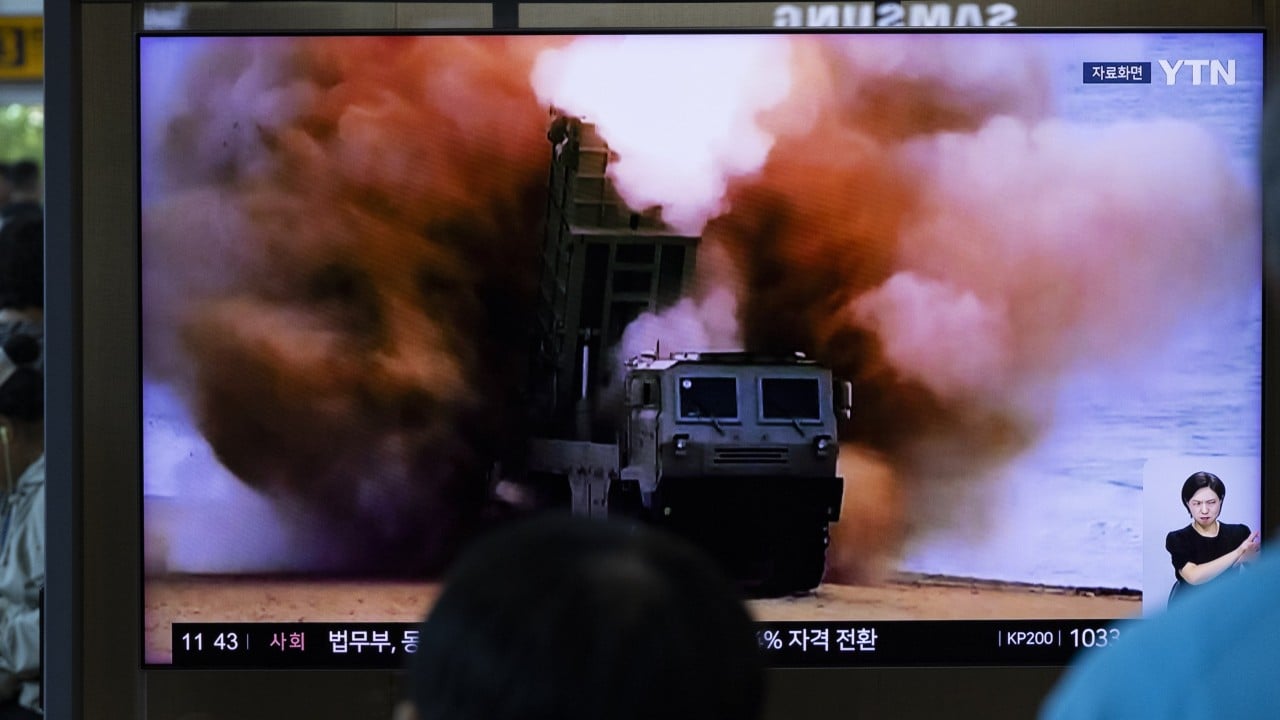
North Korea is not merely supplying old munitions to Russia for the war in Ukraine; Pyongyang is actively using the conflict as a live-fire laboratory to test, refine, and market upgraded ballistic missile systems and artillery platforms to global buyers. Recent missile launches point directly to an industrial-scale transfer of advanced conventional weaponry, transforming the isolated regime from a pariah state into an active, cash-flush participant in modern high-intensity warfare. This shift alters the strategic balance on the European battlefield while providing the Kim Jong Un regime with the hard currency and technological feedback it needs to circumvent decades of international sanctions.
We have watched this script before. Sanctions are imposed, illicit networks form, and the black market adapts. But the sheer volume of military hardware flowing from North Korean factories toward Russian railheads represents a fundamental break from historical precedent. Pyongyang is no longer just dumping surplus Cold War inventory into regional proxy conflicts. They are field-testing precision-guided munitions under modern electronic warfare conditions, accelerating a feedback loop that military manufacturers spend billions to achieve.
The Industrial Pipeline Behind the Freight Cars
Satellite imagery of the Tumangang rail facility on the North Korea-Russia border tells a story that diplomatic cables often miss. Traffic volume between the Khasan rail terminal and North Korean supply depots has surged to levels unseen since the Soviet era. Flatbed cars loaded with Hwasong-11 series ballistic missiles and millions of 152mm and 122mm artillery shells cross the border under the cover of darkness, feeding a Russian logistics machine starved of domestic production capacity.
The economic lifeline this trade provides to Pyongyang cannot be overstated. For decades, the North Korean economy functioned on a combination of cyber theft, counterfeit currency, and modest coal exports. Now, entire manufacturing districts in North Pyongan and Jagang provinces are running three shifts a day.
- Munitions factories are operating at peak capacity, funded directly by Russian state accounts.
- Raw materials, previously scarce due to strict trade barriers, are flowing back into the country via Vladivostok.
- Technical advisors from North Korean defense industries are rotating through western Russian logistics hubs, gathering operational data on missile performance against Western air defense systems.
This is not a charitable exchange of ideological solidarity. It is a transactional cash-and-hardware arrangement. Russia receives the immediate volume of steel and explosives required to sustain its artillery-heavy doctrine in Ukraine. North Korea receives crude oil, financial liquidity, and, most crucially, telemetry data on how its guidance systems perform against Patriot and NASAMS interceptors.
The Technical Reality of the Battlefield Laboratory
Every missile fired into Ukrainian airspace provides Pyongyang with engineering data that cannot be simulated in the mountains around Kaechon. Guidance failures, fuel burn rates, and terminal phase maneuverability are being tracked in real time.
Consider the KN-23 and KN-24 short-range ballistic missiles. Prior to their deployment in Ukraine, these systems were largely unproven in high-threat environments where electronic jamming and integrated air defense networks were active. By observing how these weapons navigate Ukrainian counter-measures, North Korean defense scientists gain actionable insights to improve future iterations.
[North Korean Factory Floor]
       │
       ▼ (Freight Rail via Khasan)
[Russian Frontline Logistics]
       │
       ▼ (Combat Deployment in Ukraine)
[Telemetry & Combat Feedback Loop]
       │
       ▼ (Design Upgrades & Increased Valuation)
The battlefield acts as an unsparing testing ground. When a missile misses its target because of GPS spoofing, the failure log is valuable. When a shell detonates prematurely due to degraded propellant, the quality control department back in Pyongyang adjusts the chemical mix. This iterative improvement cycle bypasses the traditional R&D timeline, allowing a sanctioned state to field battle-tested hardware at a fraction of the cost incurred by Western defense contractors.
The Geopolitical Fallout and Regional Proliferation Risks
The implications extend far beyond the immediate geography of the Donbas. By tying its defense manufacturing sector to Moscow's war effort, North Korea has secured a permanent diplomatic shield on the United Nations Security Council. Russia's willingness to use its veto to dismantle the UN panel of experts monitoring North Korean sanctions was not a diplomatic courtesy. It was a business expense paid to ensure the uninterrupted delivery of artillery shells and ballistic missiles.
This dynamic creates a dangerous precedent for global non-proliferation efforts. Other cash-strapped authoritarian regimes are watching closely. If Pyongyang can successfully monetize its military industrial complex by supplying a major nuclear power in violation of international law without suffering catastrophic economic retaliation, the deterrent value of sanctions evaporates.
Furthermore, the technology transfer is unlikely to be a one-way street. While official statements emphasize conventional munitions, intelligence analysts track deep cooperation in aerospace engineering, submarine quieting technology, and satellite guidance systems. Moscow has advanced capabilities in areas where North Korea has historically struggled. Compensating Pyongyang with aerospace components or submarine design documents multiplies the long-term security threat to South Korea, Japan, and the United States.
The Long-Term Horizon for Global Security
The war in Ukraine has effectively integrated the security architectures of Eastern Europe and East Asia. Pyongyang views the conflict not as a distant European tragedy, but as a golden economic and strategic opportunity.
We are looking at the emergence of a permanent parallel defense economy, operating entirely outside the Western financial system. As long as the war in Ukraine persists, North Korea will remain a primary armorer for prolonged attrition warfare, using the revenues to modernize its own nuclear delivery systems while cementing a resilient alliance with Moscow.