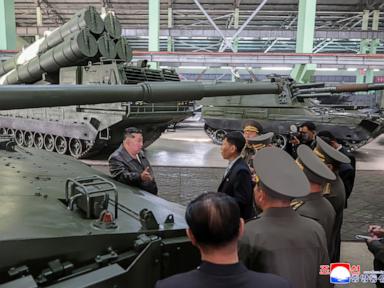
Kim Jong Un is no longer content with the slow burn of diplomatic posturing. While the West focuses on the intermittent flair of intercontinental ballistic missiles, a more immediate and lethal shift is occurring along the 38th parallel. North Korea has initiated the mass production of a new 240mm multiple rocket launcher system specifically designed to hold Seoul under a permanent, high-precision shadow. This isn't just another parade piece. It is a calculated upgrade to the "sea of fire" strategy that has defined regional tension for thirty years. Simultaneously, the North Korean leadership has signaled a departure from its traditional brown-water navy by commissioning its first true destroyer-class vessel, a move that attempts to bridge the gap between coastal defense and blue-water projection.
These developments represent a fundamental change in the tactical reality of the Korean Peninsula. For decades, the North’s artillery threat relied on volume over accuracy. They had the numbers, but the circular error probable—the measure of a weapon's precision—was wide enough to offer a slim margin of hope for civilian centers. That margin is evaporating. The new 240mm system integrates advanced guidance kits, likely leveraging satellite navigation data to ensure that shells don't just fall on a city, but on specific intersections and command hubs.
The Calculus of Precision Terror
The 240mm rocket launcher serves as the backbone of North Korea's frontline corps. By upgrading this specific caliber, Pyongyang maximizes its existing logistics chain while drastically increasing the lethality of its salvos. Recent live-fire tests, personally supervised by Kim, demonstrated a "revelatory" level of accuracy.
This isn't an isolated technical achievement. It is the result of a concerted effort to modernize the tactical weapons that the United States and South Korea find most difficult to intercept. While the Patriot and THAAD batteries are designed to catch high-altitude missiles, a saturation strike of guided rockets flying at lower trajectories presents a nightmare scenario for missile defense. You cannot shoot down every rained-down bolt when there are thousands in the air at once.
The timing of this rollout matters. By commissioning these units now, Pyongyang is signaling that its domestic defense industry has bypassed the supply chain constraints many analysts assumed would cripple their production lines. They aren't just building these launchers; they are integrating them into an automated fire-control system that reduces the "sensor-to-shooter" window. This means the time between spotting a target and leveled destruction is shrinking to a matter of minutes.
Breaking the Coastal Chains
For the better part of a century, the Korean People’s Navy has been a collection of aging torpedo boats, rusted frigates, and a massive but antiquated submarine fleet. It was a force designed to hide in the coves and strike from the shadows. The announcement of a new destroyer changes the math of the East and West Seas.
A destroyer is a statement of intent. It requires a level of structural engineering and propulsion integration that North Korea has historically struggled to master. If this vessel is equipped with the new "Hwasal-2" cruise missiles, it effectively extends the North's nuclear umbrella further into the Pacific. It forces the US Navy to dedicate more assets to tracking individual surface vessels rather than focusing purely on the sub-surface threat.
The hull design of this new class suggests an attempt at radar-cross-section reduction. While it likely falls short of true "stealth" by Western standards, it indicates a move away from the clunky, Cold War-era aesthetics of their previous flagship vessels. The ship represents a mobile, survivable platform for cruise missile launches, making a pre-emptive strike against the North’s nuclear capabilities exponentially more difficult.
The Russian Connection and Technical Leaps
One cannot ignore the sudden acceleration in North Korean military tech without looking toward Moscow. The diplomatic warming between Kim and Putin has moved beyond mere rhetoric. While North Korea sends millions of rounds of 152mm shells to fuel the Russian war machine in Ukraine, the "repayment" is likely appearing in the form of telemetry data, composite materials, and perhaps even refined GPS-jamming technology.
The precision of the new 240mm rockets mirrors Russian artillery doctrine, which has shifted toward "smart" saturation. If Russian technicians are providing feedback on how these systems perform against Western-style defenses, North Korea is essentially getting a real-world laboratory for its hardware without firing a shot in an actual war. This symbiotic relationship has shortened North Korea’s development cycles by years, if not decades.
Seoul's Hardened Dilemma
South Korea’s response, the "Kill Chain" strategy, relies on hitting North Korean launchers before they can fire. This strategy is predicated on the idea that North Korean systems are slow to deploy and easy to spot. The new 240mm launchers are mounted on highly mobile, 8x8 wheeled chassis, allowing them to "shoot and scoot" before a counter-battery radar can even lock onto their position.
The sheer density of the Greater Seoul Area—home to nearly 25 million people—makes it an impossible target to defend fully. The South is currently developing its own "Low Altitude Missile Defense" (LAMD) system, often called the Korean Iron Dome. However, the sheer cost of interceptors compared to the relatively low cost of a 240mm rocket creates an economic war of attrition that favors the North. For every $50,000 rocket Pyongyang fires, Seoul might have to spend $500,000 to intercept it.
The Strategy of Permanent Presence
Kim Jong Un is moving away from the "crazy man" trope. These military advancements are the work of a rational actor who understands that a credible, conventional threat is more useful for daily leverage than a nuclear one that can only be used once. By putting a "gun to the head" of the South Korean economy through high-precision artillery, the North creates a permanent state of suppressed investment and heightened anxiety.
The destroyer serves a similar purpose in the maritime domain. It challenges the legitimacy of the Northern Limit Line (NLL) not just with small-boat skirmishes, but with a significant surface combatant that cannot be easily brushed aside by the South Korean navy. It creates a "new normal" where North Korean hulls are seen further from their shores, slowly expanding their de facto maritime borders.
The reality of 2026 is that North Korea has moved past the era of "testing." They are now in the era of "deployment." The factories are humming, the crews are training, and the tactical map of East Asia is being redrawn in the favor of the Kim regime. The world has spent so much time looking for the big mushroom cloud that it may have missed the moment the North achieved a conventional advantage that makes a traditional war unthinkable.
The pressure on the US-South Korea alliance is no longer about hypothetical nuclear strikes. It is about the hundreds of 240mm tubes currently rolling off assembly lines in the outskirts of Pyongyang, each one capable of hitting a specific building in downtown Seoul. That is a tangible, daily threat that no amount of diplomatic theater can currently resolve.
The transition from a ragtag coastal defense force to a navy with destroyer-level ambitions, backed by artillery that finally hits what it aims at, signals a regime that believes its time has come. They are no longer waiting for the world to recognize them as a power; they are building the hardware that makes that recognition mandatory. The "fire and fury" of the past was mostly talk. This new hardware is anything but.