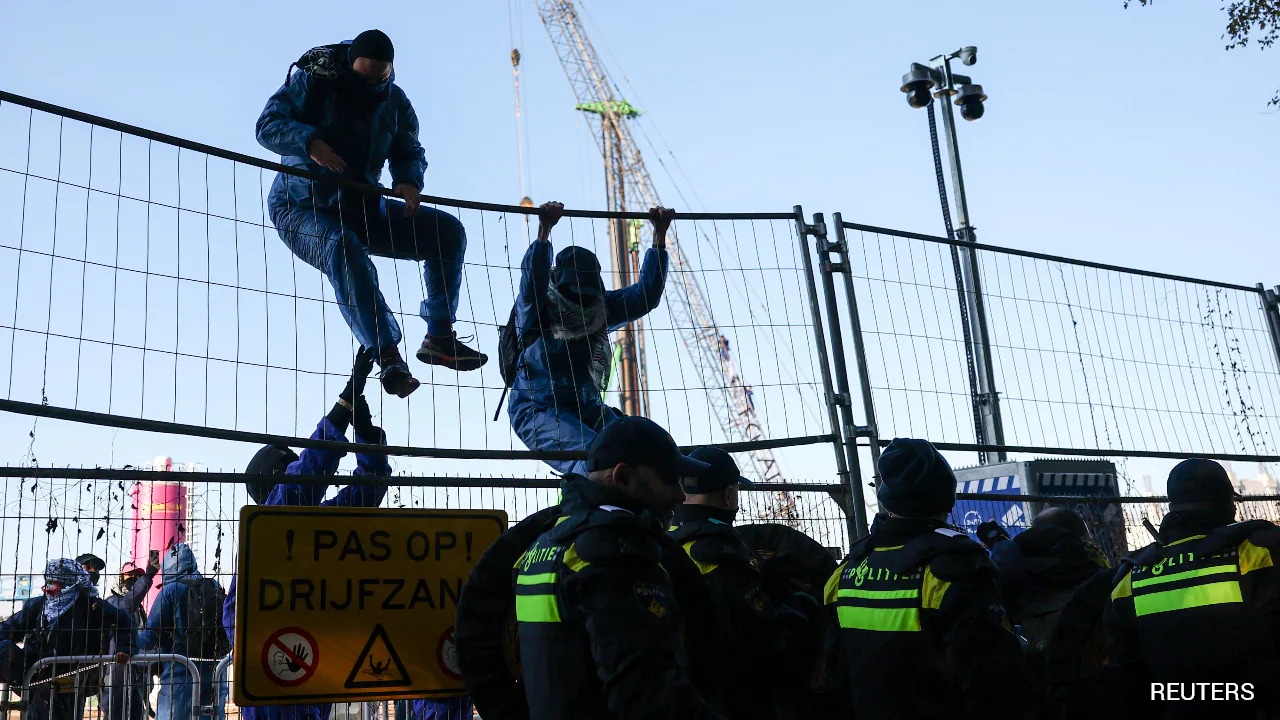
Activists cut through the perimeter fencing of a Microsoft AI data center construction site in Amsterdam, signaling a massive escalation in Europe's backlash against hyperscale cloud infrastructure. The breach isn't an isolated stunt. It's the boiling point of years of quiet frustration over water consumption, strained electrical grids, and broken local promises across the Netherlands and Western Europe.
For a decade, tech giants treated Europe like an open playground for server farms. Cheap land, cool climates, and compliant local municipalities made places like North Holland irresistible. That honeymoon is dead.
What Actually Happened at the Amsterdam Site
Demonstrators bypassed security at the Microsoft site—located in the broader Amsterdam metropolitan hub—to halt construction machinery and hang banners protesting the environmental cost of artificial intelligence. Police moved in quickly, clearing the area and making arrests, while Microsoft downplayed the operational impact on its broader European cloud timelines.
The choice of target wasn't random. Amsterdam and the surrounding province of North Holland have become ground zero for Europe's data center moratoriums. Back in 2022, the Dutch government imposed a temporary ban on new hyperscale data centers exceeding 70 megawatts and 10 hectares after public outcry over a massive Meta facility planned for Zeewolde. Microsoft already operates a huge campus in Wieringermeer, just north of Amsterdam, which famously drew fierce criticism when investigative journalists revealed it used far more drinking water for cooling than originally disclosed to local authorities.
Protesters aren't just angry about concrete and steel. They're furious about the sheer opacity of how these deals get made behind closed doors.
The Real Reasons Europe Is Turning Against AI Infrastructure
If you listen to corporate press releases, data centers are clean, modern engines of economic growth that bring high-tech jobs to rural or industrial areas. On the ground, residents see something totally different.
1. The Power Grid Is Literally Full
The Netherlands has one of the worst grid congestion crises in the developed world. Grid operators like TenneT and Liander have placed thousands of businesses, housing developments, and solar farms on waiting lists because the high-voltage network simply can't handle more load.
When a single AI-ready hyperscale facility demands enough electricity to power a mid-sized city, local communities snap. Homeowners can't get heat pumps connected, and local bakeries can't expand their kitchens, yet tech giants keep breaking ground on server warehouses.
2. AI Demands Exponentially More Resources Than Standard Cloud
Traditional cloud storage—hosting emails, websites, and basic enterprise software—runs relatively cool and steady. Generative AI changes the math entirely. Training and running large language models requires dense clusters of high-wattage GPUs that generate immense heat.
- Power density jumps from roughly 5–10 kilowatts per server rack to upwards of 50–100 kilowatts for AI training clusters.
- Water usage spikes during hot European summers when evaporative cooling systems work overtime to prevent hardware throttling.
- Land footprint expands rapidly as companies build buffer zones, diesel backup generator farms, and dedicated electrical substations.
3. The Myth of Local Job Creation
Politicians love cutting ribbons at data center openings because they expect thousands of permanent tech jobs. The reality is grim. Once construction workers pack up and leave, a massive 100-megawatt facility might employ fewer than 50 full-time staff—mostly security guards, facility maintenance technicians, and a handful of network engineers. Communities trade away their scarce land, water, and grid capacity for almost zero local employment.
How Amsterdam Became the Frontline of European Tech Resistance
Amsterdam's relationship with the data center industry is complicated. The city hosts AMS-IX (the Amsterdam Internet Exchange), one of the largest internet hubs on the planet, making it a natural magnet for subsea cables and cloud providers. Because of this strategic location, the municipality saw explosive growth in server farms throughout the 2010s.
By 2019, Amsterdam realized it had a monster on its hands and instituted a strict pause on new data center permits, later replacing it with tight zoning rules that restrict new builds to specific industrial zones like the Westpoort port area and demand strict heat-reuse commitments.
That pushed developers outward into neighboring municipalities like Haarlemmermeer and Hollands Kroon. Instead of solving the problem, it exported the conflict to agricultural communities that never signed up to become Silicon Valley's server closet.
Activist groups across Europe—from Extinction Rebellion chapters in the Netherlands to anti-data-center collectives in Ireland, France, and Germany—have watched this play out. Ireland now sees data centers consume over 20% of its national electricity, prompting EirGrid to effectively freeze new connections in the Dublin area until at least 2028. French activists in Marseille and the Paris basin have similarly protested digital infrastructure projects over water stress and urban heat islands. The breach in Amsterdam shows these groups are moving from bureaucratic petitions to direct physical disruption.
Microsoft's Sustainability Claims vs. Ground Reality
Microsoft has pledged to become carbon negative, water positive, and zero waste by 2030. In their sustainability reports, they highlight massive investments in renewable power purchase agreements (PPAs) and closed-loop cooling systems that eliminate water evaporation.
Here's the catch. Buying green energy certificates on paper doesn't create new physical transmission lines in North Holland. Even if Microsoft funds a new offshore wind farm in the North Sea, that electricity still has to travel through the exact same congested Dutch grid that's currently failing local households.
Furthermore, Microsoft's own environmental reports have admitted that the AI boom has caused its total carbon emissions to rise significantly since 2020—up nearly 30%—largely due to the construction and operation of new data centers needed to support Copilot and Azure AI services. You can't spin a 30% emissions hike as an ecological win to protesters standing outside your fence.
What Tech Companies and Planners Must Do Immediately
The era of quietly rubber-stamping hyperscale permits in Europe is over. If cloud providers want to avoid constant site blockades, stalled capital expenditure, and hostile legislation, the playbook has to change right now.
First, stop building in grid-constrained hubs. Companies need to follow the energy instead of forcing grids to bend to their real estate preferences. Scandinavia, parts of Spain, and Northern Scotland offer abundant renewable generation with far less transmission congestion than the Amsterdam-Frankfurt-London corridor.
Second, mandate closed-loop liquid cooling from day one. Evaporative cooling that drains municipal potable water supplies is politically suicidal in Western Europe. Direct-to-chip liquid cooling and closed-loop chillers cost more upfront, but they eliminate the single biggest environmental flashpoint for local residents.
Third, enforce binding waste-heat integration. Dozens of data centers promise to pipe excess heat into local district heating networks for homes and greenhouses, yet very few actually deliver at scale because the infrastructure is expensive and the low-grade heat requires heat pumps to boost temperatures. Municipalities must tie construction permits to legally binding heat-delivery milestones rather than vague memorandums of understanding.
Finally, publish real-time resource metrics publicly. Secrecy breeds radicalization. When residents have to file Freedom of Information requests just to find out how many millions of liters of water a tech giant pumped out of their local aquifer, distrust turns into direct action.
If you're watching European tech policy, keep your eyes on upcoming municipal zoning votes in North Holland and Dublin over the next six months. Regulators are no longer debating whether to slow down AI infrastructure—they're deciding who gets unplugged first when the grid hits capacity.