The dry desert air of California has a way of stripping away the velvet and gold of royalty. In 1977, a young Prince of Wales stood in the middle of a dusty paddock, squinting against a sun that didn’t care about his lineage. He wasn't sitting on a throne; he was sitting on a horse, ready to play polo. To the locals, he was just another player in a white jersey. To the British establishment, he was a walking diplomatic mission. But to the American public, he was a curiosity—a living relic of an empire their ancestors had spent a lot of gunpowder trying to escape.
That trip was just one stitch in a fifty-year garment of visits. We often view royal tours as a series of photo opportunities—handshakes, ribbons, and stiff dinners. That’s a mistake. These journeys represent a strange, ongoing conversation between a man born into a rigid destiny and a country that prides itself on the ability to reinvent oneself overnight.
The Cowboy and the Crown
Consider the 1970s. America was nursing a hangover from its bicentennial celebrations, leaning hard into its own rugged mythology. When Prince Charles arrived, he didn't hide in a consulate. He leaned into the friction. He met the icons of the era, including the "Queen of Hollywood" herself, Elizabeth Taylor.
There is a specific kind of pressure that comes with being a symbol. Imagine walking into a room where everyone already thinks they know your story because they’ve read it on a coin. Charles navigated this by embracing the absurdity. He donned Stetson hats. He ate barbecue. He spoke with the grit of a man trying to understand the soul of a former colony.
In 1977, during a visit to Los Angeles, the Prince was the guest of honor at a star-studded gala. The room was packed with the closest thing America has to royalty: Oscar winners. Yet, the tension was palpable. The Americans were performing "informality," while the Prince was performing "tradition." It was a dance of two different worlds trying to find a common language. He wasn't just a visitor; he was a bridge.
A Dinner with the Stars
Move the clock forward to 1985. This is the moment most people remember, though they often remember it for the wrong reasons. The setting was the White House. Ronald and Nancy Reagan were the hosts. The guests were the crème de la crème of 1980s power and glamor.
While much of the world focused on Princess Diana’s legendary dance with John Travolta, the Prince was engaged in a different kind of labor. He was cementing the "Special Relationship" in a way that formal treaties never can. Soft power is a quiet thing. It happens in the margins of a toast. It happens when a British heir discusses urban planning with American architects or organic farming with skeptical Midwesterners.
The 1985 visit was a whirlwind of high-stakes socializing. To the casual observer, it looked like a party. To those behind the scenes, it was a logistical marathon. Every word spoken by the Prince was weighed for its diplomatic value. In America, he could be more than just a future king; he could be an intellectual, a conservationist, and a thinker. He found in the U.S. an audience that was often more willing to listen to his "radical" ideas about architecture and the environment than the cynical press back in London.
The Environmentalist in the Oval Office
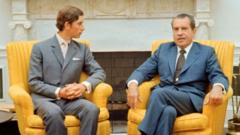
By the time the 2000s rolled around, the narrative had shifted. The young polo player had become a man of deep, often controversial, convictions. When he visited George W. Bush in 2005 and later Barack Obama in 2011 and 2015, the conversations weren't about the glitz of Hollywood. They were about the survival of the planet.
In the Oval Office, Charles became a lobbyist for the Earth. This is the invisible stake of his American visits. While the headlines focused on what he wore or who he shook hands with, the substance was often found in his private meetings with scientists and activists. He used his unique position—one of complete privilege but zero legislative power—to act as a catalyst.
He walked through the streets of New Orleans after Katrina. He didn't come with a checkbook; he came with a spotlight. In a country where politics is often a blood sport, the Prince represented a neutral ground. He could talk about climate change with a Democrat and heritage with a Republican, and neither side could easily dismiss him as a partisan hack. He was simply the man from across the pond who had been watching the world turn for a very long time.
The Humanity Behind the Protocol
It is easy to forget that beneath the medals and the bespoke suits is a human being who has spent his entire life in a fishbowl. His visits to the U.S. often provided a strange kind of relief. In America, the obsession with the monarchy is intense, but it is also celebratory. There is a lack of the "class baggage" that haunts his every move in the United Kingdom.
On a 2015 trip to Washington D.C., he visited a local school. There were no cameras allowed in certain rooms, no press releases for every interaction. He sat with students and talked about their futures. For a moment, the Prince of Wales wasn't a historical figure. He was a grandfatherly man worried about the world those children would inherit.
The weight of the crown is heavy, but the weight of being a "celebrity" is different. Charles has had to navigate both. In the U.S., he found a place that respected the crown but fell in love with the character. Whether he was joking with Barbra Streisand or discussing sustainable urbanism in Kentucky, he was constantly refining his own identity against the backdrop of the American Dream.
The Long Road to the Throne
Every trip Charles made to the United States served as a chapter in a very long apprenticeship. He saw the country change from the post-Vietnam malaise of the 70s to the tech-heavy superpower of the 21st century. He met every president from Eisenhower to Biden (though not all on U.S. soil).
These weren't just vacations. They were lessons in how to lead without a vote. He watched the American experiment from the best seat in the house. He saw the triumphs of the space program and the tragedies of social upheaval. And through it all, he remained a constant.
There is a specific kind of loneliness in being a royal visitor. You are always the center of the room, but you are never quite part of it. You are a guest who can never stay. Yet, in his many decades of traversing the Atlantic, Charles managed to build something more durable than a guest list. He built a reputation as a man who cared about the details.
The cowboy boots he was gifted in Texas, the honorary degrees from Ivy League schools, the quiet walks through national parks—these are the artifacts of a man trying to find his place in a world that is rapidly moving away from the era of kings.
As King Charles III, his visits to the U.S. will change. The protocol will be tighter. The stakes will be higher. But the foundation is already there, built over fifty years of dust, dinners, and difficult conversations.
The horse in the California paddock is long gone. The young prince who squinted into the sun is now the man who wears the crown. But the memory of that heat, that dust, and that American openness remains. It is the human core of a royal history, written in the margins of a thousand handshakes across an ocean that both divides and joins two very different ways of being.
The next time a royal plane touches down on American soil, don't look at the plane. Look at the eyes of the man stepping off it. He isn't just looking at a crowd of strangers. He is looking at a country that helped him figure out who he was supposed to be when the cameras finally stopped clicking.