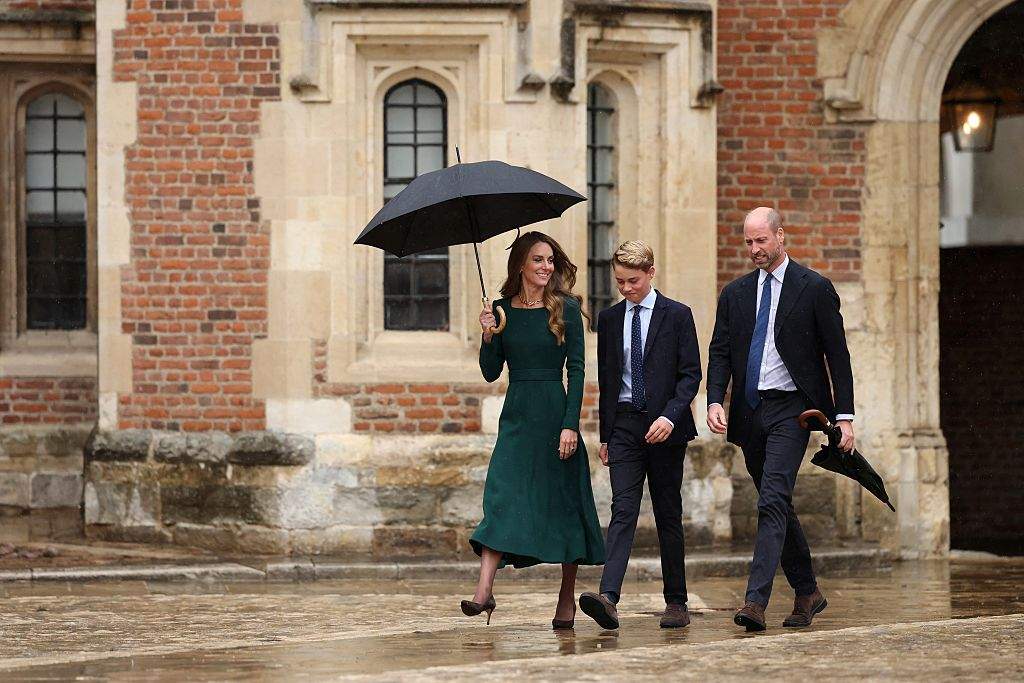
Every royal commentator and tabloid columnist loses their collective mind whenever an eight-year-old or an eleven-year-old heir steps toward a campus gate. The latest frenzy treats Eton College like a magical incubator for future heads of state, as if ancient limestone and tailcoats magically forge statesmanship. The lazy consensus is simple: get the kid into Windsor, hand him a stiff collar, and watch an institution mint a monarch.
It is a lazy, backward narrative that misunderstands power, privilege, and the actual mechanics of modern elite survival.
Prince George does not need Eton. Eton needs Prince George to stay relevant in a century that is rapidly rendering nineteenth-century boarding culture obsolete.
The Myth of the Eton Monopoly on Power
Let us dismantle the mythology immediately. For decades, the media has perpetuated the fiction that attending a specific all-boys boarding institution on the banks of the Thames is a mandatory prerequisite for British governance. The numbers do not back this up with the pristine inevitability people assume.
I have watched institutional gatekeepers cling to these old networks while the ground shifts beneath their feet. The old-boy network is not dead, but it has mutated. A roster of Prime Ministers once crossed those same quadrangles, true. Yet look at the modern political and economic landscape. The correlation between wearing a white tie and running a successful global enterprise or commanding modern geopolitical influence has frayed to the point of snapping.
When people ask whether Eton still guarantees a crown or a cabinet seat, they are asking the wrong question entirely. The real question is whether an institution optimized for the Victorian British Empire can produce leaders for a decentralized, hyper-connected, algorithmic world. The answer is a flat no.
What the Media Misses About Royal Education
The commentary surrounding royal schooling always centers on pedigree, tradition, and the supposed rigor of elite scholastic hothouses. This ignores the psychological burden and the strategic isolation such places impose.
Imagine a scenario where a future monarch is placed in a hyper-competitive, shark-tank environment where every social misstep is whispered about in elite circles and eventually leaks to the press. That is not elite training; that is a goldfish bowl designed to create institutional paranoia.
Tradition in these spaces often masquerades as excellence. The reality is far more mundane. Institutions like Eton thrive on path dependency. Families send their sons there because their grandfathers went there, creating a closed-loop ecosystem of self-congratulation. It is a brilliant branding exercise, but terrible preparation for a changing world.
If you want to understand why modern institutions struggle with agility, look at the education of their leaders. They are taught to preserve order, not to disrupt systems. They learn how to fit into a pre-existing hierarchy, not how to build a new one from scratch. For a modern royal family trying to justify its existence to a skeptical, digital-first generation, sticking an heir into a Victorian boarding relic is a strategic miscalculation.
The Uncomfortable Truth About Elite Networking
Defenders of the traditional royal education path always point to the network. They argue that the friendships forged over quad-side cricket matches pay dividends for a lifetime.
This is half-true and entirely overrated.
The networking argument relies on a static view of wealth and power. The people who will run the next thirty years of global capital, technology, and governance are not hanging out in Berkshire boarding houses. They are building algorithmic infrastructure in secondary tech hubs, navigating venture capital in Singapore, or bypassing traditional gatekeepers entirely.
Confining a future head of state to a homogenous bubble of upper-class privilege creates blind spots the size of continents. A true modern education for a public servant requires friction, exposure to opposing economic realities, and immersion in the messy, unstructured world outside 15th-century chapel walls.
When you isolate a child from the realities of everyday economic struggle, you do not protect him; you handicap his ability to govern effectively later in life.
Stop Fixing the Wrong Problem
The obsession with where a royal child goes to school is a proxy war for society's anxiety about class and meritocracy. People want to believe that if you buy the right ticket, you get the right outcome.
It does not work that way in business, and it certainly does not work that way in modern constitutional monarchies.
The Windsor family would do better to look at how modern sovereign wealth funds, tech founders, and global diplomats train their successors. It involves multidisciplinary fluency, digital literacy, cross-cultural competence, and deep psychological resilience—none of which are guaranteed by a stiff collar and Latin declensions.
We need to stop treating royal schooling milestones as monumental shifts in national destiny. They are merely administrative choices made by parents trying to balance family tradition with public scrutiny.
George will be fine whether he wears the Eton uniform or carves his own path somewhere entirely unexpected. The institution itself is the one gambling its relevance on a boy who has more modern options than any of his ancestors ever did.
The crown does not need the school. The school is just paying for the association.