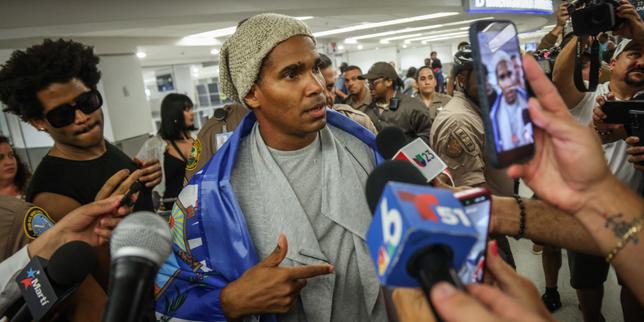
The tarmac at Miami International Airport does not feel like freedom. It feels like asphalt. It radiates the brutal, uncompromising heat of a subtropical afternoon, a heavy dampness that sticks to the skin and mimics the air of the island just ninety miles south. But the air here carries a different weight. For Luis Manuel Otero Alcántara, stepping off that plane was not a triumphant arrival. It was a amputation.
For years, the Cuban state treated his body as a canvas for state control and his art as a threat to national security. They locked him in the maximum-security prison of Guanajay. They counted his days in gray concrete and iron bars. They offered him a choice that was never truly a choice: rot in a cell, or leave the soil that fed your imagination.
He chose to breathe. But the price of that breath is a permanent ache.
To understand what Cuba lost when Otero Alcántara boarded a flight to Florida, you have to look past the international headlines and the sterile vocabulary of political dissidence. You have to look at San Isidro. This is a neighborhood in Old Havana where poverty is thick, the paint is peeling from colonial facades, and the spirit of survival is loud. It is a place of communal patios, shared meals, and music spilling from open windows. It was here that an afro-Cuban artist decided that the flag belonged to the people, not the regime.
Art in Cuba is tightly policed. The government decides who is an artist and what can be expressed. Otero Alcántara refused to ask for permission. He draped the Cuban flag over his shoulders like a second skin. He wore it while brushing his teeth, while sleeping, while walking the broken streets of his neighborhood. The performance piece, titled Drapeau, was simple. It asserted a dangerous truth: the country belongs to those who inhabit it, not just those who rule it.
The state responded with panic. A regime armed with tanks, courts, and a massive apparatus of surveillance found itself paralyzed by a man with a camera, a piece of cloth, and an unshakeable smile.
Consider what happens to a person when their daily existence becomes an act of war. You wake up every morning wondering if the state security agents stationed at the corner will let you buy bread. You check your phone to see if your internet access has been cut off again. Your home becomes a fortress, then a prison, then a shrine.
In November 2020, that home in San Isidro became the epicenter of an unprecedented cultural earthquake. Otero Alcántara and a group of fellow artists, poets, and activists went on a hunger strike. They were protesting the imprisonment of rapper Denis Solís. The world watched through sporadic Facebook Live streams. The air in that house grew thin. The bodies grew frail. Yet, the energy radiating from that small space ignited something long dormant across the island.
When the police finally smashed through the doors dressed as medical workers to break up the strike, they thought they were extinguishing a fire. Instead, they scattered the embers.
What followed was a cascade of historical defiance. The spark of San Isidro led directly to the massive protests of July 11, 2021, when tens of thousands of Cubans took to the streets demanding freedom. It was the largest anti-government demonstration in decades. People sang Patria y Vida—Homeland and Life—a direct, poetic inversion of Fidel Castro’s chilling slogan, Patria o Muerte.
Otero Alcántara never made it to the protests that day. He was arrested before he could join the crowds.
The state took its revenge in shadows. They sentenced him to five years in prison. They hid him away in Guanajay, away from the cameras, away from the streets he loved. In prison, his health deteriorated. His eyesight failed. He went on multiple hunger strikes, using the only weapon he had left: his own flesh.
Prison is designed to break the mind by starving the senses. For a visual artist, the deprivation is a specific kind of torture. The world is reduced to shades of slate and institutional green. The vibrant colors of Havana—the turquoise sea, the pink and yellow colonial plaster, the deep brown of his neighbors' faces—were replaced by monotony.
The Cuban government understands that keeping a martyr behind bars is dangerous. A political prisoner in a cell is a constant accusation, a symbol that refuses to quiet down. The regime prefers exile. Exile silences the voice by shifting the geography. It turns a domestic hero into an expatriate statistic.
For months, the pressure mounted. The choice was framed with exquisite cruelty. Stay here, and we will let you fade into nothingness. Leave, and you can live, but you can never come back.
The flight to Miami was the culmination of that cruelty.
When an artist is forced from their homeland, they do not travel light. They carry the ghosts of every street corner they left behind. Miami is full of these ghosts. The city has built an entire culture on the foundations of exile, a glittering monument to displacement. It is a place where you can buy Cuban espresso on every corner and hear the accent of Havana in every grocery store aisle, yet it remains fundamentally elsewhere.
The tragedy of this transition is that it fulfills the regime's darkest desire. By placing Otero Alcántara on a plane, they removed a thorn from their side. They want the world to see his departure as a defeat, a sign that the island's iron fist will always outlast the individual spirit.
But the real shift lies in what cannot be exiled. You can banish the man, but you cannot recall the images he created. You cannot unring the bell of San Isidro. The young people who stood outside the Ministry of Culture demanding to be heard still remember the feeling of their own voices. The songs written in defiance are still whistled in the alleys of Central Havana.
The silence that now settles over Otero Alcántara’s empty room in San Isidro is heavy, but it is not the silence of submission. It is the silence of an intermission.
On the streets of Miami, the newly arrived exile must learn a new rhythm. He must navigate the vast highways, the glittering glass towers, and the distinct alienation of safety. The immediate danger is gone, replaced by the profound vertigo of survival. He is free to speak, free to create, free to walk without a shadow. Yet every glance backward reveals an island shrinking on the horizon, guarded by walls that require more than art to tear down.
A man steps out of an airport into the blinding Florida sun. He looks around at a city built by people just like him, people who packed their lives into a single suitcase and left their hearts on a Caribbean dock. He takes a breath. The air is warm, but it tastes of salt and distance.