The ink on a treaty in Brussels often feels like it belongs to a different world than the cracked pavement of a family-run bakery in Debrecen or the quiet, anxious hallways of a university in Budapest. We talk about "funds" and "mechanisms" as if they are weather patterns—vast, untouchable, and impersonal. But for a decade, the freeze on Hungarian capital wasn't just a line item in a ledger. It was a slow-motion tightening of the lungs for a nation’s infrastructure, its schools, and its dreams of a European future.
Now, the air is shifting. The European Union has signaled a thaw, dangling a staggering 16 billion euros. It is a sum that could rebuild a country twice over. Yet, this money doesn't come for free. It arrives with the shadow of a new man and the weight of a heavy "if."
The Ghost in the Vault
For years, the vault was locked. Under Viktor Orban, Hungary became the EU’s problematic child, a nation where the rule of law seemed to bend toward the whims of a single party. Brussels responded the only way a bureaucracy knows how: it cut off the oxygen. Billions of euros intended for green energy, digital bridges, and social cohesion sat behind a glass wall.
Imagine a village doctor waiting for a diagnostic machine that never arrives because a politician five hundred miles away refused to change a judicial appointment rule. That is the reality of "frozen funds." It isn't a political chess move; it’s a direct hit on the quality of a life. The stagnant economy became a breeding ground for a specific kind of fatigue—a sense that the country was drifting away from the continent it had fought so hard to join.
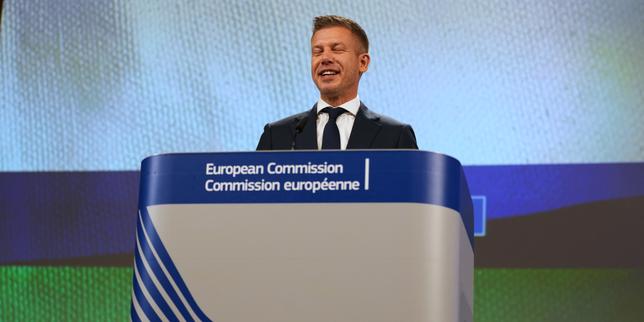
But the political landscape of Hungary is no longer a monolith. The emergence of Péter Magyar, a man who stepped out of the very heart of the establishment to challenge it, has changed the math in Brussels. He didn’t just bring a new face to the opposition; he brought a different kind of leverage.
The Fourteen Pillars of Change
The 16 billion euros aren't a gift for a job well done. They are a carrot held at the end of a very long, very sharp stick. The European Commission isn't handing over the keys to the vault just because there’s a new name on the ballot. They have laid out a roadmap of "milestones"—concrete reforms that touch the very marrow of how a country functions.
It starts with the courts. The EU is demanding a judiciary that doesn't take phone calls from the executive branch. They want an anti-corruption framework that actually has teeth, rather than one that just chews on the small fish while the sharks swim free. For the average Hungarian citizen, this is the "invisible stake." You might not feel the independence of a judge when you wake up on a Tuesday, but you feel it when your small business is crushed by a government-linked conglomerate and you have nowhere to turn for justice.
Consider a hypothetical entrepreneur—let's call her Elena. She has a patent for a new water-filtration system. In the old system, she might fear that if she grows too large, a "friend of the state" will offer to buy her out at a fraction of the value, backed by a legal system that looks the other way. The 16 billion euros are meant to buy Elena the certainty that her work belongs to her.
The Magyar Factor
Péter Magyar is an unlikely protagonist. He knows where the bodies are buried because he helped dig the graves. His rise from an insider to a populist challenger has given the EU a reason to believe that their pressure might finally produce a result. By signaling the release of these funds "under condition of reform," the EU is effectively betting on Magyar’s ability to force the government’s hand—or replace it entirely.
This isn't just about money; it’s about a pivot. The EU is using the 16 billion as a bridge for Magyar to walk across. If the reforms are met, the money flows, the economy stabilizes, and the narrative of a "lonely Hungary" begins to dissolve. If the reforms are faked, the vault slams shut again, and the blame falls squarely on the shoulders of those who refused to change.
It is a high-stakes gamble with the lifeblood of a nation.
The Friction of Reform
Changing a system isn't as simple as passing a law. It's about changing a culture. The 16 billion euros represent a massive influx of liquidity that could jumpstart the "green transition" Hungary has lagged behind on. We are talking about solar arrays across the Great Plain and high-speed rail links that make the borders of Europe feel like the invisible lines they were meant to be.
But the friction is real. The current administration views these conditions as an assault on national sovereignty. They paint Brussels as a foreign invader trying to dictate Hungarian values. This is the emotional core of the conflict: the struggle between the desire for European prosperity and the fear of losing a distinct national identity.
The money sits in the middle of this tug-of-war. 16,000,000,000. It is a number with enough zeros to make any politician blink.
The Cost of Hesitation
What happens if the deal fails? The cost isn't just financial. It’s a cost of time. A generation of Hungarian students is watching their peers in Poland or Czechia benefit from EU-funded research grants and Erasmus exchanges that feel increasingly out of reach. Every month the funds remain in limbo is a month where a bridge stays unbuilt, a hospital wing stays unrenovated, and a young engineer decides that her future lies in Berlin or London rather than Budapest.
The "New Leader" narrative surrounding Péter Magyar is built on the idea that this stagnation is optional. He is selling the vision of a Hungary that can be both fiercely Hungarian and competently European. The 16 billion euros are the fuel for that vision. Without it, he is just another voice in the wilderness. With it, he has the resources to prove that reform pays dividends.
The process is grueling. It involves line-by-line audits of public procurement. It involves public hearings that expose the rot in local administrations. It is painful, messy, and deeply unglamorous work. But it is the only way to ensure that when the vault finally opens, the wealth doesn't just disappear into the pockets of the few.
A Nation Between Two Worlds
Hungary stands at a crossroads that is familiar to anyone who has ever had to choose between a comfortable lie and a difficult truth. For years, the comfortable lie was that the country could reap the benefits of the European Union while ignoring its fundamental rules. The 16 billion euros are the price of the truth.
The truth is that a modern economy cannot survive on an island of its own making. It needs the trust of its neighbors. It needs the stability of law. It needs the transparency that allows a foreign investor to put down stakes without fearing they will be seized.
As the sun sets over the Danube, the lights of the Parliament building reflect in the water—a structure built on the grandeur of the past. But the future of the people inside that building, and the millions they represent, is currently being decided in sterile meeting rooms in Brussels. They are haggling over percentages and legal clauses, but they are really deciding whether a child born in Miskolc today will have the same opportunities as one born in Munich.
The 16 billion euros are a promise, a threat, and a lifeline all at once. The thaw has begun, but the ice is still thin. One wrong step, one broken promise of reform, and the silence will return to the vault. For now, Hungary waits, watching a man named Magyar and a mountain of gold, wondering if this is finally the spring they were promised.
The city holds its breath, the ledger stays open, and the first few coins are beginning to clink into the bowl.