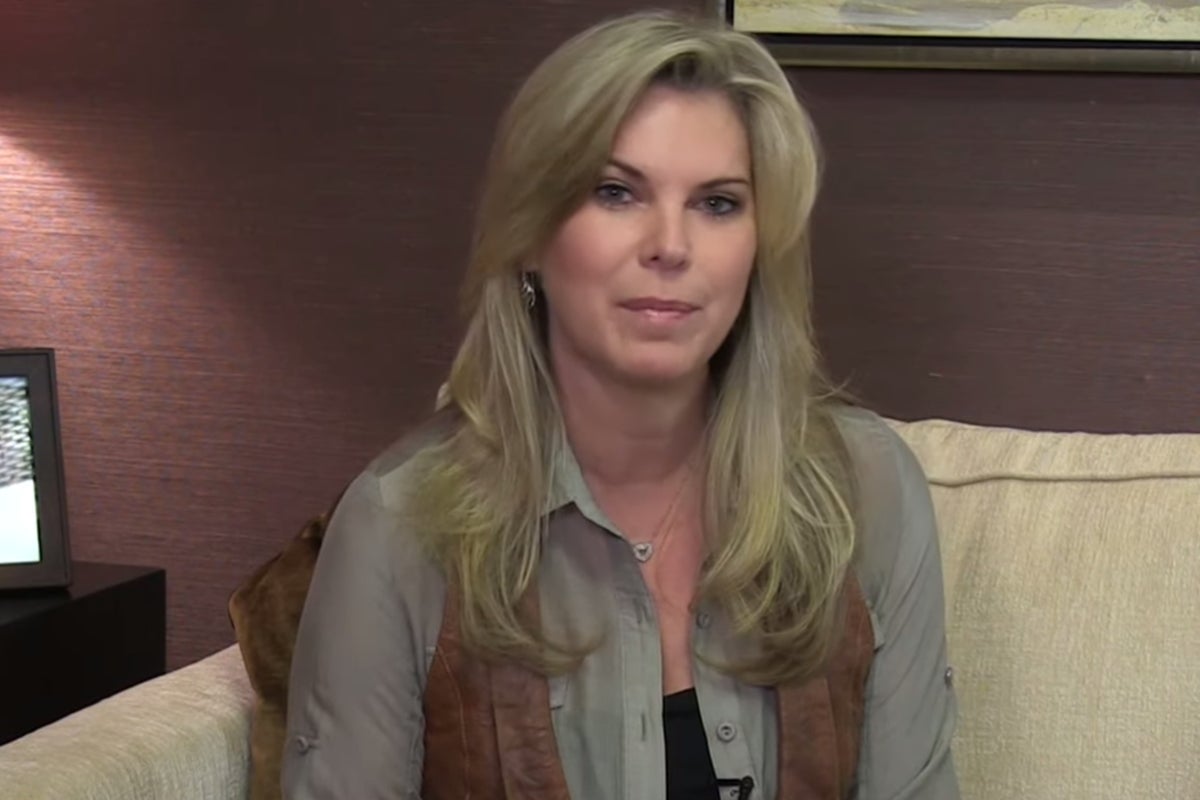
The courtroom does not care about the Malibu sunset. It does not care about the crisp, white linen of a summer gala or the social register that dictates who belongs where in the hills of Los Angeles. Inside those four walls, the air smells of old paper, industrial carpet, and the heavy, suffocating weight of accountability.
Rebecca Grossman sat in that room and watched her carefully constructed world splinter. For years, her name was synonymous with privilege, philanthropy, and the effortless luxury of the Southern California elite. Today, it is permanently tethered to a tragedy that unfolded in a matter of terrifying, high-velocity seconds.
On a warm September evening, Mark and Jacob Iskander, aged 11 and 8, were crossing a street in Westlake Village with their mother. They were on a marked crosswalk. They did everything right. Then came the roaring engine of a Mercedes SUV, traveling at speeds that turned a residential street into a launchpad. The impact was not just a collision; it was an erasure.
Now, the legal system has handed down a number of staggering proportions. One hundred and seventy-six million dollars.
It is a figure meant to punish, to compensate the uncompensable, and to send a shudder through the hills of absolute privilege. Yet, the response from the center of this storm was a phrase that lands with a sickening thud against the reality of the grief left behind.
I earn no money.
Consider the profound disconnect of that statement. It is a defense mechanism born from a specific kind of modern insulation, where wealth is shielded by corporate shells, marital assets, and the complex architecture of high-net-worth existence. But to a mother who goes to bed every night to the echo of a silent house, that excuse sounds less like a legal strategy and more like a final, bitter insult.
The Architecture of the Shield
To understand how someone can live in a mansion, drive luxury vehicles, and still claim financial blankness, you have to look into the mechanics of modern wealth. It is a world of illusions.
When an average person owes a debt, it is simple. The bank looks at their checking account, their paycheck, their modest car. The line between what they have and what they owe is straight and brutal. For the ultra-wealthy, that line is a labyrinth.
Wealth at this level is rarely a pile of cash sitting in a vault. It is a web of trusts, limited liability companies, and family partnerships. It is a system designed specifically to separate the human being from the asset. The person enjoys the yacht, the estate, the private travel, but on paper, they are merely a guest of their own fortune.
During the civil proceedings, the court peeled back these layers with clinical precision. The defense painted a picture of a woman stripped of independent means, reliant entirely on the financial ecosystem of her husband, a prominent burns surgeon. The argument was clear: you cannot squeeze blood from a stone, even if that stone resides in a multi-million-dollar zip code.
But the jury looked past the ledger sheets. They looked at the reality of a lifestyle that continued to hum along even as the bodies of two young boys lay under the California earth. The massive civil judgment was not just a calculation of economic loss; it was a furious rejection of the idea that privilege grants immunity from consequence.
The Heavy Ghost of Westlake Village
Step away from the legal maneuverings for a moment. Look at the intersection where it happened.
It is a quiet stretch of road. The kind of place where parents feel safe letting their kids ride bikes ahead of them. The Iskander family was doing what thousands of families do every single evening. They were walking home.
Imagine the sound of a high-performance engine growing louder in the dusk. It is a sound that signifies power, wealth, and speed. In that moment, the driver behind the wheel was not thinking about the physics of momentum or the fragility of human bone. She was a woman in a hurry, her judgment clouded, her sense of entitlement stretching out miles ahead of her bumper.
The crash changed the telemetry of that community forever.
When we talk about a $176 million judgment, the human mind struggles to comprehend the scale. We see the zeros. We think of lottery winners or corporate acquisitions. But this number was built systematically, piece by painful piece, by a jury trying to quantify the infinite. They looked at the future tech careers these boys would never have. They looked at the decades of companionship stolen from their parents. They looked at the sheer, agonizing terror of the final moments of two children.
The defense tried to argue that the astronomical sum was punitive to the point of absurdity, especially given Grossman’s asserted lack of personal income. They wanted the conversation to be about math. The prosecution, and ultimately the jury, insisted that the conversation remain about value.
What is the market rate for a mother's sanity? What is the cost of an empty bedroom that will never again see a messy desk or a pile of dirty laundry?
The Mirage of Insolvent Luxury
The claim of earning no money is a technical truth used to obscure a larger reality. It relies on a narrow definition of income. In the eyes of the law, a person who does not receive a traditional W-2 paycheck might technically have an income of zero.
Yet, the lifestyle remains unbothered. The legal fees, which climbed into the millions throughout the criminal and civil trials, were paid. The properties remain standing. The resources are there, humming quietly in the background, out of reach of the collection agents but fully available to maintain the comfort of the accused.
This is the point where public fascination curdles into genuine rage. The spectacle of a socialite, convicted of second-degree murder, pleading poverty from within the safety of an elite financial fortress is almost too cynical to bear. It exposes a systemic flaw in how we view accountability.
If a person can cause catastrophic destruction and then simply shrug, pointing to a clever arrangement of family assets as a shield against restitution, then the law becomes nothing more than a theater piece. It suggests that if you are rich enough, you can contract out your liabilities. You can let your insurance companies and your husband's corporations fight the legal battles while you maintain the fiction of your own destitution.
The court, however, refused to play along with the theater.
The judge and the jury recognized that while Grossman might not have a salary in the traditional sense, she had access to a vast engine of wealth. The judgment was designed to smash through that engine. It was an declaration that the legal system would not allow technicalities to obscure the moral debt owed to the Iskander family.
The Long Road to Somewhere Else
This story is not going to end with a neat check being written and handed over at a press conference. The battle over the $176 million will drag on through appellate courts, bankruptcy filings, and forensic accounting investigations. The lawyers will continue to argue over definitions of community property and individual liability.
The news cycle will eventually move on to the next high-profile fall from grace. The headlines will fade.
But the reality of that Westlake Village intersection remains. The true stakes of this case were never about whether a socialite has to sell her jewelry or give up her club memberships. The stakes were about whether a society can look at its most privileged citizens and demand that they pay the same price for their negligence as anyone else.
Grossman remains behind bars, serving her fifteen-years-to-life criminal sentence, a reality that no amount of corporate structuring could prevent. But the civil judgment is about something else entirely. It is about legacy. It ensures that for the rest of her life, and long after she is eligible for parole, every single dollar that passes near her name will be marked by the memory of Mark and Jacob.
The empty pockets she claims to have are a mirage, a paper wall built to keep out the storm. But the storm is already inside. It is found in the quiet, undeniable truth that no matter how many trusts you form or how many assets you hide, you cannot outrun the ghost of what you left behind on the pavement.