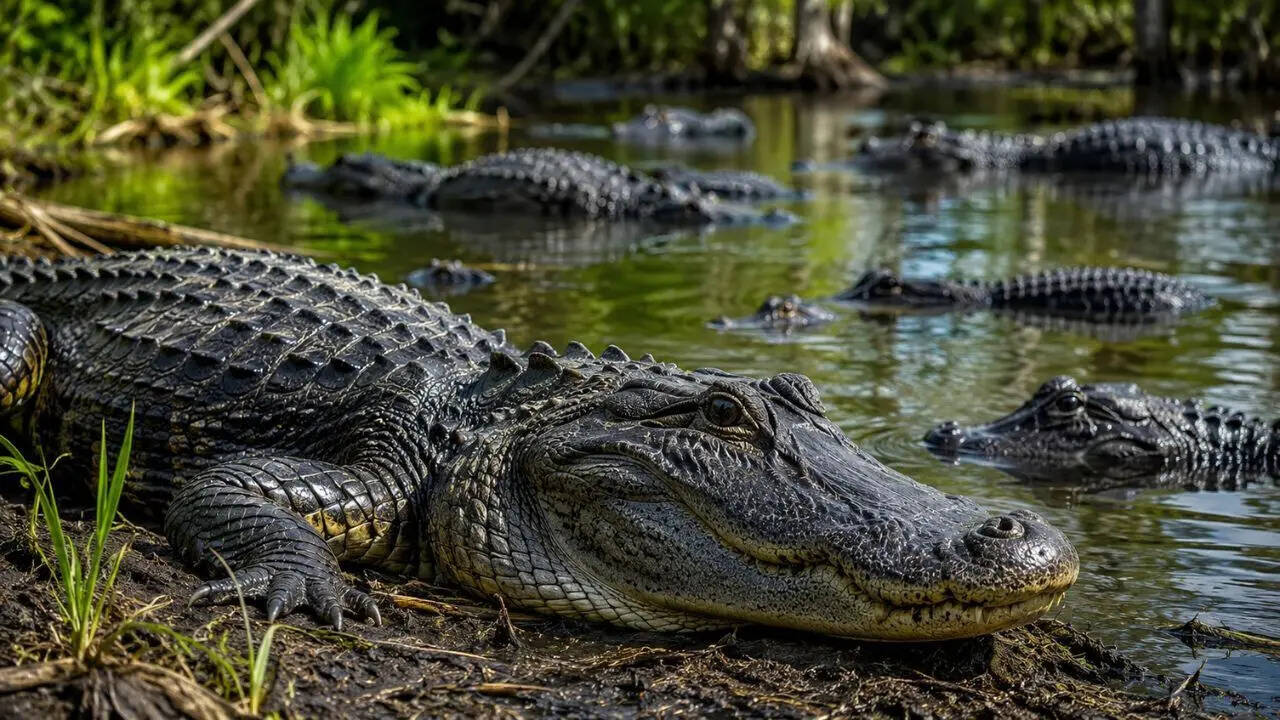
The presence of the American alligator (Alligator mississippiensis) in freshwater river systems represents a complex ecological equilibrium driven by thermal availability, hydrological stability, and prey density. For centuries, public perception of alligator-dense waterways has relied on sensationalist terminology like "infested." In contrast, an analytical evaluation treats these river systems as highly efficient biological bioreactors where carrying capacity is maximized by specific geographic and environmental variables.
Evaluating safety, conservation, and resource management within these zones requires moving past anecdotal sightings toward quantitative frameworks. By analyzing the structural, thermal, and biological vectors of six major US river basins—ranging from the St. Johns River in Florida to the Brazos River in Texas—we can map out the actual risk profiles and ecological mechanics governing these apex predators.
The Tri-Centric Framework of Alligator Carrying Capacity
The spatial distribution and population density of alligators within any given river system are dictated by three core pillars. When these variables intersect optimally, population density spikes, creating high-density habitats that human observers frequently mischaracterize.
       [Thermal Optimization]
                 /\
                /  \
               /    \
              /______\
[Hydrological        [Nutrient Base &
  Stability]          Prey Biomass]
1. Thermal Optimization (The Latitudinal Baseline)
As ectothermic organisms, alligators rely entirely on external environmental temperatures to regulate their metabolic processes. The metabolic cost function of an alligator dictates that digestion, immune function, and reproductive success operate optimally between 82°F and 92°F (28°C to 33°C). River systems positioned below the 32nd parallel north provide the requisite heating degree days to sustain large populations without extended, metabolically draining periods of brumation.
2. Hydrological Stability and Littoral Complexity
Alligators require low-velocity water columns integrated with extensive littoral zones—the shallow areas near the shoreline where aquatic plants grow. Fast-flowing, channelized rivers inhibit nesting success and increase juvenile mortality due to physical displacement. Conversely, slow-moving river systems with expansive wetlands, oxbow lakes, and backwater sloughs provide ideal structural environments for courting, nesting, and juvenile predator avoidance.
3. Nutrient Base and Prey Biomass Density
The carrying capacity of a river is directly proportional to its primary productivity. Eutrophic or mesotrophic river systems support massive populations of macroinvertebrates, fish, amphibians, and small mammals. This trophic wealth fuels the rapid growth of juvenile alligators and sustains the high caloric requirements of mature adults, who can exceed 11 feet in length and 500 pounds in weight.
Deconstructing the Six High-Density River Basins
The St. Johns River (Florida)
The St. Johns River represents the absolute optimization of the tri-centric framework. Flowing lazily northward across low-gradient terrain, its exceptionally slow current mimics a continuous wetland matrix rather than a traditional river channel.
- Hydrological Profile: Low-gradient, slow-flowing, highly channelized in portions but flanked by massive lake expansions (e.g., Lake George, Lake Jesup).
- The Density Multiplier: Lake Jesup, connected directly to the St. Johns main stem, maintains one of the highest alligator densities per shore-mile in North America. This is driven by systemic agricultural runoff that fuels hyper-eutrophic conditions. The resulting explosion in rough fish populations provides an virtually inexhaustible nutrient base.
- Ecosystem Bottleneck: The primary limitation here is high human-alligator interface frequency. Because the St. Johns is a major recreational and commercial artery, the probability of negative encounters scales linearly with human watercraft density, not just alligator numbers.
The Sabine River (Texas/Louisiana Border)
Marking the geopolitical boundary between Texas and Louisiana, the Sabine River drains a vast, flat basin characterized by dense bottomland hardwood forests and expansive coastal marshes.
- Hydrological Profile: High annual discharge coupled with low-lying deltaic flats that flood predictably, creating temporary, highly productive feeding grounds.
- The Density Multiplier: The lower Sabine basin transitions into intermediate and fresh marshes. These ecosystems act as critical nurseries. The lack of intensive urban development along significant stretches reduces human culling pressures, allowing a higher percentage of the population to reach mature, alpha-predator size classes.
- Ecosystem Bottleneck: Industrialization and petrochemical infrastructure along the lower reaches introduce localized chemical gradients. While alligators possess resilient immune systems, long-term bioaccumulation of heavy metals in apex predators acts as a silent constraint on maximum lifespan and reproductive viability within this specific basin.
The Mississippi River (Southern Reaches)
The sheer volume and velocity of the main channel of the Mississippi River make it poorly suited for alligator habitation. However, its expansive alluvial valley and associated delta system tell a completely different story.
- Hydrological Profile: A massive, high-energy main channel bordered by an intricate network of slow-moving bayous, distributaries, and backwater swamps.
- The Density Multiplier: Alligator populations are concentrated away from the navigation channel, occupying the peripheral backwaters and the massive Atchafalaya Basin to the west. The annual spring flood pulse deposits nutrient-rich sediments across millions of acres, creating a hyper-productive trophic web that supports massive alligator biomass.
- Ecosystem Bottleneck: Hydrological manipulation via the US Army Corps of Engineers' levee systems restricts natural flooding cycles. By cutting off rivers from their floodplains, human engineering artificially compresses the available nesting habitat, forcing alligators into higher-density configurations within remaining un-leveed pockets.
The New River (North Carolina)
Positioned near the northernmost limit of the species' sustainable geographic range, the New River in North Carolina (specifically the coastal river system in the southeastern portion of the state, distinct from the ancient Appalachian river of the same name) operates under severe thermal constraints.
- Hydrological Profile: Coastal plain blackwater river, highly acidic, characterized by slow movement and close proximity to marine estuaries.
- The Density Multiplier: Population density here is low compared to Florida or Louisiana, but the relative concentration in specific slow-moving tributaries is notable. Alligators leverage the brackish interface to exploit marine prey resources like blue crabs and mullet during high-tide excursions.
- Ecosystem Bottleneck: The thermal threshold is the defining bottleneck. Shorter summers and prolonged winter brumation periods mean North Carolina alligators grow at a fraction of the rate of their Gulf Coast counterparts. Consequently, populations take significantly longer to recover from localized depletion events, making them highly sensitive to environmental shocks.
The Savannah River (Georgia/South Carolina)
The Savannah River serves as a vital ecological corridor carving through the Piedmont and Coastal Plain provinces. It showcases how industrial containment can inadvertently safeguard wildlife populations.
- Hydrological Profile: Managed river system regulated by upstream dams, transitioning into a broad, tidally influenced delta near the Atlantic coast.
- The Density Multiplier: A significant portion of the lower Savannah basin borders protected federal land, including the Savannah National Wildlife Refuge and the Department of Energy’s Savannah River Site. Decades of restricted public access have created an involuntary park effect. Free from poaching, motorized recreational interference, and shoreline development, alligators have achieved an optimal age-structure distribution with an unusually high proportion of large adults.
- Ecosystem Bottleneck: Upstream hydroelectric dam releases introduce sudden thermal and volumetric fluctuations. Cold-water discharges from deep reservoirs can artificially depress water temperatures miles downstream, disrupting the localized thermal regimes required for successful egg incubation.
The Brazos River (Texas)
Representing the western frontier of the American alligator's range, the Brazos River is an environment defined by climatic volatility and steep environmental gradients.
- Hydrological Profile: Highly variable flow regimes, subject to severe seasonal droughts punctuated by flash flooding events; highly turbid with elevated sediment loads.
- The Density Multiplier: Alligators are primarily confined to the lower Brazos basin where the river slows and meanders through the coastal plains. To survive the frequent droughts that dry out peripheral stock ponds and sloughs, alligators here rely heavily on deep river bends and self-excavated "alligator holes" along the riverbanks that retain water during critical dry spells.
- Ecosystem Bottleneck: Water scarcity and dynamic salinity levels are the primary limiters. As the river's flow drops during hot summer months, saltwater intrusion from the Gulf of Mexico moves upstream. While adult alligators can tolerate brackish water for extended periods due to their specialized keratinized skin, juveniles lack advanced osmoregulatory capabilities, capping reproductive recruitment during dry years.
Quantitative Matrix of Environmental Drivers
To understand how these rivers compare analytically, we can evaluate their performance across the three core carrying capacity pillars, alongside their primary ecological bottlenecks.
| River Basin | Thermal Profile | Hydrological Suitability | Prey Biomass Density | Primary Operational Bottleneck |
|---|---|---|---|---|
| St. Johns | Optimal | Maximum | Hyper-Abundant | Human-Wildlife Conflict Interface |
| Sabine | High | High | Abundant | Localized Industrial Bioaccumulation |
| Mississippi | High | Low (Main) / High (Backwater) | Extreme | Levee-Induced Habitat Compression |
| New (NC) | Marginal | Moderate | Moderate | Thermal/Metabolic Growth Constraints |
| Savannah | Moderate | Moderate | High | Anthropogenic Dam-Induced Thermal Fluctuation |
| Brazos | High | Unstable | Moderate | Hydrological Volatility & Salinity Spikes |
The Mechanics of Risk Mitigating the Human Predator Interface
Evaluating the danger alligators pose to humans requires dismantling the flawed assumption that high alligator density equals high human risk. Alligator attacks are rarely random; they are predictable outcomes governed by specific behavioral and environmental variables.
       [High Water Temperatures (Metabolic Spike)]
                          +
       [Foraging/Nesting Seasons (Spring/Summer)]
                          +
       [Human Encroachment / Low-Light Activity]
                          =
            [Elevated Encounter Risk]
The Metabolic and Seasonal Risk Curve
Alligator behavior fluctuates predictably based on the annual solar cycle. During early spring (April to May), increased testosterone levels drive courtship and territorial movements, significantly escalating the distance individuals travel. By mid-to-late summer, ambient water temperatures peak, driving alligator metabolic rates to their highest levels. This metabolic spike demands increased caloric intake, resulting in heightened foraging activity.
Risk scales exponentially during twilight and nocturnal hours. Alligators possess a tapetum lucidum—a reflective layer behind the retina that amplifies low-light vision—giving them a definitive predatory advantage over terrestrial mammals after dusk.
Anthropogenic Conditioning (The Feeding Vector)
The single most critical failure point in human-alligator coexistence is habituation via food conditioning. Naturally, alligators exhibit a strong aversion to humans, typically retreating when approached. However, when humans consistently introduce artificial food sources (either directly or via discarded fish offal at boat ramps), the alligator’s neurological framework rewrites its risk-reward calculus.
The animal ceases to associate humans with danger and instead associates them with low-energy caloric rewards. Once an alligator undergoes this behavioral shift, it transitions from a wild apex predator into a high-risk liability that almost always requires lethal removal by wildlife authorities.
Resource Management Strategy for High-Density Systems
Managing river basins with high alligator populations requires shifting away from reactionary eradication toward predictive, data-driven intervention.
To maintain ecological balance while protecting human populations, state wildlife agencies must prioritize the preservation of intact littoral zones away from urban centers. By ensuring alligators have access to high-quality, undisturbed natural habitats, resource managers can naturally draw these populations away from human-dominated infrastructure.
Concurrently, municipalities bordering high-density zones like the St. Johns or Sabine rivers must enforce strict physical barriers and design interventions around public access points. This includes constructing elevated boardwalks rather than ground-level paths near the water's edge, installing specialized grates over stormwater drainage outfalls to prevent alligator entry into suburban water systems, and enforcing zero-tolerance penalties for wildlife feeding.
Ultimately, safety in these apex-predator bioreactors is not achieved by attempting to clear the water, but by strictly regulating the human behavior that occurs along the edge.