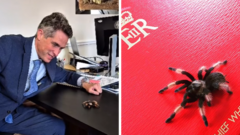
Power is a lonely business. In the halls of Westminster, where corridors echo with whispered betrayals and the air smells faintly of damp wool and old ambition, loyalty is a currency traded away before lunch. Politicians learn early to shield their vulnerabilities. They surround themselves with spin doctors, focus groups, and generic, focus-group-approved golden retrievers.
Then there was Gavin Williamson.
The former UK Defence Secretary and Chief Whip always carried a reputation for unconventional methods of intimidation. During his tenure enforcing party discipline, one particular fixture of his office became legendary. It was not a binder of blackmail or a team of heavy-handed enforcers. It was an unblinking, copper-furred Chilean rose tarantula named Cronus.
For years, the public viewed Cronus as a prop. A theatrical tool of psychological warfare designed to make errant Members of Parliament sweat while discussing their voting records. But symbols have a strange way of outlasting their utility. When the headlines faded, the ministerial red boxes were packed away, and the brutal theater of high-stakes politics shifted elsewhere, the spider remained.
Cronus recently died. He was fourteen years old.
To the casual observer scrolling through a news feed, the death of a politician's exotic pet is a bizarre footnote. A quirky blurb tucked between macroeconomic forecasts and celebrity divorces. But look closer. Stripped of the political caricature, the loss reveals something deeply human about the strange, isolated worlds we build for ourselves, and the unexpected anchors that keep us grounded when everything else spins out of control.
The Architecture of Fear
We are hardwired to recoil from the multi-legged. It is an evolutionary leftover, a survival mechanism burned into our DNA from the days when a rustle in the prehistoric brush meant agonizing death. Spiders do not possess faces we can read. They do not wag their tails when we enter a room. They do not offer the warm, mammalian comfort of a cat curling onto a lap.
Because of this, the tarantula became the perfect avatar for Williamson’s political persona.
When he became Chief Whip in 2016, tasked with maintaining ironclad discipline in a fractured Conservative party, he brought Cronus into his parliamentary office. The symbolism was heavy-handed, almost cinematic. Visitors would sit across from a man holding the power to ruin careers, while just inches away, a massive arachnid sat motionless in a glass terrarium.
It was a masterclass in silent intimidation. You do not need to threaten a colleague when a biological nightmare is sitting on your desk, perfectly still, embodying the very concept of a sudden, calculated strike. The media ate it up. Cronus became a character in the grand soap opera of British governance, a miniature monster deployed by a political operator.
But the problem with public personas is that they are exhausting to maintain.
Consider the reality of a high-pressure political career. The constant scrutiny, the knives in the back, the knowledge that your closest allies are merely waiting for you to stumble. In that environment, trust becomes an impossibility. Every conversation is a chess match. Every smile has an expiration date.
Who do you talk to when the door closes and the cameras turn off?
An Unlikely Sanctuary
The life expectancy of a male Chilean rose tarantula is relatively short, but a female can live for decades. Cronus defied the odds for a male of his species, surviving through Williamson’s meteoric rise, his dramatic sackings, his returns to the cabinet, and his eventual retreat to the backbenches.
While prime ministers came and went, the spider endured.
In a rare moment of vulnerability, Williamson spoke of Cronus not as a weapon of political theater, but as a "trusty companion." It is a jarring phrase to hear applied to an animal that lacks the neurological capacity for affection. Yet, it hints at an unspoken truth about loneliness.
An animal like a tarantula demands nothing from you. It does not care about polling data. It is entirely indifferent to bad press, Twitter outrages, or ministerial reshuffles. For someone whose entire existence is predicated on managing perceptions and surviving judgment, there must have been a profound, almost therapeutic relief in sitting before a creature that viewed a cabinet minister and a piece of driftwood with the exact same level of detached neutrality.
The care of an exotic pet requires a hyper-focused routine. You must monitor humidity levels. You must ensure the temperature mimics the scrublands of South America. You must feed it live prey with long metal tweezers, watching for the subtle signs of an impending molt.
This routine is a form of mindfulness. For a few minutes every day, the noise of the external world—the ringing phones, the hostile briefings, the impending career disasters—fades into the background. There is only the glass, the heat lamp, and the fragile life inside.
To the world, Cronus was a tool of fear. To the man cleaning his enclosure, he was a silent witness to the quiet, crushing pressure of public life.
The Weight of the Ridiculous
It is easy to mock the grief of a public figure, especially when that grief is directed at a creature most people would pay an exterminator to eliminate. The internet reacts to these moments with predictable cynicism. Satirists sharpen their knives, and political opponents find ways to turn the loss into a punchline about cold-bloodedness.
But grief is rarely about the objective value of the thing lost. It is about the space that thing occupied in the sufferer's life.
We live in an age of performance. Every action must be curated, every emotion verified by an audience. When a beloved public figure loses a dog, the collective mourning is performative and structured. There are established scripts for how we respond to the death of a canine companion.
There is no script for a tarantula.
By publicly mourning Cronus, Williamson invited ridicule. He knew the jokes that would be made. Yet he did it anyway, shattering the carefully constructed wall of political stoicism to acknowledge a genuine absence. In a strange twist of irony, the pet used to project an image of ruthless, calculated power became the one thing that exposed a raw, unpolished patch of human emotion.
The loss of a long-term pet marks the passage of time with brutal clarity. Fourteen years is a lifetime in politics. In that span, empires fall, parties rebuild, and youth gives way to the gray realities of middle age. To look at an empty terrarium is to realize that a specific epoch of your life has definitively ended. The silent partner who sat through the midnight strategy sessions and the frantic phone calls is gone, leaving behind only an empty glass box and a handful of strange memories.
The corridors of power remain as loud and chaotic as ever. New crises will emerge, new whips will find new ways to terrorize their backbenchers, and the cycle of ambition and betrayal will continue its relentless rotation.
But in a quiet office, away from the glare of the television cameras, a glass tank sits dark. The copper-furred sentinel is gone, and a politician is left with the one thing he spent his entire career trying to avoid.
Silence.