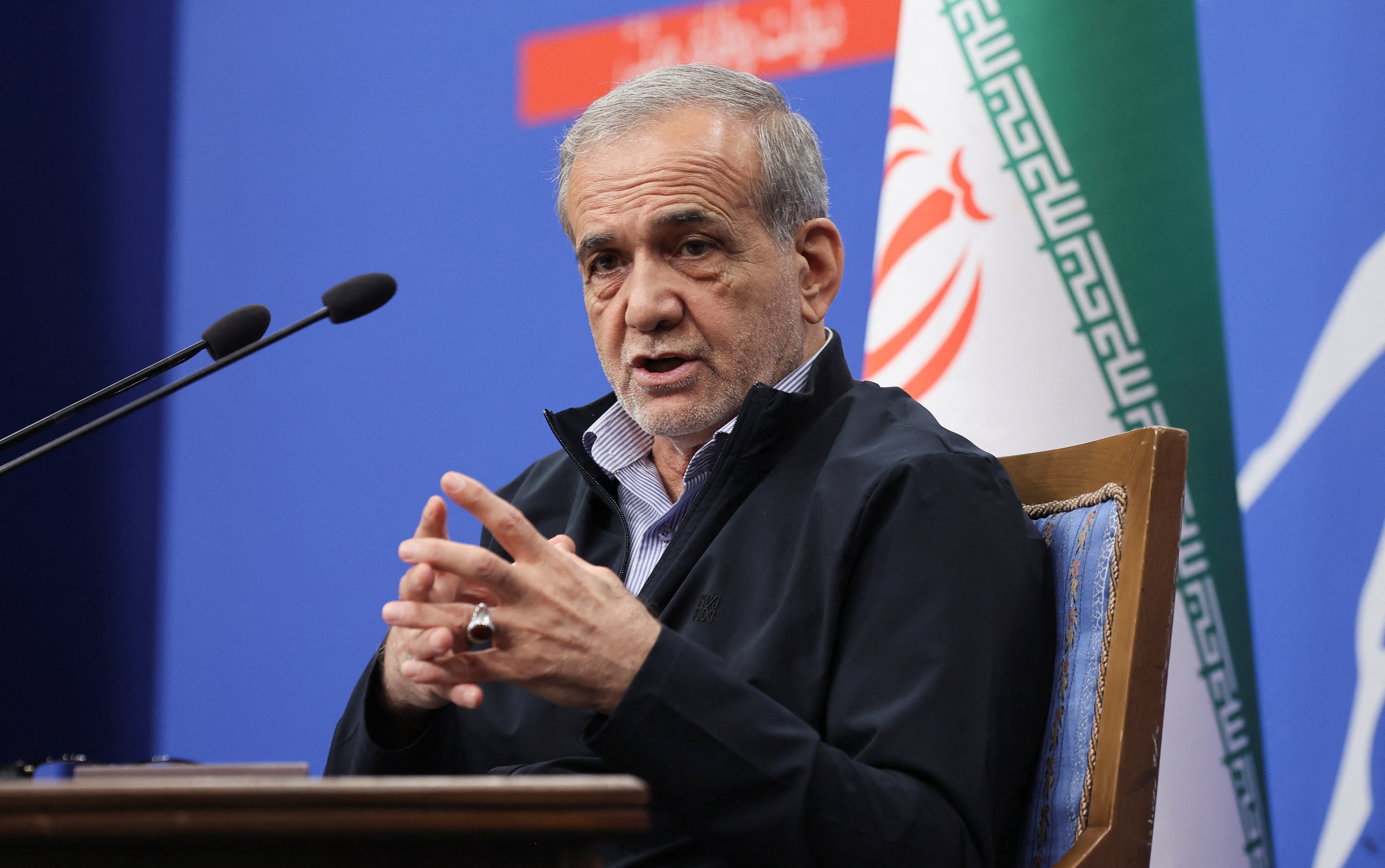
Iranian President Masoud Pezeshkian recently stood before a crowd and attributed the retreat of historical aggressors to the unwavering steadfastness of the Iranian people. While the rhetoric sounds like standard political fare, it signals a deeper strategy within the Islamic Republic to bridge a widening gap between a restless population and a rigid state. Pezeshkian is not just reciting history; he is attempting to repurpose the memory of the Iran-Iraq War to bolster a government facing internal economic fractures and external military pressure.
The core of his message focuses on "resistance" as a national identity. By invoking the eight-year conflict of the 1980s, Pezeshkian seeks to remind the public that collective endurance once saved the nation from collapse. However, the modern reality is far more complex than a simple retelling of past victories. The President is walking a tightrope, trying to maintain the "revolutionary" fervor required by the hardline establishment while addressing a younger generation that is increasingly disconnected from the traumas and triumphs of forty years ago.
The Weight of the Sacred Defense
In Iranian political discourse, the war with Iraq is known as the "Sacred Defense." It is the foundational myth of the current regime. Pezeshkian’s recent comments serve to reinforce the idea that the "people" are the ultimate shield of the state. He argues that without this mass mobilization and psychological resilience, the "aggressors"—a term usually implying Western-backed regional actors—would have succeeded in dismembering the country.
This isn't just about nostalgia. It is about legitimacy. When a leader emphasizes that the people’s "steadfastness" caused an enemy to retreat, he is subtly shifting the burden of national survival onto the shoulders of the citizenry. It suggests that if the nation currently suffers under sanctions or diplomatic isolation, the solution is more of the same endurance that won the war in 1988.
But there is a flaw in this logic that modern analysts cannot ignore. The endurance of 1980 was fueled by a revolutionary honeymoon period and a clear, existential threat in the form of Saddam Hussein’s tanks. Today, the "aggressors" are often invisible, manifesting as banking restrictions, hyperinflation, and digital warfare. You cannot fight a currency collapse with the same tactics used to defend a trench in Khuzestan.
The Pezeshkian Paradigm
Masoud Pezeshkian entered office as a "reformer" or at least a pragmatist. His reliance on traditional "resistance" rhetoric is an intentional move to signal loyalty to the Supreme Leader, Ayatollah Ali Khamenei. By using the language of the old guard, he buys himself the political capital necessary to potentially negotiate on other fronts, such as the nuclear deal or economic liberalization.
Behind the scenes, the Iranian presidency is a role of limited power, often serving as a lightning rod for public frustration while the real decisions are made in the higher echelons of the clerical and military elite. Pezeshkian’s focus on the "people's steadfastness" is a clever bit of framing. It honors the public while simultaneously demanding they continue to tolerate the status quo.
Domestic Economic Friction
The biggest threat to this narrative of unity is the economy. Iran’s inflation rate has hovered at levels that make daily life a struggle for the middle and lower classes. When a president speaks of "steadfastness," a worker who has seen their purchasing power evaporate over a decade hears something different. They hear a request for endless sacrifice without a clear timeline for relief.
Data from the Iranian Statistical Center often paints a grim picture of housing costs and food insecurity. For Pezeshkian, the challenge is to turn "steadfastness" from a passive state of suffering into an active national project. If he fails to connect the historical pride of the Iran-Iraq War to a modern economic "win," his words will remain empty echoes in a hollowed-out economy.
The Regional Chessboard
Pezeshkian’s comments also target a foreign audience. By stating that aggressors "inevitably retreat" in the face of Iranian resolve, he is sending a message to Washington and Tel Aviv. The message is simple: military pressure will not yield concessions. This is the "Deterrence by Defiance" model.
The Iranian leadership believes that the West eventually tires of long-term pressure campaigns. They look at the U.S. withdrawal from Afghanistan and the shifting priorities in Ukraine as evidence that if they simply wait long enough, the "aggressors" will indeed retreat. Pezeshkian is doubling down on this long-game strategy. He is betting that the Iranian social fabric can hold out longer than the political will of his adversaries.
The Generational Divide
There is a massive demographic shift occurring in Iran. Over 60% of the population is under the age of 30. These individuals did not live through the "Sacred Defense." They did not see the black-and-white footage of volunteers heading to the front in real-time. For them, the "steadfastness" Pezeshkian praises is an abstract concept found in textbooks, while the reality is a lack of high-speed internet and limited global travel.
The 2022 protests following the death of Mahsa Amini showed that a significant portion of the youth is no longer moved by the rhetoric of the 1979 Revolution. When Pezeshkian talks about the "people," he is increasingly talking about a shrinking base of loyalists. To reach the rest of the country, he must translate "steadfastness" into "prosperity."
The Role of the IRGC
The Islamic Revolutionary Guard Corps (IRGC) is the institutional guardian of the "resistance" narrative. They control vast swaths of the Iranian economy and are the primary architects of its regional influence. For Pezeshkian to succeed, he must keep the IRGC satisfied while trying to open doors for foreign investment.
The IRGC views any softening of the "steadfastness" rhetoric as a sign of weakness. Therefore, Pezeshkian’s speeches often mirror the Guard’s own internal communiqués. It is a survival mechanism. He is a doctor by trade, and he knows that you don't treat a patient by ignoring the most powerful organ in the body. In the Iranian state, the IRGC is the heart and the muscle.
Miscalculating the Breaking Point
History is full of leaders who praised their people's ability to suffer right up until the moment those people decided they had suffered enough. The "inevitable retreat" of enemies is a comforting thought for a besieged government, but it ignores the internal "retreat" of a population that stops believing in its leadership.
Pezeshkian’s rhetoric assumes that the Iranian people see themselves and the state as a single, indivisible unit. This was largely true during the war with Iraq. It is much less true in 2026. The proliferation of satellite TV and social media has created a dual reality in Iran: the official narrative of the defiant, pious citizen, and the private reality of a cosmopolitan, frustrated public.
Technical Realities of Modern Defiance
Modern conflict isn't just about "steadfastness" on the battlefield. It involves complex systems of electronic warfare, cyber defense, and financial engineering. Iran has made significant strides in drone technology and missile development, which provides a physical backbone to the President’s claims.
However, these advancements come at a massive opportunity cost. Resources diverted to the military are resources not spent on infrastructure or environmental crises, such as the country’s looming water shortage. A nation can be steadfast in the face of an invading army but remains vulnerable to the slow, grinding erosion of its natural resources and public services.
The Strategy of Strategic Patience
The "steadfastness" Pezeshkian describes is often called "Strategic Patience" in Tehran’s policy circles. It is the idea that time is an Iranian asset. By refusing to buckle under maximum pressure, Iran forces its opponents into a dilemma: escalate to a full-scale war that no one wants, or slowly accept Iran’s role as a regional power.
This strategy has worked to an extent. Iran has expanded its influence in Lebanon, Syria, Iraq, and Yemen. But it has also left the country's population in a state of permanent mobilization. There is no "normal" life for a nation constantly being told it is at war. Pezeshkian is essentially asking the people to keep their guard up forever.
Negotiating from a Position of Defiance
The President’s most difficult task is to turn this defiance into a diplomatic bargaining chip. He wants to go to the international community and say: "Look, we have survived your worst pressure. You cannot break us. Now, let’s talk on equal terms." This is the core of his administration's foreign policy.
If the U.S. and its allies see this "steadfastness" as a sign of intransigence, then the cycle of sanctions and escalation continues. If they see it as a sign of stability—a regime that is not going anywhere—then they might be more inclined to negotiate. Pezeshkian is using his speeches to convince the world that the Iranian government is too deeply rooted in the "people" to be toppled from the outside.
Internal Dissidents and the Counter-Narrative
While Pezeshkian speaks of unity, the Iranian diaspora and internal activists have a different interpretation. They argue that the "steadfastness" of the Iranian people is not directed with the state against a foreign enemy, but against the state itself. They see the economic and social struggles not as a badge of honor, but as the result of decades of mismanagement and corruption.
This counter-narrative is the primary competition for Pezeshkian’s message. Every time he praises the people’s endurance, his critics point to the "brain drain" of the country's most educated citizens leaving for Europe, North America, and the Gulf States. A truly "steadfast" nation should be one that people want to stay in, not one they are desperate to flee.
Strategic Infrastructure and Modern Vulnerabilities
The Iranian power grid and banking sectors have faced repeated cyberattacks. This is a new front for "steadfastness." When Pezeshkian talks about historical retreats, he ignores the reality that modern "aggressors" can strike from a basement in a different hemisphere. The traditional Iranian response of mass mobilization and public rallies does little to counter a virus that shuts down gas pumps across the country.
To truly honor the people’s steadfastness, the state must transition from a model of 1980s-style mass endurance to one of 21st-century technological resilience. This requires an openness to global standards and a level of transparency that the current establishment often views as a threat.
The Future of the Defiant State
The Pezeshkian administration is at a crossroads. It can continue to use the language of the past to mask the failures of the present, or it can attempt to evolve. The "inevitable retreat" of enemies is only possible if the state itself remains a cohesive and functioning unit.
If the Iranian people’s steadfastness is to mean anything, it must lead to a tangible improvement in their quality of life. Rhetoric alone cannot feed a family or provide a job. The legacy of the "Sacred Defense" is a powerful tool, but it is one that loses its edge with every passing year. Pezeshkian is betting everything on the idea that the Iranian people will continue to choose the path of resistance over the path of capitulation. But "resistance" is a heavy burden to carry for forty years without an end in sight.
The real challenge for any Iranian leader is not convincing the world of their strength, but convincing their own people that the strength they show is being used for their own benefit, rather than just the survival of a political system. The "aggressors" may retreat, but if the people are left with nothing but their steadfastness, the victory will be a hollow one.
True national strength is built on more than just the ability to endure pain. It is built on the ability to thrive despite it. For Pezeshkian, the clock is ticking to turn his hard-hitting words into a functional reality that goes beyond the echoes of a four-decade-old war.