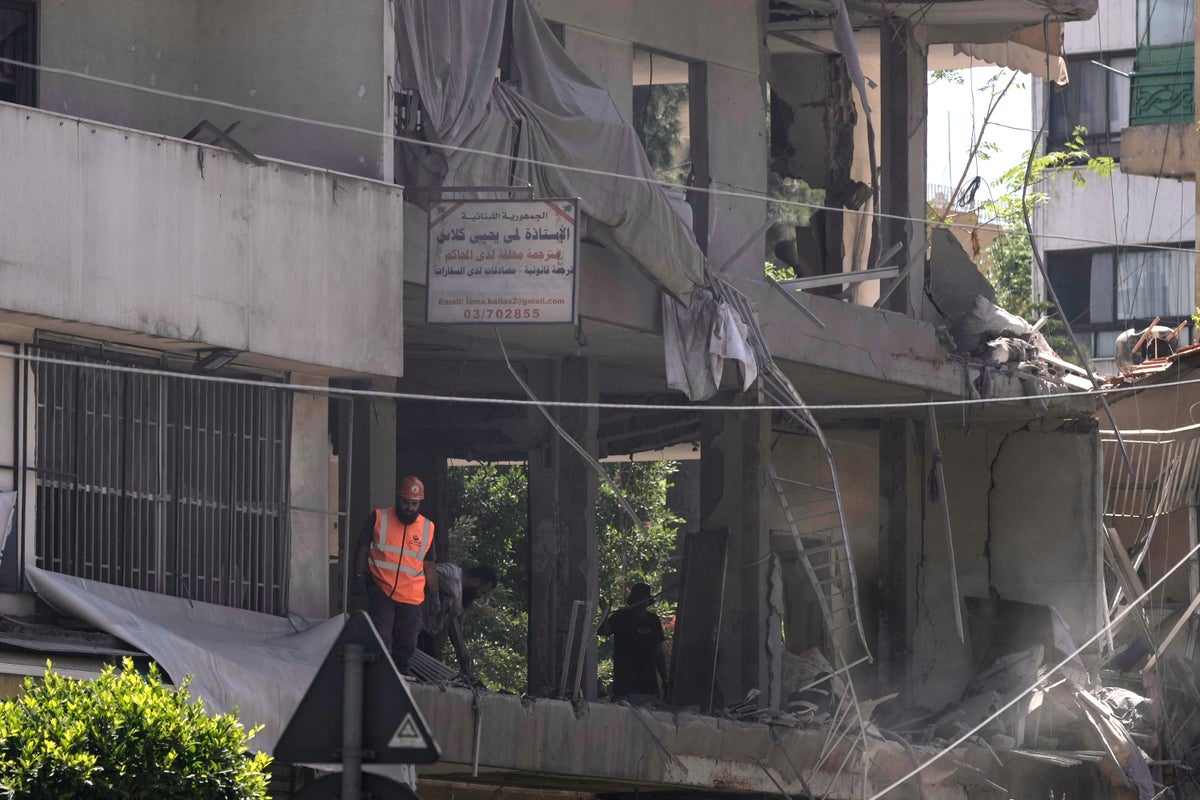
Conventional geopolitical analysis is stuck in 1945. When a defense minister stands at a podium and declares that a nation will never withdraw from newly seized territory in Lebanon, Syria, or the Gaza Strip, mainstream commentators immediately fall into a predictable trap. They treat land as the ultimate prize. They analyze the announcement through the dusty lens of twentieth-century realpolitik, assuming that holding ground equals holding power.
They are completely wrong.
In the modern global economy, permanent territorial occupation of hostile land is not an asset. It is a toxic liability. The lazy consensus screams that refusing to withdraw is a sign of unyielding strength or a permanent geopolitical shift. In reality, it represents a catastrophic misunderstanding of modern statecraft, resource allocation, and risk management.
Holding hostile territory is a financial black hole that drains national power while yielding zero return on investment.
The Balance Sheet of Bullets and Concrete
Let's look at the raw math that traditional defense analysts ignore. When an state seizes territory in a conflict zone like the Levant, the initial military victory is the cheapest part of the entire operation. The real, compounding costs begin the moment the fighting stops.
I have watched corporate boards and state planners make the exact same mistake for decades: they conflate acquisition with integration.
To turn a piece of seized land into a strategic asset, an occupying power must do one of two things: fully integrate the population or completely subsidize a permanent military buffer state. Both options are economically ruinous in the twenty-first century.
- The Insurgency Tax: Holding land populated by millions of hostile civilians requires a massive, permanent deployment of active-duty and reserve forces. This removes productive labor from the domestic economy. Every engineer, programmer, and builder sitting in an armored vehicle on a foreign hillside is a net negative for national GDP.
- The Infrastructure Trap: Power grids, water treatment facilities, and roads in conflict zones do not maintain themselves. The moment a nation claims permanent ownership of a region, it becomes legally and practically responsible for its basic survival. You are no longer just fighting an enemy; you are running a bankrupt utility company under constant mortar fire.
- The Capital Strike: Global capital is cowardly. It flees instability. A nation locked into a permanent, unresolved territorial occupation signals to international investors that its borders are volatile and its legal framework is subject to emergency military decrees. Sovereign credit ratings suffer, borrowing costs rise, and foreign direct investment dries up.
Imagine a scenario where a multinational corporation acquires a competitor, realizes the acquired factories are riddled with structural failures and hostile labor unions, and then announces they will never sell those factories. Shareholders would revolt. Wall Street would short the stock into oblivion. Yet, when a government does the exact same thing with land, commentators wave flags and call it grand strategy.
Dismantling the Myth of Strategic Depth
The most common defense for holding seized land is the concept of "strategic depth." The argument goes that more buffer space between your civilian population and your enemies makes you inherently safer.
This is an obsolete military doctrine completely debunked by modern technology.
In an era dominated by precision-guided loitering munitions, ballistic missiles, cyber warfare, and cheap, asymmetric drone swarms, physical geography has lost its defensive supremacy. A hundred extra kilometers of buffer zone does not stop a hypersonic missile or a coordinated cyberattack on a national power grid.
By holding onto hostile territory, a state actually increases its vulnerability. It creates thousands of fixed, predictable targets—checkpoints, supply convoys, forward operating bases—deep inside a hostile environment. You are not pushing the threat further away; you are embedding your own troops inside the threat matrix.
The Cost of the Buffer Zone
| Tactical Illusion | Operational Reality | Long-Term Strategic Consequence |
|---|---|---|
| Physical distance deters rocket fire | Sub-state actors adapt with longer ranges and steeper trajectories | Constant, low-intensity attrition drains military readiness |
| Control of high ground ensures observation | Satellite imagery and cheap commercial drones democratize surveillance | The occupational force loses the element of surprise |
| Resource denial starves the adversary | Black markets and illicit supply lines thrive in chaotic borderlands | The occupying power ends up funding its own opposition via corruption |
The hard truth is that modern security is a function of technological superiority, economic resilience, and intelligence dominance. Physical land ownership is a distraction that ties down mobile, agile forces in static defensive positions. It forces an advanced military to play a permanent game of whack-a-mole against decentralized insurgencies.
The Hidden Risk of Institutional Rot
There is a severe internal downside to this strategy that no defense minister will ever admit at a press conference. Permanent occupation corrupts the institutions tasked with maintaining it.
When a military shifts from a high-tech, maneuvering defense force into a permanent colonial police unit, its capabilities degrade rapidly. Soldiers spend their deployments policing civilian populations, managing checkpoints, and conducting urban raids rather than training for peer-to-peer, high-intensity conflict. The tactical skillset rots from the inside out.
Furthermore, the domestic political landscape becomes warped. A state that refuses to withdraw from contested land must constantly justify the ongoing sacrifice of blood and treasure to its own citizens. This requires the permanent maintenance of a wartime siege mentality. Normal economic policy, education reform, and infrastructure investment are perpetually sidelined to feed the defense budget.
I have seen organizations destroy their core product lines because they became obsessed with defending a legacy asset that was already obsolete. Governments do the exact same thing. They sacrifice their economic future to defend a line on a map drawn during a previous century's war.
Shift the Paradigm From Land to Leverage
The question shouldn't be "How do we hold this land forever?" The correct question is "How do we convert temporary tactical control into permanent structural leverage?"
True power in the modern era is asymmetric and economic. If a state wants to secure its borders, it doesn't need to plant its flag in the soil of its neighbors. It needs to dominate the regional energy grid, control the flow of data and technology, and build alliances that isolate adversaries financially.
Withdrawal should never be viewed as a sign of weakness or a concession to an enemy. It should be executed as a cold, calculated optimization of national resources. You exit the territory because holding it makes you weaker, and leaving forces your adversary to shoulder the crushing burden of governance, reconstruction, and internal instability.
Stop looking at maps. Start looking at the balance sheet. The nation that wins the next fifty years is not the one with the largest territory, but the one with the most efficient economy and the highest technological agility.
Every dollar spent pouring concrete for a permanent base in a hostile wasteland is a dollar stolen from the research labs, semiconductor fabrication plants, and cyber defense systems that actually determine national survival.
The defense ministers proclaiming permanent holding rights aren't playing chess. They are hoarding real estate in a market that has already moved on.