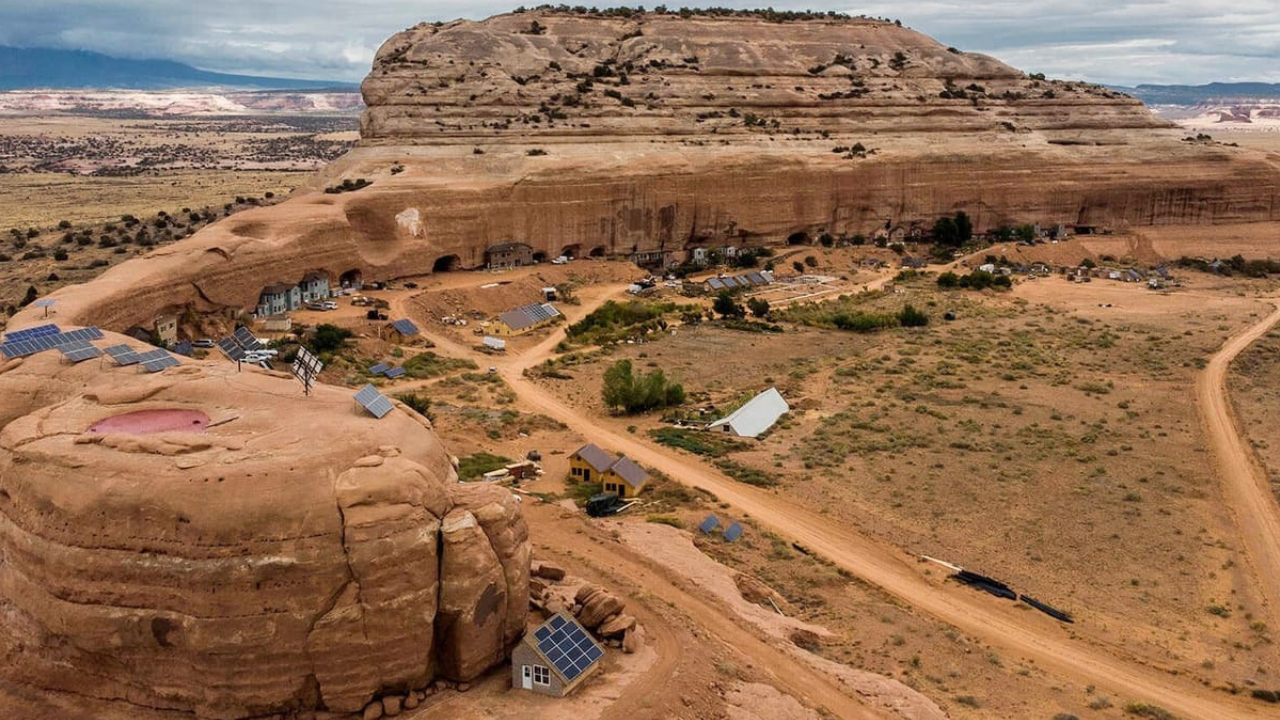
Driving south from Moab down U.S. Highway 191, you see nothing but the usual brutal, beautiful Utah desert. Red rock mesas, sagebrush, and empty blue sky. But turn onto a remote, unpaved road toward Hatch Rock, and you stumble into something that looks like a survivalist sci-fi film.
Giant openings are blasted directly into a 500-foot sandstone cliff face. Windows and regular front doors peek out from the solid stone.
This is Rockland Ranch. Locals call it "The Rock."
Lately, the internet has become obsessed with this place, treating it like a viral anomaly. Headlines scream about a hidden cave city where hundreds of children live off-grid, hiding from modern society. People scroll through photos of giant canyon walls and assume it's a primitive, post-apocalyptic bunker or a coercive compound completely cut off from civilization.
The truth is way more complicated, boringly modern, and fascinating all at once. Residents aren't huddled around campfires in loincloths. They have high-speed internet, modern kitchens, and indoor plumbing. It's an intentional community built on a mix of fundamentalist Mormon theology, extreme DIY engineering, and a desire to raise big families away from mainstream cultural pressures.
If you want to understand how a fully functioning village ended up inside a cliffside, you have to look past the sensationalism.
The Man Who Blasted a Community Into Existence
The story starts back in 1977 with a man named Robert Dean Foster. Foster was a fundamentalist Mormon who believed in plural marriage—a practice the mainstream LDS church officially abandoned way back in the 19th century.
Foster reportedly had a vision directing him to find a specific rock in the desert to shield his people. He didn't want to live in a standard subdivision where his lifestyle would invite constant legal scrutiny and neighborhood gossip. He wanted isolation.
He found an 80-acre parcel of land leased from the state, which the residents eventually bought outright. But how do you build a town on a giant, sheer rock face?
You buy a lot of dynamite.
Foster started blasting. He used controlled explosions to carve deep, cavernous voids into the Navajo sandstone. It wasn't primitive digging. It was a massive engineering project.
Once the dust cleared, the caverns were framed out with regular interior walls, electrical wiring, and flooring. The result wasn't a dark, damp cavern. It was a series of spacious, modern homes hidden behind a facade of solid rock.
The Physics of Living Inside Solid Sandstone
Living inside a mountain has one massive advantage that any desert dweller will instantly appreciate: thermal mass.
The Utah high desert is a land of brutal weather extremes. Summer days routinely push past 100°F, while winter nights drop well below freezing. If you're running a standard timber-frame home out there, your air conditioning bill will ruin you.
Sandstone changes the math entirely. The thick rock walls act as natural insulation, absorbing heat during the day and radiating it slowly at night. Step inside one of these cliff dwellings, and the temperature hovers around a stable, comfortable 73°F all year round.
It keeps the homes incredibly energy efficient. The community relies heavily on a massive solar panel system to generate electricity. They draw water from a deep, private natural well that supplies the entire settlement.
They also run their own livestock pastures, keeping cows, chickens, and goats. They tend large outdoor gardens and even an indoor orchard to grow fruits and veggies.
To a casual observer, it looks completely self-sufficient. But the "off-grid" label gets overused.
Residents aren't completely disconnected from the American economy. They have a central P.O. Box. They share giant commercial garbage containers. Many of the men hold regular jobs in nearby towns or travel as long-haul truckers, driving into Moab or Monticello for work, medical care, and groceries. They use smartphones, stream videos, and manage daily life with the same digital tools you do.
The Social Structure Inside The Rock
Right now, roughly 15 to 17 extended families live at Rockland Ranch, totaling around 100 to 150 people. A huge chunk of that population consists of children.
This is where the outside world usually gets uncomfortable. The community was founded as a haven for religious polygamy, and about half of the families there still practice plural marriage. The other half are monogamous couples who just prefer the lifestyle, safety, and community spirit.
If you watched the 2017 documentary series Three Wives, One Husband, you've seen the inner workings of the Foster and Morrison families who lead the community. The households are huge. It's common for a single patriarch to have multiple wives and upwards of 20 children.
Daily life requires massive logistical coordination. The wives generally split the labor. One might focus on homeschooling and education, while another manages the commercial-scale cooking, and a third handles childcare or property maintenance.
The community operates on a strict chore rotation. One family might be in charge of the cattle for a month, while another handles the solar grid maintenance.
They aren't affiliated with the fundamentalist sects you usually hear about in news exposes, like the FLDS church formerly run by Warren Jeffs. There are no compound walls, no guards, and no forced uniform dress codes. It's a independent cooperative.
Why the Internet is Suddenly Fascinated
The sudden spike in online interest around Rockland Ranch says a lot more about modern anxieties than it does about the ranch itself.
We live in an era of skyrocketing housing costs, crushing utility bills, and deep political polarization. When people scroll past a video of a family living rent-free inside a self-insulated rock house with its own solar grid and fresh well water, it triggers a weird mix of envy and fascination.
Some look at it as the ultimate blueprint for homesteading and escaping the corporate grind. Others look at the isolated religious structure and feel a deep sense of suspicion.
The reality sits squarely in the middle. It's a group of highly traditional, deeply religious people who chose to build a literal fortress in the desert to protect their way of life. It works for them because they share an identical, rigid worldview and a willingness to do backbreaking physical labor.
Thinking About Going Off-Grid? What to Do Next
If the idea of cliffside living or radical self-sufficiency appeals to you, don't rush out to buy dynamite. Blasting into public lands will land you in a federal prison, and buying private red-rock acreage is astronomically expensive.
Instead, look at the practical principles that make Rockland Ranch work:
- Prioritize Earth-Sheltered Design: You don't need a natural cave. Earth-bermed houses, earthships, or underground builds use the same thermal mass principles to cut energy costs by up to 80%.
- Secure Water First: True self-reliance lives and dies by water rights. Before looking at solar panels, evaluate the water table, well-drilling costs, and local rainwater harvesting laws in your target area.
- Build the Community, Not Just the House: The toughest part of off-grid living isn't the solar wiring; it's the isolation. If you don't have a tight-knit group of neighbors willing to trade labor, fix broken tractors, and share childcare, the lifestyle quickly becomes unsustainable.
The folks at Rockland Ranch didn't just build homes inside a cliff. They built a hyper-specific social safety net. Without that shared dedication, those cave dwellings would just be incredibly expensive holes in the mud.