For decades, scientists stared at the Sun and missed the most important detail. You see, our star builds up massive amounts of magnetic energy before exploding into violent solar storms. But tracking down how that energy actually accumulates has felt like hunting for a ghost.
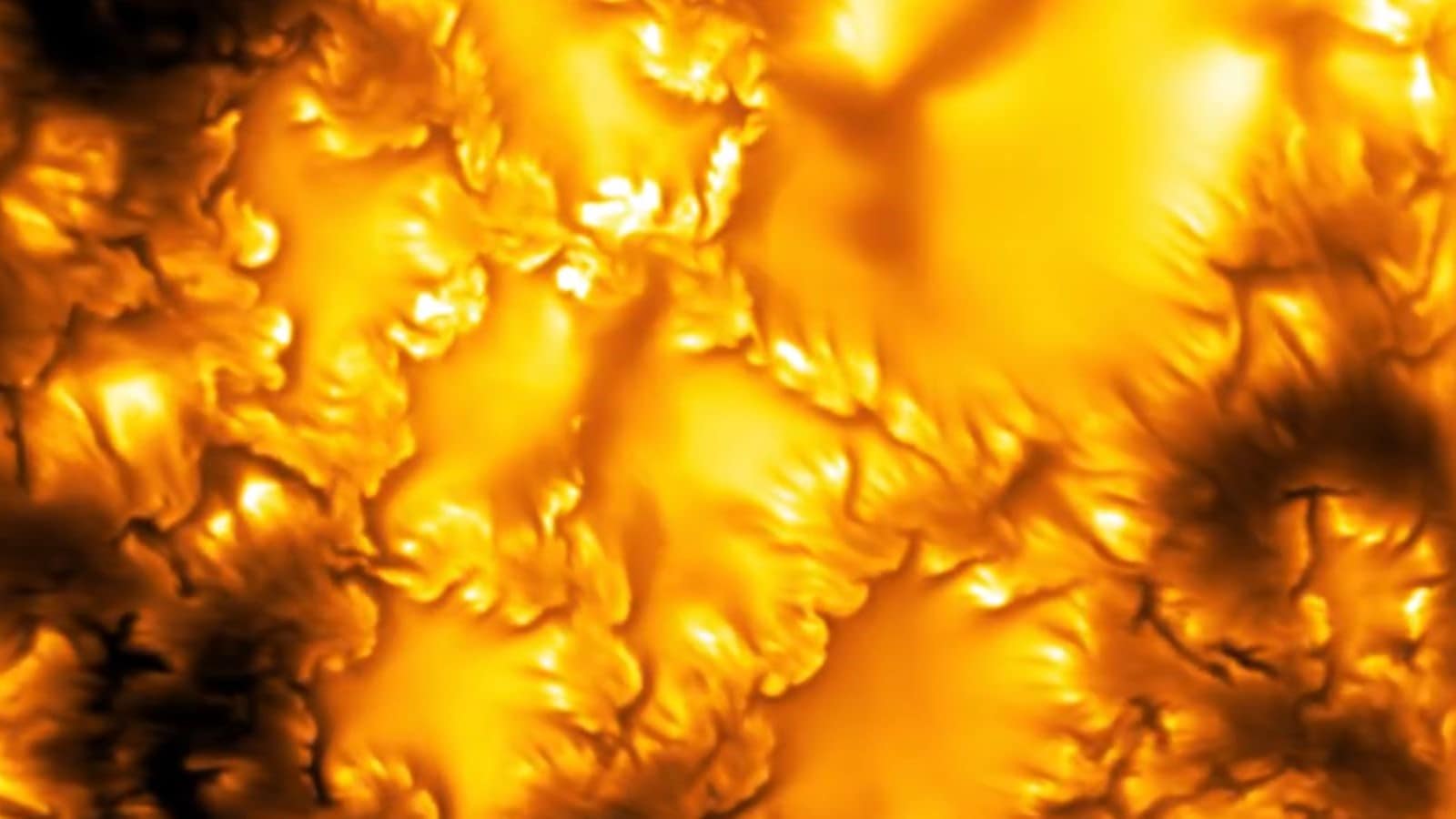
Everything changed recently when researchers pointed the NSF Daniel K. Inouye Solar Telescope in Maui at the solar surface. The resulting images capture the Sun's photosphere at a jaw-dropping resolution of roughly 19 kilometers. That is sharp enough to spot tiny, churning whirlpools of magnetized plasma dancing across boundaries.
These aren't just pretty pictures. They represent the first hard proof of the Kelvin-Helmholtz instability in action on our star, solving a puzzle that has stumped astrophysicists for generations.
The Real Driver Behind Solar Flares
Most casual science articles tell you that solar flares happen because magnetic field lines get tangled and snap. While that statement is technically true, it skips the most crucial part. How do those lines get so hopelessly twisted in the first place?
That process is called flux braiding, and until now, researchers only had vague theories about it. The Inouye telescope data changes the narrative completely. By capturing details down to tens of kilometers, teams led by astronomers at the National Solar Observatory spotted wave-like patterns resembling breaking ocean waves right at the edges of magnetic field concentrations.
When adjacent layers of solar plasma slide past each other at different speeds, they create a shear effect. This friction triggers the Kelvin-Helmholtz instability, turning ordinary plasma flow into spinning vortex structures. These tiny whirlpools literally twist the local magnetic fields, storing the explosive energy that eventually triggers massive coronal mass ejections.
Solving Two Cosmic Mysteries at Once
If you think magnetic twisting is the only thing these whirlpools explain, you are missing half the picture. Astrophysicists have wrestled with two massive solar paradoxes for decades.
First, the Sun's outer atmosphere—the corona—reaches millions of degrees, while the visible surface sits at a comparatively chilly 5,500 degrees Celsius. That defies basic thermodynamic logic. Second, the solar magnetic cycle operates on a tight 11-year loop, meaning magnetic flux must diffuse and reset at an extraordinarily rapid pace. Old computer models completely failed to account for how fast this energy spreads.
These newly discovered whirlpools act as efficient mixing engines. They blend magnetized and non-magnetized plasma together at micro-scales. This rapid churning provides the missing magnetic diffusion that researchers needed to make their models work. It explains both how the corona gets superheated and how the solar dynamo resets itself on schedule.
Why Space Weather Tracking Just Got Serious
You might wonder why tiny swirls happening millions of miles away matter to your daily life. The truth is simple. Modern infrastructure runs on technology vulnerable to space weather.
When a major solar storm hits Earth, it can knock out power grids, fry satellite electronics, and disrupt GPS networks. Better resolution means better prediction models. By feeding data about these 19-kilometer whirlpool scales into physics-based computer simulations, scientists can finally anticipate solar explosions before they happen rather than reacting after the damage is done.
The hardware on Maui combined with automated AI-driven pattern detection software means we are entering a new era of heliophysics. We are finally looking at the Sun with the clarity it demands.