The Sound of Ink
The ink on a peace treaty dries much slower than the blood spilled to get it.
On paper, a conditional ceasefire is a masterpiece of legal architecture. It has clauses, sub-clauses, verified mechanisms, and international guarantors. It is negotiated in carpeted rooms in European capitals where the coffee is always hot and the lighting is perfectly dimmed. It is a document designed to bring order to chaos.
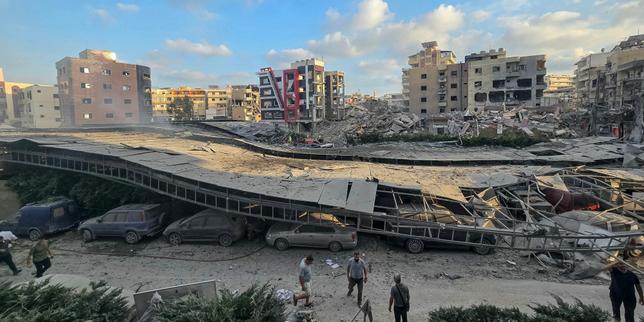
But fifty miles south of Beirut, in the ancient port city of Tyre, peace does not sound like a pen scratching on parchment. It sounds like a drone. It sounds like the high-pitched whine of an unmanned aerial vehicle hovering just above the cloud line, a persistent, mechanical mosquito that reminds everyone below that breathing is still a luxury.
Then comes the phone call. Or the text message. Or the leafed piece of paper dropping from the sky, fluttering down like a winter snowflake onto an orange grove.
The message is brief. It is an evacuation order. The Israeli military commands the residents of specific neighborhoods in Tyre to pack what they can carry and move north, past the Awali River.
The ink is dry. The war is supposed to be on pause. Yet, the road to the north is full again.
Consider the geometry of a displacement. To a military strategist, moving a population north of a river is a logistical adjustment, a clearing of the grid to ensure a buffer zone remains pristine. To a grandmother whose family has fished the waters of Tyre since the Ottomans ruled the coast, that line on a map is a chasm. It is the difference between sleeping in your own bed, surrounded by the smell of sea salt and wild thyme, and sleeping on a thin mattress in a converted school classroom in Sidon.
The tragedy of a conditional ceasefire is that it introduces a cruel element of hope.
When the announcements of a truce first echo through the streets, there is a collective intake of breath. People look at each other. Can we unpack? Can we plant the winter crops? Can we finally stop looking at the ceiling every time a heavy truck rumbles down the street, mistaking the vibration for an incoming strike?
Then the military maps are published online, highlighted in bright, clinical red. The red zones cover your street. The illusion shatters.
The Mirage of the Conditional Line
The fundamental flaw in how the outside world views these conflicts lies in the word conditional.
A condition is an abstraction. For a government or an army, a condition means ensuring that no weapons are moved through a specific corridor, or that certain lookouts remain abandoned. But for the civilians caught in the gears, a condition is a trapdoor. They do not control the conditions. They do not know if a rogue militant three towns over will fire a mortar, or if a thermal camera on a border fence will misinterpret a stray dog for an infiltrator. They simply wait for the trapdoor to swing open.
This is not a new pattern. History is littered with the ghosts of cities that were told they were safe, right up until the moment they weren't.
Imagine walking through the old quarter of Tyre just hours after the ceasefire was declared. The UNESCO World Heritage ruins sit quietly under the Mediterranean sun, columns of Roman granite staring out at a sea that has witnessed Alexander the Great, the Crusaders, and the French. For a moment, the silence feels heavy, almost sacred.
Then the modern world intrudes. An automated voice message broadcasts over Lebanese cellular networks. A digital map appears on a smartphone screen, shared frantically via WhatsApp groups. The contrast is jarring: ancient stone that has survived millennia, juxtaposed with a digital notification that gives you two hours to abandon it.
What do you take when the peace treaty tells you to leave?
You take the documents. The birth certificates, the property deeds to houses that may no longer have roofs, the passports that allow you to exist in the eyes of a bureaucratic world. You take the medicine. You take the old photographs, the ones that cannot be replaced because the negatives were lost in a previous evacuation twenty years ago.
You leave the furniture. You leave the heavy wool blankets. You leave the kitchen table where, just yesterday, you dared to drink coffee without looking at the door.
The road heading north from Tyre is a monument to uncertainty. It is not a panicked rout of people running from falling shells; it is something sadder. It is a slow, methodical procession of people who are exhausted. They have done this before. They know the route. They know which bends in the coastal highway are visible to the sea and which ones offer temporary shade.
The Grid and the Garden
There is a profound disconnect between the language of security and the reality of survival.
When an army issues an evacuation order during a ceasefire, it justifies the action as a preventative measure. It is a move to protect civilians from potential crossfire should the conditions of the truce fail. The logic is sterile, mathematical, and entirely defensible within the framework of military doctrine.
But the logic fails to account for the erosion of the human spirit.
Every time a family is uprooted, a small piece of their connection to the land dies. The orange trees in the south require tending. The fishing boats tied to the docks in Tyre need their hulls scraped and their engines turned over. A city is not just a collection of concrete structures that can be emptied and filled like a stadium; it is a living organism kept alive by the daily routines of its inhabitants.
When you empty the city, even under the guise of safety, you are killing it just as surely as if you dropped ordnance on its plazas.
The real border is not the Blue Line drawn by the United Nations, nor is it the banks of the Awali River. The real border is the psychological threshold where a citizen realizes that their permanence is a myth.
We often talk about refugees as a statistics. We read that ten thousand, fifty thousand, or one hundred thousand people have been displaced. Those numbers are too large to mean anything. They numb the brain.
Instead, look at a single old Mercedes taxi idling on the side of the road outside Tyre. The trunk is tied down with blue nylon rope because it is overflowing with mattresses. Inside, three generations of a family sit in silence. The grandfather is staring straight ahead, his hands clamped tight over the handle of a cane. He remembers 1978. He remembers 1982. He remembers 1993. He remembers 1996. He remembers 2006.
To him, this ceasefire is not a historical breakthrough. It is merely intermission.
The car stays idling because fuel is expensive and hard to find. The driver is debating whether to press on toward Beirut, where rent has skyrocketed to predatory levels, or to stop in Sidon and hope that a relative has a spare corner in a garage.
This is the true cost of the conditional peace. It turns life into a series of agonizing logistical calculations made on the fly, under the glare of a midday sun, while the drones sing overhead.
The Vocabulary of Postponement
We must change how we talk about these moments. To call this a "post-war period" or even a "temporary cessation of hostilities" is a form of linguistic dishonesty. It implies a linear progression from conflict to resolution.
The reality along the southern Lebanese coast is cyclical. It is a state of permanent suspension.
The international community celebrates the diplomatic achievement of a signed document, eager to move the news cycle along to the next crisis. The stock markets adjust. The politicians hold press conferences in front of blue flags. They praise the resilience of the people.
Resilience, however, is a word used by those who are safe to describe those who have no choice but to endure. The people of Tyre do not want to be resilient. They want to be bored. They want to complain about the price of fish, the potholes in the road, and the humidity of August. They want the mundane luxury of a life where the most important decision of the day is what to cook for dinner, not which highway to take to escape an imminent strike.
As the sun begins to dip below the horizon of the Mediterranean, casting a long, golden light over the abandoned harbor of Tyre, the silence returns. But it is a hollow silence. It is the quiet of a house that has been emptied in a hurry, where the tea in the cup is still lukewarm but the occupants are gone.
The Mediterranean sea continues to lap against the ancient Phoenician seawalls, indifferent to the shifting red lines on the military maps, indifferent to the conditions of the ceasefire, and entirely indifferent to the small, white papers still scattered across the asphalt, waiting for the wind to carry them away.