Every single pundit on television right now is peddling the exact same brand of predictable panic. A high-profile politician gets targeted in a violent attack, the cameras roll, the talking heads hyperventilate about lawless streets, and the public is funneled into a binary choice between total authoritarian clampdowns or burying our heads in the sand.
It is lazy, it is predictable, and it completely misses how modern cities actually function.
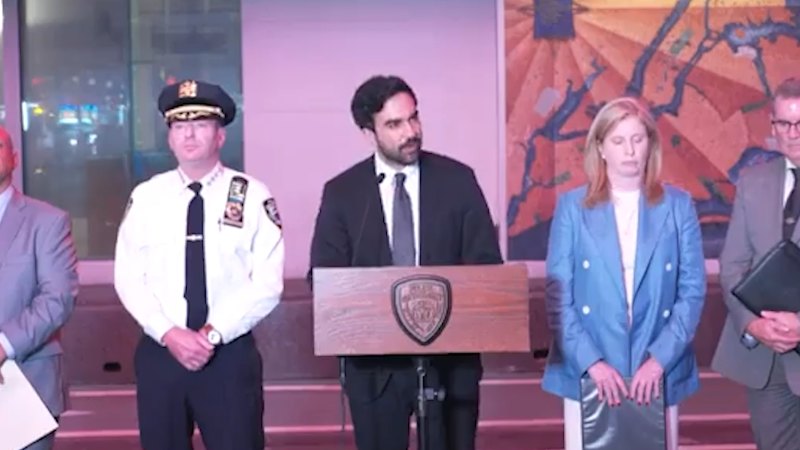
I have spent years analyzing urban security infrastructure and watching politicians scramble to retrofit crisis PR into actual policy. I have seen millions of dollars flushed down the drain on theatrical policing initiatives that do nothing except make tourists feel momentarily comforted while ignoring the systemic rot beneath the pavement. When a leader like Zohran Mamdani steps up to a microphone after a violent incident, the knee-jerk reaction from the commentariat is to treat the event as an isolated moral failure or a referendum on a specific politician's ideological platform.
That framing is dangerous. It assumes that urban violence is primarily a matter of political willpower, as if a sufficiently stern speech can rewrite the complex socioeconomic equations of a metropolis of eight million people.
Let us look at the mechanics of what actually happens after these high-profile incidents. The immediate response follows a strict, well-worn playbook: immediate calls for increased police presence, frantic hand-wringing over the breakdown of civic norms, and partisan finger-pointing designed to score cheap points before the 24-hour news cycle resets. This is political theater at its finest, and it relies on keeping the public in a state of perpetual emotional reactivity.
The mainstream narrative tells us that random street violence is an unpredictable anomaly that can only be beaten back by raw force. The data says otherwise. Violence in urban centers is rarely random; it clusters around predictable friction points—systemic economic despair, a decimated mental health infrastructure, and a hollowed-out social safety net that functions more like a sieve than a floor.
When we focus solely on the optics of the aftermath—who spoke, who looked shaken, who condemned the act with the most righteous indignation—we ignore the structural failures that allowed the assailant to slip through every institutional safety net in the first place.
The Fallacy of Reactive Security
The foundational myth of modern municipal governance is that safety is a product of reaction speed. If the sirens arrive faster, if the arrest is made cleaner, if the press conference is held sooner, the city is supposedly safer.
This is a profound misunderstanding of risk management.
Real security is boring. It looks like reliable lighting in neglected alleyways, functioning public housing maintenance, accessible crisis intervention teams that do not carry badges or guns, and economic pipelines that offer disenfranchised young men an alternative to the underground economy. But those solutions do not fit neatly into a thirty-second news clip. They do not give cable news anchors an excuse to run chyron banners about rising chaos.
When a prominent political figure becomes the target of violence, the incident is instantly weaponized to justify whichever pre-existing political agenda the speaker happened to hold before breakfast. Proponents of heavy-handed policing point to the attack as proof that we need more cops on every corner, ignoring the reality that saturation policing is a band-aid on a hemorrhage. Conversely, ideological purists on the opposite end often downplay the visceral terror of the event, retreating into abstract sociological theories that offer cold comfort to a victim bleeding on the asphalt.
Both sides are selling you a lie.
The truth is that urban safety is an emergent property of social trust. When that trust erodes to the point where individuals feel invisible, alienated, and desperate enough to commit public acts of violence, no amount of executive protection or tactical gear is going to seal the cracks in the foundation.
Dismantling the Crisis PR Machine
Let us examine the specific rhetoric deployed in the wake of the Mamdani incident. We were treated to a masterclass in performative resilience. Leaders stood at podiums, jawlines clenched, projecting a tough-guy veneer meant to project absolute control over an uncontrollable environment.
This is where the expertise needs to step in. In risk analysis, projecting absolute control in the face of systemic vulnerability is a red flag. It tells you that the institution cares more about maintaining its brand than fixing its architecture.
Imagine a scenario where a city administration actually responded to a high-profile violent attack by admitting its own institutional blind spots. Imagine a mayor stepping up to the microphone not to posture about toughness, but to systematically deconstruct every structural failure—every missed mental health referral, every dropped social services case, every neglected neighborhood—that created the conditions for the assailant to act.
It will never happen on live television because modern political survival depends on the illusion of infallibility. Admitting that a city's social fabric is fraying requires admitting that quick fixes are an illusion.
The public asks: How do we stop this from happening again?
The question itself is flawed. It assumes a zero-risk utopia is attainable if we just pass the right laws or elect the right strongman. It frames safety as a tech patch you can download, rather than an ongoing, messy maintenance project that requires continuous public investment and radical honesty about what is failing.
If you want to understand why urban centers remain vulnerable to these shocks, look past the politicians at the microphones. Look at the budgets that get slashed while security theater gets funded. Look at the neighborhoods where the social safety net was dismantled years ago under the banner of fiscal responsibility.
The stabbing of a public figure is a symptom, not the disease. Treating the symptom with more rhetoric, more outrage, and more temporary crackdowns guarantees that the disease will metastasize.
Stop asking for stronger walls. Start demanding a society that doesn't manufacture the desperation tearing it apart from the inside.