The British state just drew a massive, unmistakable line in the sand. If you think property destruction and coordinated disruption can pass as ordinary political dissent in the UK, the highest judges in the land have news for you. They don't care about your historical analogies, and they aren't moved by celebrity open letters.
The Court of Appeal overturned a momentous High Court decision on Monday, ruling that the government’s ban on Palestine Action under the Terrorism Act 2000 is perfectly lawful. It is a stunning reversal. Just four months ago, a lower court called the ban "disproportionate," handing a brief victory to activists who thought they had exposed a heavy-handed state overreach.
That victory evaporated in minutes. Lady Chief Justice Sue Carr, leading a powerful five-judge panel, completely flattened the idea that Palestine Action is a traditional civil disobedience movement.
The legal battle is over for now, but the political fallout is just beginning. Outside the Royal Courts of Justice, police immediately began locking up protesters under anti-terror provisions, proving that the state has no intention of treating this as a routine public order issue.
Inside the Court of Appeal U-Turn
To understand how we got here, you have to look at the massive gap between how the High Court and the Court of Appeal view the executive branch.
In February, the High Court argued that the Home Office had essentially used a sledgehammer to swat a fly. The lower court judges felt Palestine Action’s activities, while explicitly criminal, had not reached the scale or persistence required to trigger full-blown terrorism laws. They pointed out that banning an entire group criminalizes ordinary people who just want to show up to a rally with a sign.
The Court of Appeal rejected that logic completely. Lady Chief Justice Carr stated that the High Court "materially understated" the latitude a Home Secretary must have when protecting national security.
The ruling hinges on a fundamental rejection of the group's self-image. Palestine Action frequently compares its tactics to the early 20th-century Suffragettes—smashing windows, disrupting public infrastructure, and breaking things to force a moral conversation. The appeals court didn't buy it. The judges labeled the group a "covert organisation that operates using secret cells" specifically engineered to evade criminal prosecution.
More importantly, the court focused on the physical risk. This isn't just about red paint on corporate walls. The ruling came only days after four Palestine Action members were jailed as terrorists for a violent 2024 break-in at an Elbit Systems factory in Gloucestershire. One of those activists, 23-year-old Samuel Corner, received a sentence of over seven years after fracturing a police officer’s spine with a sledgehammer. For the appeals court, that crossed an undeniable line from radical protest to political violence.
The Brutal Reality of Proscription
Let’s be completely clear about what "proscription" actually means in practice. This isn't a slap on the wrist or a heavy fine. Under the UK Terrorism Act, being a member of, funding, or even publicly inviting support for a proscribed group is a severe criminal offense. It carries a maximum prison sentence of 14 years.
The state has wielded this weapon aggressively. Since the ban was first initiated, the Metropolitan Police and other forces have made over 3,000 arrests linked directly to Palestine Action support.
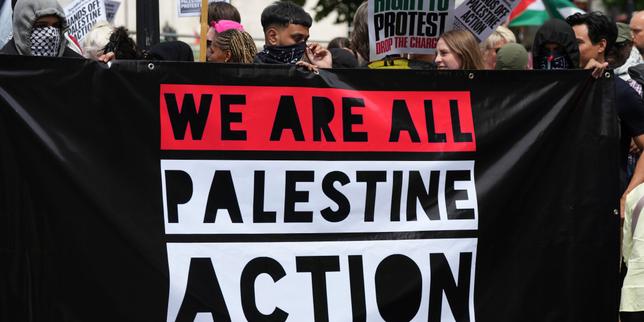
Think about that number. The vast majority of those arrests weren't for breaking into factories or handling explosives. They were for holding up a specific placard distributed by the Defend Our Juries campaign: “I oppose genocide. I support Palestine Action.”
Right now, there are over 700 cases working their way through England and Wales' criminal courts, with hundreds more stuck in pre-charge limbo. By validating the ban, the Court of Appeal just handed prosecutors a massive green light to pursue these cases under full counter-terrorism protocols. On Monday evening alone, police scooped up 117 people outside the courthouse for simply expressing solidarity with the group.
The Chilling Effect vs. The Rule of Law
The reaction to the verdict shows a deep, irreconcilable split in British society over where the right to protest ends and national security begins.
Human rights organizations are panicking. Amnesty International UK immediately blasted the ruling as a "grave misuse of counter-terrorism powers," warning that treating property-damage networks as terrorist cells sets a terrifying precedent for future environmental and social movements. If the state can ban Palestine Action, what stops it from banning the next iteration of Just Stop Oil or Extinction Rebellion?
The current Home Secretary, Shabana Mahmood, took a fiercely opposing stance, explicitly drawing a boundary between mainstream political expression and organized destruction:
"The court has found that Palestine Action has carried out acts of terrorism, celebrated those who have taken part in those acts, and promoted the use of violence. It is not an ordinary protest or civil disobedience group... This decision does not affect lawful protest in support of the Palestinian cause, which remains a fundamental democratic right."
The executive branch wants the public to believe it's separating the message from the medium. You can march through London with half a million people, but if you form an underground network to sabotage a legally operating UK defense company, the state will hunt you down using the same laws it reserves for international terrorist networks.
What Activists and Businesses Need to Know
The legal reality on the ground has shifted permanently. If you are involved in political activism in the UK, or if you run an operation targeted by direct-action groups, there are a few brutal truths you need to adapt to right now.
- The "Good Intentions" Defense is Dead: British courts will no longer weigh the moral righteousness of a cause against the illegality of the tactics. Pointing to international humanitarian law or asserting that you are trying to stop war crimes will not protect you from counter-terrorism prosecution if you participate in property destruction.
- The Threshold for Terrorism has Dropped: Historically, the public associated proscription with bombings and armed insurgencies. By upholding this ban, the judiciary has confirmed that coordinated, cell-based sabotage aimed at shutting down corporate entities can be legally classified as terrorism.
- Symbolic Support is Highly Dangerous: If you wear a badge, carry a specific banner, or share specific organizational content online associated with Palestine Action, you are exposing yourself to immediate arrest under section 11 or 12 of the Terrorism Act. The police are explicitly looking for these markers.
Group co-founder Huda Ammori says she intends to fight this ruling all the way to the UK Supreme Court. But until that long-shot appeal happens, the state’s counter-terrorism machinery is fully operational, and it's picking up anyone who refuses to step back from the line.