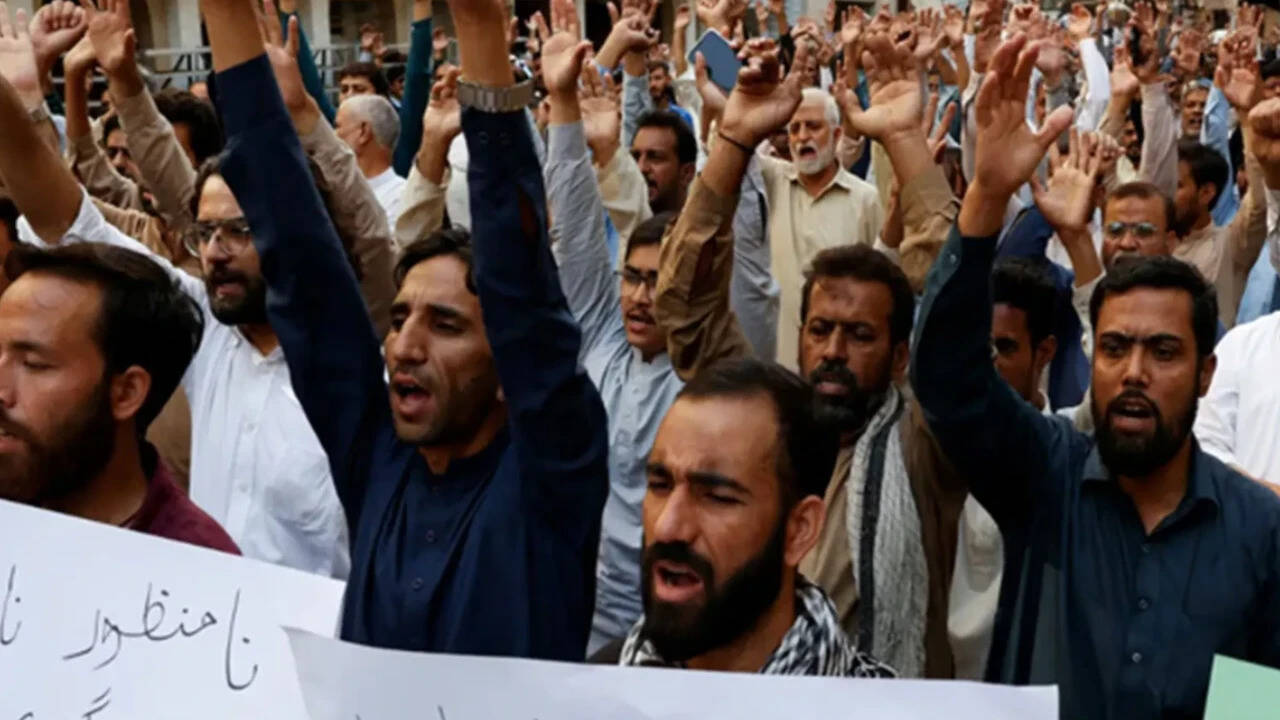
Every headline screams about the four hundred million dollar daily bleed. The pundits clutch their pearls on morning broadcasts, warning that every blocked highway and burning tire pushes the balance sheet closer to terminal velocity. They tell you civil unrest is destroying commerce, strangling supply chains, and bleeding the national treasury dry.
It is a convenient narrative. It is also entirely backwards.
The recurring cycle of street agitation in Pakistan is not the disease. It is the symptom. While corporate boards and state planners obsess over the immediate friction of traffic standstills and closed storefronts, they ignore the structural decay rotting the foundation from the inside. Street closures do not bankrupt an economy with real structural depth. They merely expose an economy that was already hollowed out by decades of bureaucratic rent-seeking, misallocated capital, and state-backed monopolies.
Let us dispense with the corporate media panic. When financial analysts claim that a day of protests shaves hundreds of millions off the gross domestic product, they rely on static accounting models that treat every halted transaction as a permanent loss. That is amateur economics. Markets adapt, shipments reroute, and deferred consumption recovers. What does not recover is capital locked inside zombie state-owned enterprises or squandered on currency manipulation to protect politically connected cartels.
I have watched foreign investors spend months navigating approval loops in Islamabad, only to realize that the regulatory framework exists purely to extract compliance fees rather than facilitate growth. When a business environment is choked by arbitrary energy pricing, import quotas designed to protect inefficient local oligarchs, and tax regimes that punish documented trade while rewarding the informal sector, a street protest is the least of your operational risks.
Focusing on the daily toll of civil disobedience allows policy architects to sidestep their own failures. It creates a ready-made scapegoat. Whenever inflation spikes or reserves dry up, blame the demonstrators. It is a brilliant deflection strategy, and corporate leadership swallows it hook, line, and sinker because confronting the actual power structures requires real courage.
Consider the mechanics of how capital actually flees a market. It does not run because protesters block a toll plaza for forty-eight hours. It runs because currency convertibility is a guessing game, because intellectual property rights are treated as optional, and because energy grids fail with the predictability of a Swiss clock. The real hemorrhage happens quietly in air-conditioned boardrooms where foreign direct investment is canceled via a simple email, long before any crowd gathers in the public square.
We need to stop pretending that administrative stability equals economic health. Stability built on police cordons and internet throttles is a fragile illusion. True economic resilience comes from unyielding competition, transparent contract enforcement, and the dismantling of protectionist walls that coddle domestic inefficiency.
If you run a supply chain through South Asia, your risk assessment is entirely miscalibrated if you spend your energy tracking crowd sizes instead of evaluating counterparty credit risk, currency depreciation exposure, and regulatory capture. The protests will clear by evening. The systemic rot remains until someone decides to tear it down.