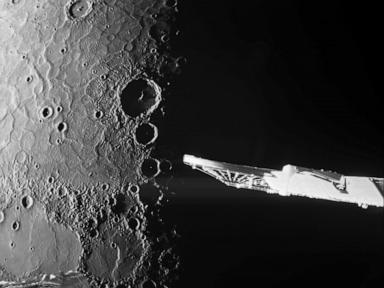
Inserting a payload into orbit around Mercury requires an extraordinary sacrifice of orbital energy, converting deep-space velocity into a controlled capture by the Sun's immense gravitational well. When a composite spacecraft makes its final approach after nearly a decade of trajectory adjustments, the underlying mechanics reflect a brutal engineering compromise between chemical propellant limits, solar thermal loads, and ion-propulsion physics.
The joint European Space Agency and Japan Aerospace Exploration Agency mission, known as BepiColombo, illustrates the absolute constraints of inner solar system transit. Navigating to the innermost planet demands a continuous negotiation with orbital velocity. Because the spacecraft falls toward the Sun, it accelerates continuously, accumulating excessive kinetic energy that must be shed before orbital insertion can succeed.
The Mechanics of Solar System Braking
Traditional orbital insertion relies on large chemical thrusters to brake a spacecraft upon arrival. At Mercury, this approach is mathematically unfeasible for a standard launch mass because the delta-v requirement—the change in velocity needed—exceeds the propellant mass fraction capacity of any current chemical rocket system.
To bypass this energy deficit, engineers designed a multi-stage gravity-assist sequence. Rather than burning heavy fuel reserves, the spacecraft executed a series of nine planetary flybys:
- One flyby of Earth to calibrate instruments and slightly alter trajectory.
- Two flybys of Venus to leverage planetary gravity for sunward redirection.
- Six flybys of Mercury to incrementally bleed off kinetic energy.
Each flyby acts as a momentum exchange, transferring orbital energy between the spacecraft and the target body. This sequence acts as a mechanical brake, lowering the spacecraft's heliocentric orbit until its velocity closely matches Mercury's path around the Sun.
The Ion Propulsion Cost Function
While gravity assists absorb the bulk of the velocity delta, fine adjustments during the long cruise phase relied on the Mercury Transfer Module and its solar electric propulsion system. Ion thrusters operate at exceptionally high specific impulse, meaning they use propellant with extreme efficiency compared to chemical rockets. However, they deliver very low thrust.
This creates a rigid operational constraint. The propulsion system depends directly on photovoltaic generation. Operating closer to the Sun increases thermal stress exponentially, forcing engineers to angle solar arrays away from peak efficiency to prevent material degradation. In 2024, a power-related anomaly reduced the available current to the ion thrusters, restricting the maximum thrust vector and altering the arrival timeline.
To salvage the mission without increasing propellant mass, trajectory designers recalculated a lower-thrust arrival profile. This operational pivot traded time for energy, delaying the final orbital capture by roughly eleven months while preserving the structural integrity of the electrical architecture.
The Architecture of Dual Orbital Capture
Upon reaching the target zone, the spacecraft separates its integrated modules to handle distinct scientific objectives from independent orbits. The composite architecture splits into the Mercury Planetary Orbiter and the Mercury Magnetospheric Orbiter.
Managing two distinct target orbits around an airless, thermally extreme body introduces complex gravitational perturbations. Mercury's irregular mass distribution—mass concentrations beneath the crust—disturbs spacecraft trajectories over time. To counteract this, the mission employs a highly eccentric polar configuration.
The planetary orbiter descends into a lower perihermion to map surface mineralogy, topography, and subsurface structure using laser altimetry and spectrometers. Simultaneously, the magnetospheric orbiter maintains a wider elliptical path to sample plasma dynamics, energetic particles, and the planet's intrinsic magnetic field.
Strategic Execution for Deep-Space Insertion
Executing a successful inner-planet arrival sequence requires strict sequencing over a multi-month insertion campaign rather than a single braking burn. Operators must sequence maneuvers to step down the orbital energy iteratively:
- Module Disconnection: Release the transfer module to eliminate dead weight and decouple high-power ion systems from the active science payloads.
- Trajectory Correction Burns: Execute small, precise thruster applications to align the approach vector with the planet's equatorial plane.
- Primary Insertion Burn: Fire onboard chemical thrusters at the point of closest approach to achieve initial capture, transitioning from a heliocentric path to a bound orbit.
- Apocenter Reduction Maneuvers: Perform sequential orbit-lowering burns over several weeks to drag the high point of the orbit closer to the surface, establishing the operational baselines for each distinct orbiter.
Future deep-space missions targeting inner rocky bodies must account for these exact thermodynamic and kinetic thresholds. Designing architecture that decouples propulsion delivery from long-term scientific observation remains the primary constraint for planetary exploration. Mission planners must bake trajectory redundancy directly into the initial launch mass allocation, ensuring that unexpected thrust degradation can be absorbed by extended arrival timelines rather than mission failure.


