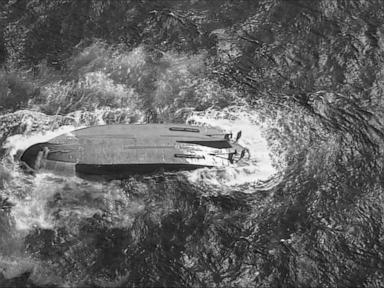
The transition from a Search and Rescue (SAR) phase to a recovery operation following a capsizing event during a typhoon is not merely a change in mission profile; it is a shift in mathematical probability and risk-reward calculus. When a crew remains missing after a vessel overturns in cyclonic conditions, the operational focus moves from life-sustaining interventions to the forensic and logistical reclamation of remains. The recent discovery of a crew member from a capsized vessel underscores the brutal efficiency of maritime drift models and the grim reality of "The Survival Window."
The Physics of a Capsizing Event
A ship overturning during a typhoon is the result of a catastrophic failure in hydrostatic stability. In naval architecture, this is defined by the relationship between the center of gravity and the metacenter. When external forces—specifically extreme wave torque and wind loading—exceed the vessel’s righting arm, the vessel reaches a point of no return.
The immediate environment of a capsized hull during a typhoon creates a three-tier danger zone for the crew:
- Internal Entrapment: If the vessel remains buoyant but inverted, air pockets may form. However, these are notoriously unstable due to temperature drops and the rapid accumulation of toxic fumes or rising water levels.
- The Kinetic Impact Zone: Personnel on deck or in transition are subjected to high-velocity water movement and structural debris. The probability of blunt force trauma is near 100% in a broadside strike by a rogue wave.
- The Hydrodynamic Displacement: Once in the water, the individual becomes a passive participant in the local current and windage. During a typhoon, the surface current is driven by the wind stress curl, often moving at speeds that far exceed human swimming capabilities.
The Three Pillars of Search and Recovery Optimization
Successful recovery operations, such as the one resulting in the discovery of the missing crew member, rely on a triangular framework of data points: Environmental Modeling, Acoustic/Visual Sweeps, and Asset Deployment.
Pillar I: Environmental Modeling and Drift Vectors
To locate a body in open water after a significant duration, searchers utilize Monte Carlo simulations. These simulations account for:
- Leeaway: The movement of an object caused by wind blowing against its exposed surfaces.
- Sea Surface Currents: Driven by both the tide and the residual energy of the typhoon.
- The Stokes Drift: The net transport of fluid in the direction of wave propagation.
When a body is recovered, it confirms the accuracy of the Search Action Plan (SAP). If a body is found within the calculated probability area, it validates the prevailing current data. If found outside, it suggests a "probability of detection" (POD) failure in earlier sweeps or an anomaly in the subsurface currents that diverted the remains.
Pillar II: Sensor Integration and Visual Constraints
Searchers face a diminishing return on visual sweeps as sea states worsen. In the wake of a typhoon, water turbidity—caused by sediment upheaval and micro-bubbles—renders standard optical sensors and human eyesight less effective. Recovery teams must then pivot to:
- Side-Scan Sonar: To identify anomalies on the seabed or snagged on submerged wreckage.
- SAR Synthetic Aperture Radar: Which can penetrate cloud cover but struggles with the "clutter" of high-wave crests.
Pillar III: Structural Penetration and Wreckage Analysis
If the body was found near the vessel, the operation shifts into a "penetration dive" or ROV (Remotely Operated Vehicle) deployment. The structural integrity of an overturned ship is highly suspect. Cargo shifts and internal flooding change the vessel’s center of buoyancy constantly. Recovery divers operate under a "Risk vs. Dignity" framework, where the hazard to the living must be weighed against the imperative to recover the deceased.
The Cost Function of Delayed Recovery
Time is the primary antagonist in maritime recovery. The physiological changes to a body in saltwater—maceration, bloating, and predation—rapidly alter its buoyancy and visual profile.
- Initial Submersion: Immediately after death, most bodies sink as air leaves the lungs.
- The Refloat Interval: As decomposition gases build, the body may return to the surface. This interval is temperature-dependent. In the warm, turbulent waters associated with tropical typhoons, this process is accelerated.
- Dispersal and Dissolution: If not recovered during the second stage, the remains are likely to be dispersed by deep-sea currents or settle into the benthos, making recovery near-impossible without specialized deep-sea equipment.
The discovery of a crew member during this window suggests that search assets were concentrated at the correct coordinates at the exact moment the "Refloat Interval" occurred.
Logistical Bottlenecks in Post-Typhoon Environments
The recovery of a body is not the end of the operation but the start of a complex logistical and diplomatic chain. In international waters or involving foreign-flagged vessels, several bottlenecks emerge:
- Jurisdictional Friction: The state of the vessel’s flag, the nationality of the crew, and the territorial waters of the recovery site create a tri-party legal requirement for autopsy and identification.
- Forensic Verification: In high-energy maritime accidents, visual identification is rarely sufficient. DNA sequencing and dental records become the baseline, requiring the transport of biological samples to land-based laboratories, often under strict chain-of-custody protocols.
- Equipment Fatigue: Search vessels and aircraft operating in the wake of a typhoon face extreme mechanical stress. The "mean time between failures" (MTBF) for search sensors drops significantly in high-salinity, high-vibration environments.
The Mechanical Failure of SAR to Recovery Transitions
A critical observation in maritime disasters is the "Communication Lag." During the height of a typhoon, distress signals (EPIRBs) provide an initial GPS burst. However, if the vessel capsizes rapidly, the EPIRB may become trapped under the hull or fail to deploy. This creates a "Cold Start" for searchers.
Without a definitive "Last Known Position" (LKP), the search area grows exponentially. The area to be searched is proportional to the square of the time elapsed since the LKP ($A \propto t^2$). This geometric expansion explains why find rates drop precipitously after the first 48 hours. The discovery of a body after this window is statistically an outlier, often facilitated by a "Luck Factor" where the remains drift into a high-traffic shipping lane or snag on a known geographic feature.
Strategic Recommendation for Maritime Operators
For maritime firms and insurance underwriters, the recovery of a crew member serves as a data point for future risk mitigation. The transition from a SAR operation to a recovery phase must be managed with clinical precision to avoid "Search Fever"—the irrational over-extension of assets in low-probability zones.
The following protocol represents the optimized path for post-capsizing response:
- Immediate Deployment of Autonomous Drifters: Launching GPS-enabled drifter buoys at the LKP to provide real-time mapping of the current vectors experienced by the missing crew.
- Tiered Asset Scaling: Reducing high-cost aerial assets (C-130s, Helicopters) in favor of long-endurance UUVs (Unmanned Underwater Vehicles) once the survival window (determined by water temperature and sea state) has closed.
- Bayesian Update Integration: Constantly updating the search grid based on "negative find" data. Every hour a sector is searched with no results, the probability density must be shifted to adjacent cells.
The recovery of remains is the final act of a failed voyage. It provides closure for the kin, but for the analyst, it provides the terminal data required to reconstruct the final moments of the vessel. The goal is to move the industry toward a "Zero Missing" standard where sensor redundancy ensures that even in total hull loss, the location of the crew is never a matter of conjecture.


