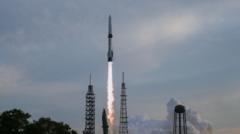
The grounding of Blue Origin’s New Shepard suborbital vehicle following a mid-flight satellite deployment anomaly exposes a fundamental tension between rapid iteration and flight safety in the private space sector. While orbital missions capture the public imagination, suborbital logistics and small-satellite delivery represent the primary stress test for reusable launch architectures. When a propulsion system or separation mechanism fails, the immediate loss is the payload; the long-term cost is the erosion of the vehicle’s flight cadence and the subsequent disruption of the amortized cost model required for commercial viability.
The Mechanics of Reusable Propulsion Anomalies
The failure of a rocket engine during the ascent phase is rarely a singular event but rather the culmination of cascading subsystems failures. In the context of the BE-3 liquid oxygen and liquid hydrogen engine, the margin for error is governed by the thermal and structural limits of the combustion chamber and the turbopump assembly. Anomaly triggers typically fall into three buckets:
- Thermal Fatigue in Nozzle Extensions: Reusable engines undergo repeated cryogenic-to-incandescent cycles. Micro-fractures in the material can lead to "burn-throughs," where the structural integrity of the engine is compromised by high-pressure exhaust.
- Turbopump Cavitation: The high-speed rotation required to feed fuel into the combustion chamber creates localized pressure drops. If gas bubbles form and collapse within the pump, the resulting shockwaves can shatter internal components, leading to a "rapid unscheduled disassembly."
- Aero-Structural Loading: The transition through Max Q (maximum dynamic pressure) subjects the vehicle to peak mechanical stress. Any misalignment in the thrust vector or a structural weakness in the satellite fairing can result in a loss of aerodynamic stability.
The grounding of a fleet is a mandatory regulatory and engineering response to ensure that the failure was not systemic. If the "mishap" occurred during the separation of a payload, the investigation shifts from propulsion to the mechanical linkages and the software logic governing the deployment sequence.
The Economic Penalty of Fleet Grounding
The business model of commercial space relies on high-frequency reuse to drive down the cost per kilogram. A grounded fleet represents more than just delayed revenue; it creates an exponential increase in the cost-of-service delivery.
The Depreciation Trap
Spacecraft are depreciating assets that consume capital even when stationary. Maintenance crews, launch site leases, and engineering overhead continue to burn cash while the vehicle sits in a hangar. For a company like Blue Origin, which is scaling its New Glenn orbital heavy-lift program simultaneously, a New Shepard grounding diverts critical engineering talent away from R&D and toward forensic failure analysis.
Contractual Liquidity and Insurance Premiums
Most satellite launch contracts include "delay penalties" or re-flight guarantees. When a mission fails, the provider must often fly the next mission for free or at a significant discount. Furthermore, the insurance market for space launches is notoriously volatile. A single failure can increase the premiums for an entire vehicle class by 15% to 25%, effectively erasing the profit margins of the next several flights.
The Regulatory Chokepoint: FAA Oversight and Public Safety
The Federal Aviation Administration (FAA) does not oversee the success of the mission’s primary objective (the satellite deployment); it oversees the safety of the "uninvolved public." A grounding order is issued when the FAA determines that the mishap posed a risk to people or property on the ground.
The path to "Return to Flight" requires a formal Mishap Investigation Report (MIR). This document must identify the root cause and outline the corrective actions taken to prevent recurrence. The structural bottleneck here is not just the engineering fix, but the bureaucratic verification of that fix.
- Root Cause Analysis (RCA): Determining whether the failure was a "random" component defect or a "design" flaw.
- Corrective Action Plan (CAP): Implementation of hardware redesigns or software patches.
- Safety Risk Management (SRM): A probabilistic assessment proving the risk to the public is below the acceptable threshold (typically defined as an expected casualty rate of less than $1 \times 10^{-6}$ per launch).
Redundancy vs. Complexity in Satellite Deployment
Satellite deployment mechanisms are often the most fragile part of the mission profile. While the rocket provides the kinetic energy to reach the desired altitude, the deployment system must execute a precise mechanical divorce between the craft and the launcher.
Failure at this stage usually stems from a "single point of failure" in the deployment canister or the pyrotechnic bolts. In more modern systems, electromagnetic or pneumatic separation is used to reduce the shock levels transferred to the satellite. However, these systems introduce electronic complexity. If the satellite fails to deploy correctly, it can remain attached to the booster, leading to a catastrophic re-entry for both or a tumble that prevents the booster from landing vertically.
Strategic Pivot: The Recovery Sequence
The immediate strategic priority for any launch provider post-failure is the preservation of the "Learning Loop." In data-driven engineering, a failure is only a total loss if the telemetry is insufficient to reconstruct the event.
- Data Retrieval: Analyzing high-frequency sensor data (vibration, temperature, pressure) at the millisecond level preceding the anomaly.
- Hardware Forensics: Recovering debris to inspect for signs of material fatigue or chemical contamination.
- Simulation Validation: Replicating the failure in a digital twin environment to confirm that the proposed fix holds under theoretical maximum stress.
The grounding of New Shepard serves as a cautionary signal for the broader industry: the transition from experimental flight to "routine" logistics is fraught with tail-end risks. The companies that survive are not those that never fail, but those that have the structural resilience to absorb a failure, diagnose the mechanism, and return to the pad within a single fiscal quarter.
The focus must now shift to the "Qualitative Reliability" of the BE-3 engine series. If the mishap is traced back to a fundamental design limit of the engine's power cycle, Blue Origin may be forced into a multi-year redesign that could jeopardize their competitiveness against SpaceX’s Falcon 9 and Starship architectures. The technical debt incurred by a failed mission is paid in the most expensive currency in aerospace: time.