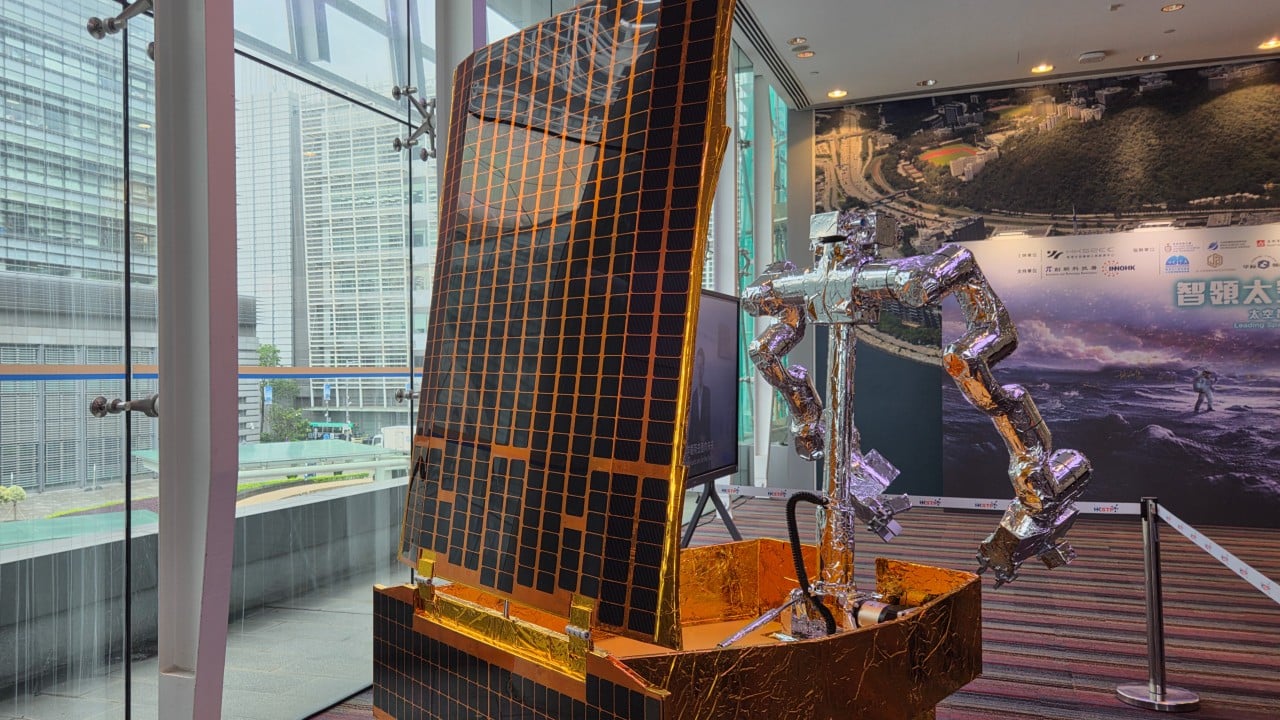
The success of the Chang’e-8 mission hinges on a fundamental shift from sample return to infrastructure establishment. While previous lunar endeavors focused on the retrieval of regolith, the deployment of the four-wheeled, dual-arm "porter" robot signifies the transition toward autonomous lunar construction. This machine is not a scout; it is a mobile logistics platform designed to solve the physical bottleneck of lunar survival: the manipulation of mass in a high-vacuum, low-gravity environment. By analyzing the mechanical constraints and operational requirements of this system, we can map the trajectory of China’s International Lunar Research Station (ILRS).
Functional Anatomy of the Dual-Arm Configuration
The decision to equip a four-wheeled rover with two primary manipulators stems from a need for mechanical redundancy and complex task execution that single-arm systems cannot provide. In lunar environments, reactive forces are difficult to manage due to the $1.622 m/s^2$ gravitational constant. A single arm attempting to lift a heavy payload or torque a bolt would likely destabilize the entire chassis.
Structural Stability and Force Distribution
The porter utilizes a coordinated dual-arm system to neutralize operational torque. When one arm exerts a downward force, the second arm can provide a counteracting lateral or vertical force to maintain the rover’s center of gravity within the footprint of its four wheels. This "active bracing" is critical for:
- Assembly of Modular Components: The arms must align and interlock pressurized modules or structural beams for the ILRS.
- Surface Preparation: Clearing debris or positioning landing pads requires a sustained application of force that single-limb systems lack.
- Tool Swapping: One arm functions as a stabilizer while the other performs precision exchanges of end-effectors, such as drills, grippers, or 3D-printing nozzles.
The Four-Wheel Mobility Constraint
Traditional six-wheel rocker-bogie systems, popularized by NASA’s Mars rovers, prioritize obstacle traversal. The choice of a four-wheel chassis for the Chang’e-8 porter suggests an optimization for load-bearing capacity and energy efficiency on relatively leveled terrain. The reduction in mechanical complexity—moving from six wheels to four—decreases the points of failure and allows for larger, more robust wheel actuators. This trade-off implies that the robot will operate primarily within a predefined "construction zone" rather than engaging in long-range exploration.
Technical Objectives of the Chang’e-8 Mission Profile
Chang’e-8 serves as the technological precursor to a permanent lunar presence. Its objectives are defined by three distinct operational phases that the porter robot must facilitate.
Phase I: Site Preparation and Material Handling
The robot acts as the primary interface between the lander and the lunar surface. Upon touchdown at the lunar south pole—likely near the Shackleton or Amundsen craters—the porter must offload scientific payloads and construction materials. The logistics of this transfer are complicated by the abrasive nature of lunar regolith. The porter’s arm joints must be shielded against high-velocity dust particles that possess a glass-like sharpness, which can lead to mechanical seizure or vacuum welding of exposed metallic surfaces.
Phase II: In-Situ Resource Utilization (ISRU) Testing
The primary strategic goal of the Chang’e-8 mission is to test the feasibility of "living off the land." This involves:
- Regolith Sintering: Using the robot’s arms to position solar concentrators or microwave emitters to melt lunar soil into solid bricks.
- Volatile Extraction: Manipulating experimental ovens to bake oxygen and water ice out of the regolith.
The porter's role in ISRU is essentially that of a furnace operator. It must feed raw materials into processing units and transport the refined outputs to storage locations. This requires a high degree of autonomous pathfinding, as the time delay for Earth-based teleoperation (approximately 2.6 seconds round-trip) prevents real-time manual control for repetitive industrial tasks.
Phase III: Infrastructure Integration
The porter must verify the interconnectivity of the ILRS modules. This involves the physical mating of power cables and data lines between the Chang’e-8 lander and subsequent mission hardware. The dual-arm design allows the robot to "hold and plug," a task that is notoriously difficult for automated systems in zero or low-gravity environments where objects tend to drift when pushed.
Theoretical Frameworks for Lunar Logistics
To understand the porter's value, we must apply the Cost-Per-Task (CPT) framework to lunar operations. Historically, the cost of space exploration was measured in Cost-Per-Kilogram ($/kg) launched. However, for a permanent base, the metric shifts to the efficiency of local labor.
The Lunar Labor Efficiency Ratio
The labor efficiency of the porter can be modeled as:
$$E_l = \frac{T_{completed}}{P_{consumed} \times O_{complexity}}$$
Where:
- $T_{completed}$ is the volume of material moved or bricks laid.
- $P_{consumed}$ is the kilowatt-hours of solar power used.
- $O_{complexity}$ is a coefficient representing the autonomy required for the task.
A dual-arm system increases $O_{complexity}$ but significantly boosts $T_{completed}$ by allowing for parallel processing. The porter represents an attempt to maximize $E_l$ by reducing the need for human intervention or additional specialized machinery. If one machine can handle, build, and repair, the mass-to-orbit requirement for the ILRS drops significantly.
Thermal Management in the South Pole
The South Pole environment presents a unique thermal challenge. While some areas exist in "peaks of eternal light," the porter will likely need to operate in the shadows of craters where temperatures drop below $-200^{\circ}C$. The robot’s internal electronics and battery systems require a Radioisotope Heater Unit (RHU) or advanced Phase Change Materials (PCM) to survive the lunar night. The energy density of the battery must be sufficient to power the high-torque motors required for the dual manipulators during peak construction periods.
Limitations and Operational Risks
Despite the advantages of the dual-arm porter, several technical bottlenecks remain. The most significant is Power-to-Weight Optimization. Heavy lifting requires high current, which generates heat that cannot be easily dissipated in a vacuum via convection. The porter relies entirely on radiation through its chassis and dedicated heat sinks. Overworking the manipulators could lead to thermal throttling, forcing the robot to remain stationary for hours to cool down.
The second limitation is Fine Motor Control in Low Gravity. The lack of atmospheric resistance means that once an arm starts moving, it must be actively braked. The software must account for the elastic deformation of the arms under load, which is magnified in a vacuum. A "bounce" in the arm during a precision docking maneuver could result in catastrophic damage to the ILRS modules.
Software and Vision Systems
The porter utilizes a combination of LiDAR and stereoscopic cameras to build a 3D map of its surroundings. Unlike Mars rovers, which navigate static rocks, the porter must navigate a dynamic construction site. This requires:
- Real-time SLAM (Simultaneous Localization and Mapping): To track changes in the terrain as bricks are moved or structures are built.
- Haptic Feedback Loops: To sense the resistance of the lunar soil or the seating of a bolt, compensating for the lack of human tactile sensation.
Strategic Trajectory of the ILRS
The deployment of the Chang’e-8 porter is a definitive move toward a Decentralized Lunar Economy. By proving that a single mobile unit can perform multiple construction roles, China is establishing the blueprint for a scalable lunar base. The porter is not merely a tool for Chang’e-8; it is the prototype for a fleet of autonomous laborers.
Future iterations will likely focus on:
- Swarm Intelligence: Multiple porters communicating to lift structures larger than a single rover's capacity.
- Cross-Mission Interoperability: Ensuring the porter can service Russian, European, or other partner modules within the ILRS framework.
The immediate priority for mission controllers will be the verification of the End-Effector Versatility. If the porter can successfully demonstrate the transition from heavy lifting to delicate electrical connection within the first 30 days of the mission, it will validate the dual-arm architecture as the standard for all future lunar infrastructure projects. The focus now shifts to the reliability of the actuator seals and the longevity of the solid-state batteries under extreme thermal cycling. The next strategic step involves the integration of the porter with a stationary 3D-printing hub, forming a closed-loop construction ecosystem that operates independently of Earth's supply chain.