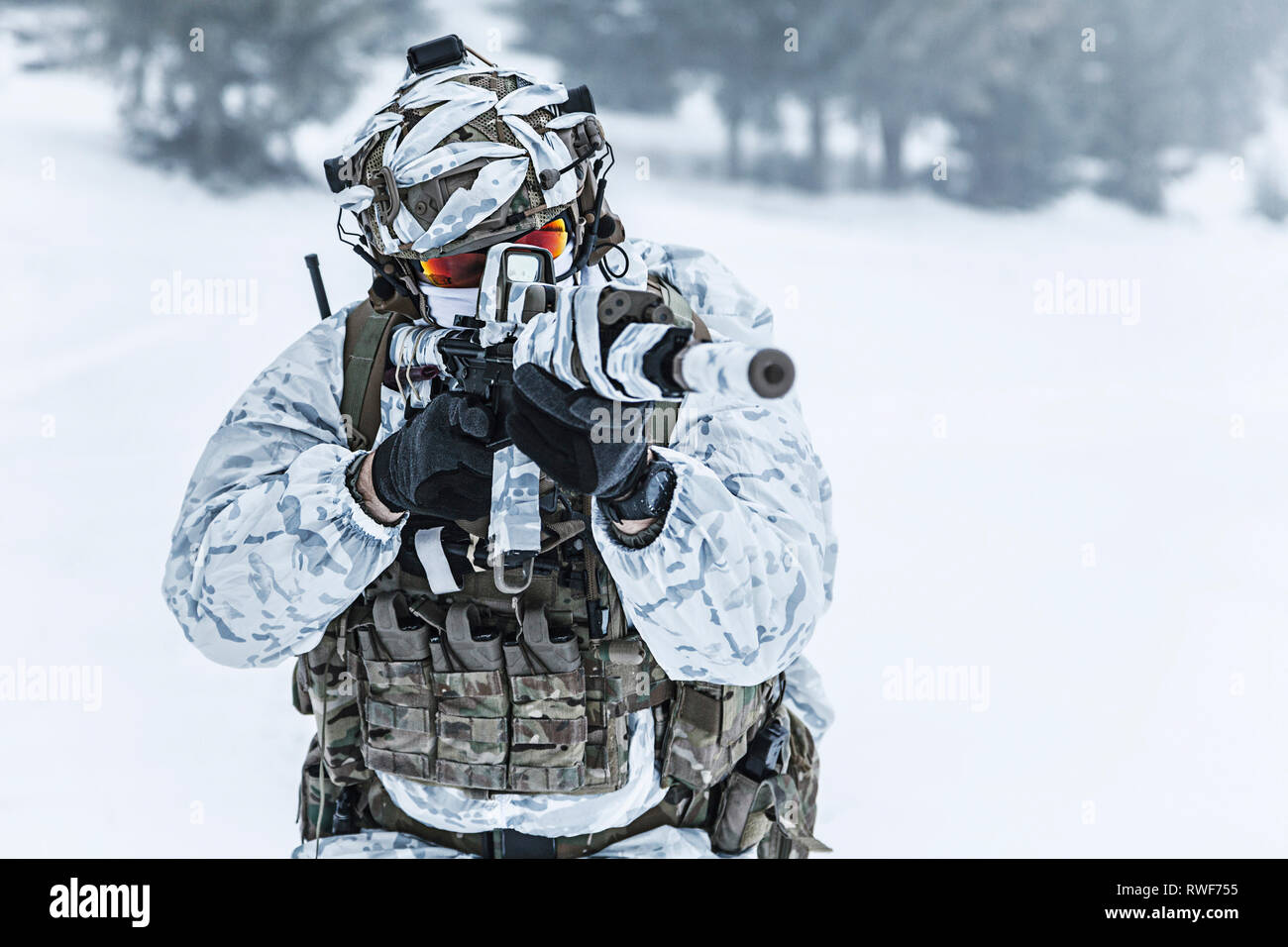
The United States Army is currently undergoing a fundamental recalibration of its force projection capabilities, shifting from twenty years of desert-centric counter-insurgency to the high-latitude, high-intensity requirements of the Arctic. This transition is not merely a change in geography but a total systemic overhaul necessitated by the physical realities of the Deep Cold. Success in this theater is governed by three non-negotiable variables: thermal management, material endurance, and multi-domain communication integrity. Current maneuvers, such as the Joint Pacific Multinational Readiness Center (JPMRC) rotations, serve as a stress test for a force that has largely lost its institutional memory of sub-zero operations.
The Physics of Arctic Attrition
The Arctic environment functions as a force multiplier for entropy. At temperatures falling below -40 degrees Fahrenheit, the chemical and physical properties of standard-issue military hardware undergo phase changes. This creates a baseline "friction cost" that must be accounted for before any tactical objective is pursued.
- Material Phase Shifts: Standard lubricants used in temperate climates increase in viscosity, transitioning from liquid to semi-solid states. This induces mechanical failures in firearm cycling and vehicle transmissions. Synthetic polymers and rubber components, such as seals and hoses, reach their glass transition temperature, becoming brittle and prone to catastrophic fracturing under stress.
- The Battery Capacity Paradox: Lithium-ion and lead-acid batteries experience rapid voltage drops. Chemical reactions within cells slow significantly, reducing effective capacity by up to 50% or 80%. This creates a critical vulnerability for digital communications, night vision optics, and unmanned aerial systems (UAS).
- Thermal Signature Inversion: In a frozen environment, the thermal contrast between a human body (98.6°F) and the ambient environment (-30°F) is extreme. Traditional camouflage is rendered secondary to thermal masking, as infrared sensors can detect heat plumes from idling vehicles or heated shelters from distances that would be impossible in more temperate zones.
Structural Logic of the 11th Airborne Division
The reactivation of the 11th Airborne Division in Alaska represents a shift from a fragmented "Stryker-heavy" approach to a specialized light infantry and airborne configuration. The logic driving this organizational change is rooted in the "Mobility Gap." In the Arctic, roads are scarce and existing infrastructure is susceptible to permafrost degradation. Heavy mechanized units are restricted to predictable lines of drift, making them easy targets for interdiction.
By focusing on "Arctic-capable" light infantry, the Army prioritizes air-mobile assets that can bypass terrain obstacles. However, this creates a logistical bottleneck. A light infantry unit in the Arctic requires four times the caloric intake of a unit in a temperate zone (approximately 5,000 to 6,000 calories per day) and a significantly larger volume of fuel to maintain thermal equilibrium in shelters. The strategy hinges on the Army's ability to solve the "last mile" resupply problem using Small Unit Support Vehicles (SUSV) or the newer Cold Weather All-Terrain Vehicle (CATV), which utilize wide tracks to achieve low ground pressure, allowing them to traverse deep snow where wheeled vehicles would flounder.
The Signal-to-Noise Constraint in High Latitudes
Communications in the Arctic are hindered by atmospheric phenomena unique to the poles. The ionosphere at high latitudes is frequently disrupted by solar activity, leading to "scintillation" that degrades satellite links and High Frequency (HF) radio waves.
- Satellite Latency and Coverage: Most traditional Geosynchronous (GEO) satellites orbit above the equator, resulting in extremely low look-angles for Arctic operators. Signals must pass through more of the Earth’s atmosphere, increasing the risk of interference and loss of signal.
- The Polar Orbit Solution: The military's reliance on Low Earth Orbit (LEO) constellations, such as Starlink or dedicated defense satellites in polar orbits, is the only viable path for high-bandwidth data transfer. Without these, the "Sensor-to-Shooter" link required for modern multidomain operations is severed.
- Magnetic Variance: Traditional land navigation is complicated by the proximity to the Magnetic North Pole and the extreme magnetic declination. Navigational errors of even a few degrees over long distances in a featureless whiteout environment are frequently fatal.
Human Performance and the Cold Weather Injury (CWI) Threshold
The biological cost of Arctic operations is the ultimate limiting factor. The Army’s "Big Experiment" is testing the limits of the Extended Cold Weather Clothing System (ECWCS). The system relies on a vapor-transport hierarchy:
- Layer 1-2: Wicking moisture away from the skin to prevent conductive cooling.
- Layer 3-5: Trapping dead air for insulation while allowing metabolic heat to escape during high-exertion tasks.
- Layer 6-7: External shells to negate the effects of wind chill, which can drop the effective temperature by an additional 20 to 30 degrees.
The failure of a single soldier to manage their "layering discipline" leads to perspiration buildup. Once activity stops, this moisture freezes, triggering rapid-onset hypothermia. This creates a tactical paradox: soldiers must move slowly enough to avoid sweating but fast enough to maintain metabolic heat. This "Arctic Pace" dictates the speed of all maneuver elements, rendering high-speed blitzkrieg-style operations nearly impossible.
Supply Chain Fragility and the Arctic "Iron Mountain"
Logistics in the Arctic cannot follow the "just-in-time" model. It must be "just-in-case." The reliance on a single airfield or a single ice road creates a precarious single point of failure.
| Resource | Temperate Requirement | Arctic Requirement | Factor |
|---|---|---|---|
| Water | 3-4 Liters (Liquid) | 5-7 Liters (Snow Melt) | 2x Fuel/Time |
| Caloric Intake | 3,000 kcal | 6,000 kcal | 2x Weight |
| Battery Life | 12 Hours | 2-4 Hours | 4x Quantity |
| Shelter | Tents/Optional | Hardened/Mandatory | Static Risk |
The "Cost Function" of staying alive in the Arctic consumes roughly 60% of a unit's operational capacity. Only the remaining 40% can be directed toward combat tasks. In contrast, in temperate environments, that ratio is closer to 20/80. To offset this, the Army is experimenting with autonomous resupply sleds and micro-nuclear reactors to provide persistent power without the constant need for "fuel convoys" that are vulnerable to both the elements and enemy action.
The Strategic Imperative of "Presence"
The objective of these experiments is not necessarily to win a sustained land war on the tundra, but to establish a credible deterrent. If the US Army cannot prove its ability to operate at -50 degrees, the Arctic becomes a vacuum that adversaries will fill. The "Big Experiment" is a data-gathering mission to define the "Failure Point" of modern technology.
The next evolutionary step in Arctic strategy involves the integration of "Cold-Hardened" Artificial Intelligence. This refers to edge computing systems capable of predicting equipment failure before it occurs and optimizing thermal management across a distributed network of sensors.
The Army must prioritize the procurement of the CATV (Cold Weather All-Terrain Vehicle) over further investment in wheeled platforms that lack the surface area to navigate the terrain. Simultaneously, the training curriculum must pivot from classroom theory to sustained "Deep-In" field exercises lasting 21 days or longer. This is the minimum duration required to identify the cumulative degradation of equipment and human psyche. Mastery of the Arctic is not achieved through superior firepower, but through the superior management of thermodynamics and the mitigation of environmental friction.