Saltwater does not usually taste like aviation fuel.
Captain Mikhail Abramov knew this in his bones, even before the concussion knocked him sideways into the chart table. For twenty-eight years, the Black Sea had been his office, his constant, and occasionally, his adversary. He knew its moods, its sudden summer squalls, its deceptive turquoise calms, and the heavy, sulfurous stench of old petroleum that sometimes clung to the horizon near the port terminals. But what tore through the night sky off the Russian coast was not a storm. It was a metal wasp, programmed with binary malice, hunting in the dark.
Consider what happens next on a floating steel city weighing over a hundred thousand tons.
To the casual observer miles inland, watching from a high-rise balcony in Novorossiysk or through a smeared kitchen window in a drowsy fishing village, it looked like a stray star. A brief, incandescent flare against the charcoal velvet of the midnight sky. Then came the sound. Not a sharp crack, but a low, subterranean groan that rattled double-paned windows and set neighborhood dogs barking in frantic, unending waves.
Seconds later, the night turned the color of an old bruise.
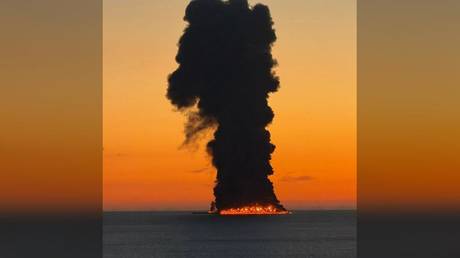
The tanker—a behemoth laden with millions of barrels of crude—did not just catch fire. It exhaled. A wall of orange heat raced across the white-capped swells, instantly turning the immediate stretch of the sea into a crucible.
Fire on water defies human logic. We are conditioned to trust the ocean as a universal extinguisher, a vast and ancient sink for our mistakes and our violence. Yet here was an island of liquid fire bobbing defiantly on the surface, feeding on the very commodity designed to power human civilization thousands of miles away.
Mikhail scrambled onto the listing deck, his lungs instantly filling with the acrid, greasy smoke of burning petrochemicals. The world had narrowed to three things: the scream of the general alarm, the sickening tilt of the hull as seawater rushed into the damaged starboard ballast, and the fierce, roaring appetite of the flames chewing through the superstructure.
At that moment, abstract geopolitical tensions ceased to exist. They evaporated in the searing heat. The billions of dollars in cargo, the complex web of international sanctions, the tense tactical calculus of modern maritime warfare—none of it mattered to the men coughing up soot near the emergency lifeboats. Survival was physical. It was the frantic fumbling with cold metal latches, the desperate shouts over the roar of the fire, the sheer primal terror of the dark water waiting below.
How did we arrive at a reality where commercial vessels double as frontline combat zones?
The answer lies in the quiet evolution of modern naval architecture and asymmetric warfare. For decades, the theater of conflict was defined by steel-clad dreadnoughts and supersonic jets. Sea power was measured in tonnage, gun calibers, and carrier strike groups. But technology has a way of democratizing destruction. When multi-million-dollar warships are too valuable to risk carelessly, innovation looks downward. It looks at the water.
Remote-controlled surface vessels—essentially explosive-laden jet skis guided by satellite telemetry and artificial intelligence vision systems—have fundamentally altered the geography of the sea. They are cheap to build, difficult to spot against the clutter of whitecaps, and utterly devoid of self-preservation. They do not get tired. They do not hesitate. They slip through the black water like ghosts, turning civilian and commercial logistics into collateral damage in a shadow war fought far from traditional battlefields.
The Black Sea has become the proving ground for this new geometry of fear.
Every barrel of oil moved across these waters now travels with an invisible asterisk. Behind every routine export statistic reported on financial tickers lies the nervous sweat of sailors who check the radar screens twice, who listen too closely to the night wind, and who wonder if the blip on the horizon is a dolphin or a death sentence.
Back on the deck, Mikhail coordinated the evacuation with the practiced calm of a man who had stared down lesser crises for decades. The crew was small, skeletal even, kept lean by modern cost-cutting and automated systems. Every hand counted. When the final lifeboat dropped into the swell, smelling of diesel and salt spray, Mikhail looked back at his ship one last time.
The massive hull, once a proud monument to industrial might, was now a smoking torch casting long, trembling shadows across the waves. It was a surreal monument to our current age: a civilization that extracts the lifeblood of ancient eras from the earth only to watch it burn beneath the indifferent stars.
The sun would rise in a few hours over the Russian coast. It would reveal a slick of black oil staining the turquoise expanse, a trail of debris, and the empty, echoing horizon where a floating city used to be. The news reports would follow soon after—dry, clinical summaries of tonnage, coordinates, and attribution claims.
They would talk about supply chains, market volatility, and tactical escalation. They would use sanitized language to describe a catastrophe.
But out there on the water, long after the cameras turned away and the stock markets adjusted to the morning bell, the salt still tasted like fuel, and the sea still remembered the night it burned.