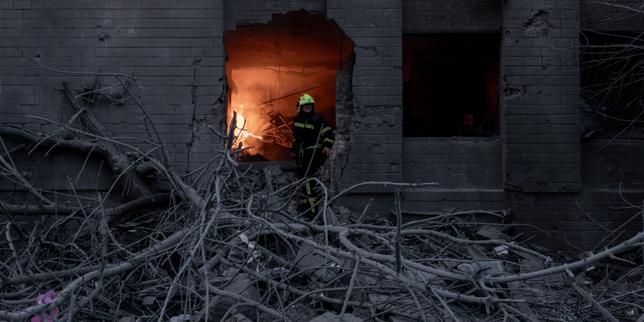
The silence of a sleeping city is never truly silent. It is a rhythmic, breathing thing made of distant traffic, the hum of refrigerators, and the soft rustle of wind through chestnut trees. In Kyiv, that silence has become a fragile commodity, a borrowed luxury that everyone knows can be snatched away at any moment.
At 3:00 AM, the air changed. Before the sirens even began their mournful climb, there was a vibration in the marrow. It was the heavy, low-frequency pulse of metal wings crossing the horizon. Then came the sirens. They do not just sound; they scream a warning that has become the grim lullaby of a generation.
Windows rattled. The sky, which should have been a velvet canvas of stars, transformed into a strobe light of orange flashes and white-hot streaks. This was not a localized event. This was a "vast attack," a phrase that looks clinical on a news ticker but feels like the end of the world when you are crouching in a hallway between two load-bearing walls.
The Mathematics of Survival
In the official reports, the numbers are stark. One dead. Sixteen wounded. Over Kyiv alone, the air defense systems were forced into a desperate, high-stakes dance with dozens of incoming projectiles. But numbers are a poor container for the reality of a Tuesday night in a residential neighborhood.
Consider a woman we will call Olena. She is not a statistic yet. She is a schoolteacher who has learned to sleep with her shoes on and a "go-bag" by the door. When the first explosion shook the glass in her frames, she didn't check the news. She checked the breathing of her seven-year-old son.
The strategy behind these strikes is often described as "strategic degradation." In plain English, it means trying to break the spirit of a city by making the act of existing an endurance test. The missiles target infrastructure, yes, but they also target the human nervous system. When sixteen people are wounded, hundreds of others are scarred by the proximity of the blast, the smell of ozone and burning rubber, and the terrifying realization that their living room is no longer a sanctuary.
The Invisible Shield
High above the Dnieper River, the technology of interception meets the physics of gravity. We often hear about the success rates of air defense—80%, 90%, sometimes nearly total. These are remarkable figures. Without them, the death toll would not be one; it would be hundreds.
However, there is a physical reality that often goes unmentioned in the brief dispatches. What goes up must come down. Even a "successful" interception involves a collision of massive kinetic energy. When a missile is neutralized, it doesn't simply vanish into a cloud of glitter. It becomes tons of falling debris. It becomes jagged shards of hot casing and unspent fuel rain-falling onto playgrounds, parked cars, and rooftops.
This is the hidden cost of protection. The very act of saving the city creates a secondary hazard. It is a cruel irony that the shield itself can sometimes cause the injury it was meant to prevent. The sixteen wounded on this particular night were victims of this chaotic physics—shrapnel through a window, a fire ignited by a falling battery, a roof caving under the weight of a downed engine.
The Weight of One
The news reports will move on quickly. By tomorrow, the "vast attack" will be a footnote, replaced by the next headline or the next volley. But for the family of the one person who did not survive, the world stopped at 3:00 AM.
Grief in a war zone is a strange, compressed experience. There is no time for the long, slow mourning that peace allows. Instead, you sweep up the glass. You cover the shattered window with plywood. You buy more water. You keep going because the alternative is to be swallowed by the shadow of the next siren.
The death of a single individual in a city of millions might seem like a statistical anomaly to a distant observer. But to those on the ground, that one life is the ultimate proof of the randomness of this violence. It wasn't a military target. It wasn't a decision-making center. It was a person who happened to be in the wrong square meter of a massive city when a piece of metal decided to return to earth.
A City That Refuses to Dim
As the sun began to rise over the golden domes of Kyiv, the smoke from the impacts started to thin. You could hear the sound of brooms on pavement. It is the most defiant sound in the world—the scratch-scratch-scratch of residents reclaiming their streets from the wreckage.
Coffee shops opened. People stood in line for lattes while the smell of smoke still hung in the damp morning air. They checked their phones, not for entertainment, but to see which metro stations were back in service and which friends had marked themselves "safe."
The psychological toll of these nights is cumulative. It builds like silt at the bottom of a river, weighing down the psyche. Yet, there is a strange, grim resilience that emerges. When you live in a place where the sky can fall at any moment, you stop taking the sky for granted. You find a deeper intensity in the mundane. A morning cup of tea becomes a victory. A commute to work becomes an act of resistance.
The "vast attack" failed in its primary, unspoken goal. It killed, it maimed, and it destroyed property, but it did not achieve the silence it sought. The city is loud again. The traffic is moving. The children are going to school, some of them rubbing eyes that saw too much fire before dawn.
Somewhere in a darkened room, a technician is likely reloading a launch rack, calculating coordinates for the next attempt to dim the lights of this city. And somewhere in a kitchen with a boarded-up window, Olena is packing a lunchbox, making sure the crusts are cut off just the way her son likes them.
The stakes are not just territory or power grids. The stakes are the right to sleep through the night and the right to wake up to a world that makes sense. Until that happens, the people of Kyiv will continue to live in the gaps between the sirens, proving every day that a city is made of more than brick and mortar. It is made of the stubborn, quiet refusal to be broken by the dark.