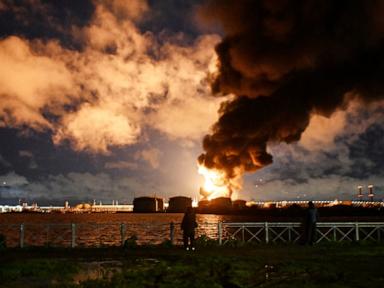
The air before a dawn strike tastes like copper and unburned fuel. You do not hear the drones at first. You feel them. A low, rhythmic tremor in the sternum, like a distant engine idling beneath the floorboards of an old house. Then comes the sound—a high-pitched, angry lawnmower buzz that has become the terrible soundtrack of a modern sky.
Imagine standing on a cold ridge overlooking a sprawling industrial horizon, watching the dark canvas tear open.
Over a thousand times in a single span of hours, that canvas tore.
This was not a skirmish. This was an industrial-scale orchestration of precision and desperation, a swarm of more than one thousand unmanned aerial vehicles launched across the dark to rewrite the geometry of a prolonged war. And when they reached their destination—a major oil terminal nestled deep within the adversary's territory—the night turned into a false, roaring noon.
To understand why a thousand small, buzzing machines matter more than a fleet of million-dollar cruise missiles, you have to look at the economics of modern survival. A missile is an aristocrat of war: exclusive, fiercely expensive, and finite. A drone is a foot soldier of the digital age: cheap, mass-produced, and terrifyingly expendable. When you send one missile, an air defense battery smiles. When you send a thousand drones simultaneously, you saturate the nervous system of the radar operators. You flood the switchboards. You force a defending nation into an impossible calculus of ammunition allocation, where intercepting a low-cost drone with a high-cost surface-to-air missile is a financial bleed-out disguised as a tactical victory.
The targets weren't chosen at random. They were chosen where it hurts most: the blood-pumping arteries of an empire's economy.
Oil terminals are fragile beasts. They look formidable from a distance with their titanic cylindrical tanks and snaking webs of steel pipe, but they are essentially giant containers of combustible potential. When a drone carrying a shaped explosive charge connects with a terminal, the ensuing fireball is not merely a tactical victory; it is a profound psychological shockwave. It carries a message whispered in orange flame and thick, black smoke: the sanctuary is gone. The distance that separates the front lines from the comfortable, coffee-scented living rooms of the interior has been compressed into nothingness by fiberglass wings and lithium batteries.
For months, the narrative of the conflict had settled into a grinding, muddy stalemate of trenches and artillery duels, a 20th-century war fought with 21st-century casualties. Analysts talked of attrition rates, supply lines, and artillery shell deficits. But capability evolves when survival demands it. The shift from defending trenches to striking economic centers represents a fundamental philosophy change. If you cannot push the invader back from your front yard, you make the cost of staying in your house unbearable.
Consider the human cost behind the telemetry data.
Thousands of miles away from the target, inside dimly lit rooms smelling of stale tobacco and cold coffee, operators stare into glowing monitors. Their fingers rest on mouse buttons, their eyes tracking green blights moving across topographical maps. These are not professional pilots sitting in air-conditioned hangars thousands of miles across an ocean; these are ordinary citizens, software engineers, mechanics, and university students who learned the lethal geometry of flight paths out of sheer necessity. They program coordinates with the quiet intensity of people writing a final will and testament, knowing that the machines they guide will either shatter an enemy's infrastructure or vanish into the static of electronic countermeasures.
When the strikes hit the oil terminal, the shock didn't just rattle storage tanks. It rippled through global markets, currency values, and quiet cabinet rooms in distant capitals. Energy markets are notoriously nervous beasts. A single column of black smoke rising over a refinery can cause futures traders in London and New York to choke on their morning tea, driving up prices at gas pumps for families who have never even looked at a map of Eastern Europe. War is no longer localized in the trenches; it is a global web where a severed wire in an industrial yard causes a flicker in a kitchen light half a world away.
There is a grim symmetry to it all. The defenders, outgunned in heavy artillery and mass armor, weaponized ingenuity. They turned hobbyist technology into strategic leverage. They proved that in the modern era, the line separating a commercial electronics store from an armory has been completely erased. You can buy the components on the open market, assemble them in a garage, and write code that directs them across international borders to reshape the map.
As the fires at the terminal burned for hours, casting an eerie, demonic glow over the surrounding countryside, the morning light finally broke through the acrid pall. It revealed a changed landscape. Not just of twisted steel and charred containment walls, but of a psychological threshold crossed.
The sky belongs to the swarm now. And the horizon will never look the same again.



