Red and Gold on the Asphalt
The heat didn't dissipate when the sun dipped below the horizon; it simply sank into the concrete, radiating upward through the thin soles of thousands of sneakers.
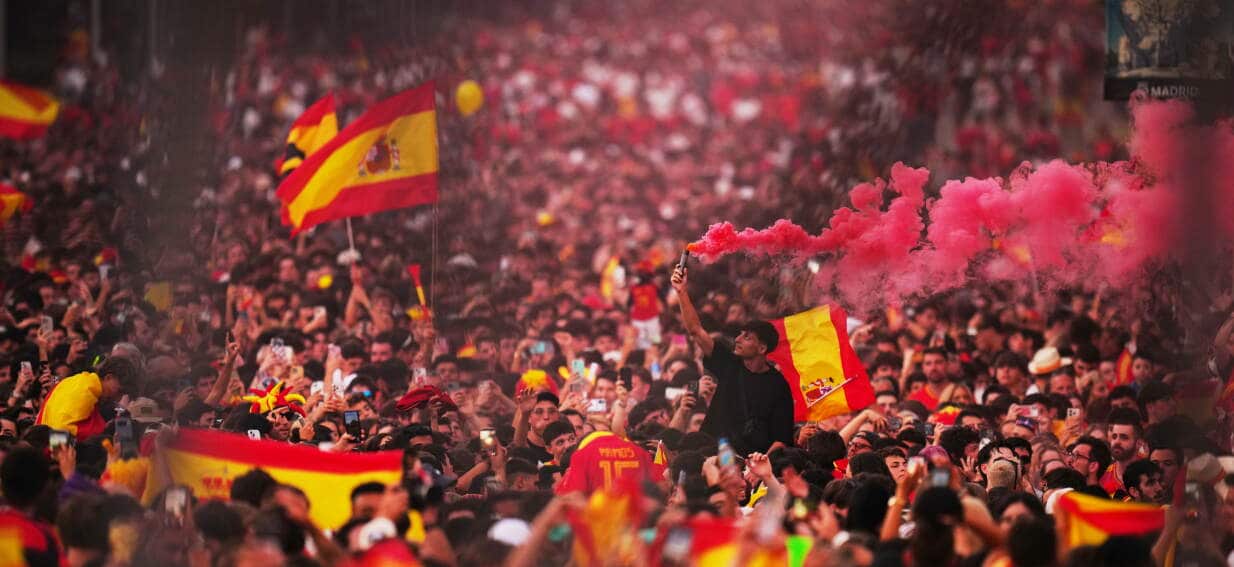
By six in the evening, Madrid’s Gran Vía wasn't a road anymore. It was an ocean. Crimson jerseys stretched from the Plaza de España all the way down to Cibeles, a thick, roaring tide of people standing shoulder to shoulder under a sun that refused to give up the sky. Drums echoed off the limestone facades of early twentieth-century buildings. Horns blared. Confetti, trapped in the thermal drafts above the avenue, hovered like brilliant, unnatural snow.
If you stood in the middle of that crowd, you felt the air vibration in your chest long before you heard the approaching bus. It was the low, thunderous reverberation of tens of thousands of voices singing the same melody, completely out of key, completely unbothered.
Spain had won the world. Again.
They call these moments celebrations, but that word is far too polite. What happened on the streets of Madrid was a collective catharsis, a national exhalation after weeks of breathless tension. A young boy sat precariously on his father’s shoulders, his face painted with two bright red bars and a yellow stripe across his nose, clutching a plastic replica of the trophy like a sacred relic. Beside them, an elderly woman in her late seventies, wearing a pristine national team scarf wrapped tight despite the oppressive heat, clapped her frail hands until her palms turned pink.
This was not merely about twenty-three athletes kicking a leather sphere across a patch of grass in a distant stadium. It was about what happens to a country when millions of strangers suddenly realize they are all weeping over the exact same thing.
The Protocol of Joy
Inside the Zarzuela Palace, the atmosphere was entirely different, yet driven by the same pulse.
There is an inherent awkwardness when royalty meets world champions. Protocol dictates composure, measured smiles, and firm, dignified handshakes. But formal attire offers very little defense against the sheer, unbridled energy of men who spent the last month running themselves into the dirt for ninety minutes at a time.
King Felipe VI stood alongside Queen Letizia and their daughters, awaiting the arrival of the squad. When the players finally filed into the grand reception hall, dressed in matching dark navy blazers that looked far too restrictive for men accustomed to lightweight jersey mesh, the stiffness dissolved almost instantly.
The trophy—that heavy, gleaming gold statuette designed by Silvio Gazzaniga—was passed into the King's hands. He held it not as a monarch receiving a tribute, but with the genuine, unscripted awe of a supporter who had watched every agonizing minute from his living room.
Consider the contrast: on one hand, centuries of royal tradition, marble arches, and strictly rehearsed diplomatic decorum; on the other, a group of young men from working-class neighborhoods in Basque Country, Andalusia, and Catalonia who had spent the previous forty-eight hours living on zero sleep and sheer adrenaline.
Captain Andrés Iniesta—or whoever wore the armband on that historic evening—stood beside the monarch, his eyes heavy with exhaustion, his smile wide and incredulous. For a brief hour, the palace wasn't a seat of state power. It was just another living room where people were talking about football.
"Thank you for giving Spain its pride back," the King remarked, his voice carrying through the acoustic chamber of the hall. It was a simple phrase, stripped of political posturing. In a nation often fractured by regional identities, fierce local rivalries, and economic anxieties, those eight words landed with heavy weight.
The Invisible Stakes
To understand why a million people filled the streets, you have to look beyond the scoreboard.
Football in Spain is not a pastime; it is a shared language. It is how grandfathers speak to their grandsons when words fail them. It is the noise spilling out of neighborhood tapas bars on Sunday evenings, the clinking of beer glasses, the frantic gesturing over a missed offside call.
When a national team goes to the World Cup, they carry an absurdly unfair burden. They carry the frustrations of a populace that has endured years of political squabbling, high unemployment rates, and social division. For ninety minutes at a time, the green pitch becomes an arena where national self-doubt goes to die.
During the tournament, every match felt like a high-wire act without a net. A single missed penalty, an unlucky deflated bounce, or a fraction-of-a-second delay in a tackle could turn national heroics into national mourning. The players knew this. You could see it in their eyes during the national anthems before kickoff—the tight jaws, the intense eyes staring into the distance, the heavy breathing before the referee blew the whistle.
They weren't just playing for personal glory or lucrative club contracts. They were playing to give thirty-five million people a reason to feel unburdened, if only for a single weekend.
The psychological pressure is almost impossible to quantify. A mistake on that stage isn't forgotten in a week; it is etched into the collective memory of an entire culture for generations. Yet, match after match, this group navigated the pressure with a calm, almost clinical grace. They passed the ball through tiny gaps, held their line against ferocious counter-attacks, and refused to break when the pressure reached a boiling point.
The Slow Crawl Through Madrid
By nine at night, the open-top bus carrying the squad began its agonizingly slow crawl toward the Plaza de Cibeles.
The bus moved at a walking pace, surrounded by a heavy escort of mounted police whose horses looked tiny amidst the human tide. Players hung over the railings of the top deck, spraying champagne into the air, waving flags, and taking turns hoisting the golden trophy into the night sky every time the crowd roared.
The air smelled of pyrotechnics, beer, and sweat. Red smoke flares illuminated the night, casting an eerie, magnificent glow over the stone goddess Cibeles sitting in her chariot.
Every time a player lifted the trophy, a fresh wave of noise rippled through the avenue, bouncing off the glass facades of the skyscrapers. It was deafening. It was disorienting. It was beautiful.
One player, draped in the regional flag of his hometown, held a microphone and began chanting a improvised song that made no grammatical sense but had fifty thousand people shouting back every word in unison. Another sat quietly at the back of the bus, holding a bottle of water, watching the sea of faces below him with an expression of quiet disbelief.
He looked overwhelmed. Who wouldn't be? How do you process the fact that your ability to kick a ball into a net has brought an entire metropolis to a complete, ecstatic standstill?
What Remains When the Smoke Clears
By three in the morning, the bus had long since departed, and the grand speeches were over.
Street sweepers in neon-yellow vests began their slow, inevitable march down the Gran Vía, pushing mountains of red and yellow paper confetti, crushed aluminum cans, and discarded plastic flags into neat piles. The heavy silence of the early hours began to reclaim the city.
In a small plaza three blocks away from the main thoroughfare, two teenage boys were still playing with a scuffed, half-deflated leather ball under the dim yellow light of a streetlamp. One of them pulled his shirt over his head, mimicking the goal celebration he had watched on a massive screen hours earlier, while the other dived across the damp cobblestones to make a pretend save.
The trophies will eventually be placed in locked glass display cases inside museum halls. The red carpet at the royal palace will be vacuumed, and the political leaders will return to their daily squabbles. The heat will remain, as heavy and relentless as ever.
But for one night, an entire nation put aside its differences, packed into the streets, and looked up at a group of young men in red shirts with absolute, unadulterated wonder. They were kings of the world, if only for a moment, and they brought everyone else along for the ride.