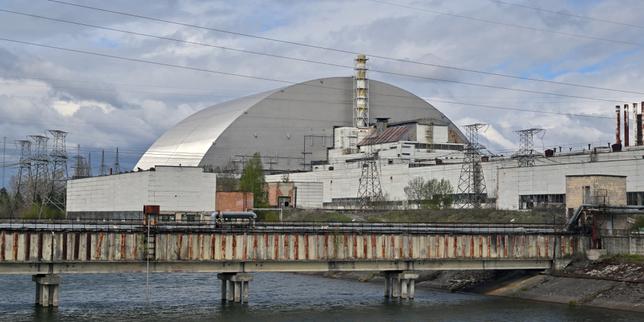
The silence around the Exclusion Zone is not the peaceful quiet of a sleeping forest. It is heavy. It is a stillness bought and paid for by the sweat of hundreds of thousands of liquidators who, forty years ago, buried a monster under layers of concrete and steel. If you stand near the perimeter on a cold night, the only sound you expect to hear is the wind whistling through the pines of the Red Forest.
Then comes the whine.
It is a high-pitched, mechanical buzz, like a swarm of angry hornets magnified a thousand times. It is the sound of a Shahed drone, a low-cost, low-tech weapon of terror, cutting through the freezing air. This time, the target wasn’t a power grid in Kyiv or a residential block in Kharkiv. The explosions tore through the dark just miles from the Chernobyl nuclear containment site.
In an instant, the fragile peace of the zone shattered.
The Precision of Cowardice
The facts of the strike are straightforward, standard fare for a wartime press briefing. A wave of Russian loitering munitions targeted the infrastructure surrounding the world’s most infamous nuclear wasteland. Ukrainian air defenses scrambled, detonations echoed across the restricted territory, and Volodymyr Zelensky quickly took to the airwaves, his face lined with the exhaustion of a thousand sleepless nights, to brand the attack an act of "absolute cowardice."
But to understand the true weight of those words, you have to look past the political theater and the sanitized body counts of the morning news cycle. You have to look at what it means to drop explosives next to a sleeping dragon.
Imagine a specialized technician—we will call him Oleksandr. He is a real type of man, one of the unsung engineers who still clocks into the Chernobyl plant every day. His job is not to produce electricity; the plant hasn't done that for decades. His job is maintenance. He monitors radiation levels, checks the integrity of the New Safe Confinement structure, and ensures the cooling systems for spent nuclear fuel remain functional.
When the drones strike, Oleksandr does not just hear the blast. He feels it in his teeth.
For men like Oleksandr, an attack here is a visceral violation. The world treats Chernobyl as a historical museum, a cautionary tale from the late Cold War. For Ukrainians, it is an open wound that requires constant, meticulous medical attention. When Russian forces cut the power lines to the grid or drop ordnance near the reactors, they are pulling at the stitches of that wound.
Playing Roulette with the Unseen
The danger of firing weapons near a defunct nuclear plant is rarely about a Hollywood-style atomic explosion. Reactors do not detonate like nuclear warheads. The real threat is far more insidious, governed by the laws of physics and engineering rather than cinematic drama.
To keep highly radioactive material safe, you need constant, uninterrupted power. The spent fuel pools, which house the remnants of Chernobyl’s past operations, must be kept cool. The formula is unforgiving:
$$\text{Decay Heat} \propto t^{-\alpha}$$
Even decades after a reactor shuts down, the radioactive isotopes continue to decay, generating heat. If the pumps stop because a drone severed the power lines, that water evaporates. If the water evaporates, the fuel rods exposed to the air can catch fire, releasing a plume of cesium-137 and strontium-90 into the upper atmosphere.
From there, the wind takes over. A radioactive cloud knows nothing of borders, frontline trenches, or geopolitical alliances.
This is the invisible stake of the conflict. By launching strikes within striking distance of the exclusion zone, the Kremlin leverages the global trauma of 1986 as a psychological cudgel. It is blackmail wrapped in the plausible deniability of a stray drone. They do not need to hit the reactor directly to achieve their goal; they only need to remind the world that they could.
The Human Shield of Concrete
There is a profound irony in using advanced, 21st-century drone technology to threaten a monument to 20th-century Soviet incompetence. The New Safe Confinement structure—the massive, silver arch that spans the ruins of Reactor No. 4—is a marvel of modern engineering. It was built with international funding, designed to last a century, and engineered to withstand tornadoes and earthquakes.
It was not, however, designed to be a shield in an artillery duel.
During the initial invasion, Russian troops dug trenches in the highly radioactive soil of the Red Forest, kicking up dust that had lain undisturbed for a generation. Now, they send automated suicide drones to buzz the perimeter. It reveals a terrifying shift in the psychology of modern warfare: the normalization of ecological and radiological terror.
Consider the psychological toll on the crews working the shifts at the plant. They are already working under the stress of an ongoing occupation of their country, isolated from their families, operating on shoestring budgets. Now, they must perform highly precise, hazardous tasks while listening for the telltale hum of an incoming strike.
One mistake, one severed wire, one panicked miscalculation by an exhausted technician, and the containment protocols fail.
The Echo Across Europe
When Zelensky used the word "cowardice," he wasn't just throwing insults at Moscow. He was pointing out the asymmetry of the threat. It requires immense resources, heroism, and international cooperation to keep Chernobyl safe. It requires only a few thousand dollars and a GPS coordinate for a drone to threaten that safety.
The international community often reacts to these events with a predictable rhythm of statements expressing "deep concern." But concern does not patch a punctured cooling line. It does not calm the nerves of the men and women standing guard over the waste.
We have grown numb to the statistics of this war. The millions of displaced, the thousands of missiles, the endless lines on maps that shift by mere meters each week. But the strike near Chernobyl is a sharp needle prick to that numbness. It reminds us that some consequences are permanent.
The ghosts of Chernobyl do not stay in the zone. If released, they travel on the breeze, settling in the soil of European farms, in the milk of cows hundreds of miles away, and in the bones of children yet unborn.
As the sun rose over the exclusion zone the morning after the strike, smoke curled from a charred patch of forest not far from the concrete tracks of the railway line. The drone had missed the critical infrastructure this time. The air defense systems had done their job. The monitors showed the radiation levels remained within the normal, albeit elevated, baseline of the zone.
Oleksandr finished his shift, packed his gear, and looked out over the massive silver arch glinting in the pale morning light. The dragon was still asleep. But the sky above it remained wide open, empty, and waiting for the next hum in the dark.