The air inside a packed arena has its own weight. It smells of spilled beer, stale popcorn, and the collective sweat of twenty thousand people waiting for a secular miracle. For decades, a Bruce Springsteen concert has been a reliable ritual of American optimism. You buy the ticket, you squeeze into the arena, and for three hours, you forget the mortgage, the bad knees, and the fracturing world outside. You let the wall of sound wash over you.
But on a damp night in Washington, D.C., the ritual broke.
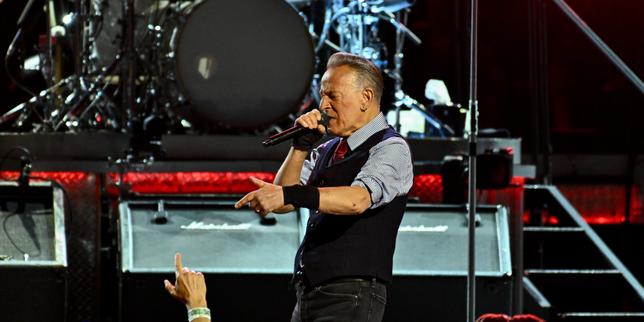
The guitars didn't fade out so much as they froze. The house lights stayed low, casting a stark, amber glow across the stage. Springsteen stepped away from the microphone, paused, and looked out at the sea of faces. The usual stadium roar softened into an uneasy murmur. This wasn't the setup for a high-octane anthem. This felt like a reckoning. When he spoke, the gravel in his voice wasn't from singing; it was from a deep, heavy anger.
He didn't offer a polite political critique. He delivered an indictment.
To understand why a rock star’s words in a capital arena mattered so much, you have to look past the headlines that popped up the next morning. The standard news reports listed the adjectives like a grocery list of outrage: dangerous, racist, incompetent, a traitor. But those words, stripped of the room's energy, miss the entire point. The real story wasn't just what was said. It was the terrifying, beautiful friction of a cultural icon tearing down the safety wall of entertainment to force a mirror in front of his audience.
The Weight of the Microphone
Music is a soft weapon. Usually, it heals. It bridges the gap between people who would otherwise vote against each other’s existence. At any given Springsteen show, you have union factory workers rubbing shoulders with corporate lawyers, united by a shared mythology of the American highway. It is a fragile peace, built on the unwritten rule that we don't talk about the ugly stuff while the band is playing.
Springsteen shattered that rule into pieces.
By labeling Donald Trump not just an opponent, but a fundamental threat to the American experiment, he wasn't trying to win a debate. He was performing an exorcism of complacency. Consider the specific choice of words. "Incompetent" stings a politician, but "traitor" cuts to the bone of national identity. It is a word heavy with historical ghosts.
When a performer uses that vocabulary within spitting distance of the Capitol building, the geography changes the meaning. The stage stops being a platform for entertainment. It becomes a witness stand.
The reaction in the crowd was instantaneous and fractured. A collective gasp, followed by a wave of furious cheers, laced with the sharp hiss of boos from sections of the arena where the mythology had suddenly clashed with personal politics. You could see people visibly stiffen. Some crossed their arms, suddenly feeling isolated in a crowd they had felt a part of just moments prior. Others wept.
This is the hidden cost of speaking truth in a divided room. You risk breaking the very community you spent fifty years building.
When the Myth Meets the Reality
For half a century, Springsteen has been the poet laureate of the American struggle. He wrote about the deindustrialized towns, the ghosts of veterans, the desperate choices of people left behind by progress. Ironically, many of the people who populated his songs—the forgotten working class—are the exact demographic that propelled Trump to power.
That is the knot at the center of this confrontation.
Springsteen was not attacking an abstract ideology; he was challenging a choice made by many of his own disciples. It was a moment of profound vulnerability for an artist. He had to know that by speaking so bluntly, some people would walk out, demand refunds, or burn their vinyl records. Yet, he chose the demolition of his own universal appeal over the comfort of silence.
Imagine the internal calculus. You are in the autumn of your career. You have nothing left to prove, no money left to make, and a legacy secured in the halls of rock history. You could easily coast on nostalgia, playing the hits, letting everyone leave happy. Instead, you choose to make yourself a target.
The anger directed at Trump was rooted in a sense of profound betrayal. For an artist who viewed the American promise as something sacred—almost biblical—the rhetoric and actions of the administration weren't just bad policy. They were a defilement of the temple.
The Echoes in the Dark
The music eventually started up again, but the atmosphere had permanently shifted. The songs that followed felt darker, stripped of their easy triumph. "Born to Run" wasn't a celebratory escape anymore; it felt like a desperate plea for survival.
Critics will say that musicians should stick to music. They will argue that a stage is not a pulpit, and that paying customers don't want a lecture on morality from a millionaire rock star. It is an old, tired argument, designed to keep art safe and castrated.
But true art has never been safe.
The night in Washington proved that the dividing lines in modern society are now so deep that they cannot be paused for an evening of entertainment. The arena didn't offer an escape from the political storm; the storm simply breached the walls and flooded the floor.
When the final notes died out and the crowd spilled into the cold Washington night, the silence was different. People didn't walk out humming the choruses. They walked out talking, arguing, and staring at the illuminated dome of the Capitol in the distance, suddenly aware of how fragile everything truly is. The singer had done his job, not by making them feel good, but by making it impossible for them to remain numb.