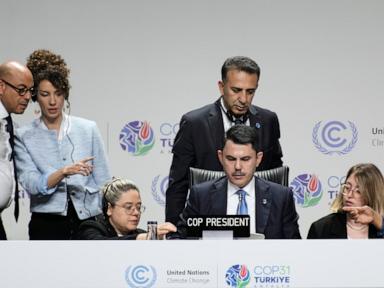
At 3:14 in the morning, the fluorescent lights inside a windowless conference hall begin to hum at a frequency that drills straight into the base of your skull.
You have been awake for thirty-two hours. Your shirt smells like stale espresso, recycled air, and the peculiar, sour sweat of panic. Around a horseshoe table the size of a tennis court, two hundred delegates are arguing over a single verb.
Not a policy. Not a rescue plan. A verb.
Should the final text say nations will phase out fossil fuels, or merely transition away from them? Does the comma go before the clause about climate finance, or after? If a trillion dollars is promised to the nations currently drowning, who holds the pen on the check, and when does the ink dry?
Outside that hall, the planet does not read legal drafts. It does not care about diplomatic syntax.
When a United Nations climate conference collapses without a deal—when the gavel finally falls on an exhausted stalemate over fossil fuels and money—the headlines treat it like a sporting event that ended in a dull tie. Talks stall. Nations clash. Gridlock in the plenary. You read it over breakfast, feel a familiar, heavy thud of cynicism in your chest, and scroll to the next story.
That reaction is completely understandable. Honestly, it is the only sane defense mechanism left when the people tasked with saving the house cannot even agree on who should buy the fire extinguisher.
Yet to understand what actually happens when these talks fail, we have to leave the fluorescent glare of the negotiating room and walk down a dirt road that is slowly turning into salt water.
The Arithmetic of a Rising Tide
Consider a hypothetical scenario, grounded entirely in the hydrology reports sitting unread on those conference tables.
Meet Elena. She is fifty-four years old, lives in a low-lying coastal district in the Bay of Bengal, and grows rice on four acres her grandfather cleared by hand. For forty years, Elena knew the monsoon the way a musician knows a favorite song. She knew the smell of the dust ten minutes before the first fat drops hit the tin roof. She knew which week to plant and which week to harvest.
Now, the song is broken.
The cyclones arrive out of season, heavier and slower, lingering over her fields like a bruised thumb pressed into soft fruit. Worse than the storms is the quiet invasion from beneath. As global temperatures climb—driven overwhelmingly by the burning of coal, oil, and gas—the ocean expands and ice sheets bleed into the sea. Salt water pushes miles inland through the groundwater, poisoning the roots of Elena’s rice before the stalks even reach her knees.
Elena does not need a diplomat to explain what "1.5 degrees Celsius above pre-industrial levels" means. She can taste it in her well water.
When negotiators gather at a UN climate summit, the core conflict is brutally simple, even when buried under ten thousand pages of bureaucratic jargon. To stop Elena’s well from turning to brine, the world has to stop burning fossil fuels at the speed we currently burn them. And to help Elena survive the damage already locked into the atmosphere, wealthy nations—the ones that built their railroads, factories, and skyscrapers by burning coal and oil for two centuries—have to help pay for seawalls, drought-resistant seeds, and clean power grids in countries that barely contributed to the problem.
Fossil fuels and finance. The match and the bucket of water.
Every time a summit ends without a binding agreement on those two pillars, the clock does not pause until next year’s meeting. Physics does not grant extensions.
Inside the Greenhouse of Egos
I have spent enough nights pacing the corridors of these summits to know that the people inside are rarely cartoon villains. Most of the junior delegates are brilliant, sleep-deprived twenty-somethings who genuinely want to save the world. They survive on vending-machine crackers and sheer terror for their own futures.
The rot happens higher up the chain, where national survival collides with short-term political terror.
Think of the global atmosphere as a shared apartment with a single, wildly expensive utility bill. For a hundred and fifty years, three or four roommates threw lavish parties, cranked the heat to ninety degrees, and left every light blazing. Now the bill has arrived, the wiring is sparking, and the landlord says the building will burn down unless everyone cuts their power usage tomorrow.
The roommates who threw the parties say, Fine, we should all turn down the thermostat.
The roommates who spent a century sitting in the dark—nations across Africa, South Asia, and Latin America—look at the wealthy roommates and ask a fair question: You got rich while running the air conditioner. We still don't have electricity in half our hospitals. If you want us to skip coal and go straight to solar, you need to help us pay for the panels. And you need to pay to fix the roof you broke.
Meanwhile, a third group of roommates—nations whose entire national budgets depend on pumping oil and gas out of the ground—quietly slip into the hallway and try to unscrew the thermostat from the wall.
This is why the language becomes so tortured. In UN climate negotiations, decisions require consensus. Not a majority. Consensus. One nation can hold a room of two hundred hostage until the coffee runs out and the flights home are missed.
So words get watered down. Eliminate becomes abate. Billions in grants becomes mobilizing financial flows. A promise to pay becomes an invitation to consider discussing a framework for future voluntary contributions.
It feels absurd. It is absurd. Watching grown men in tailored suits haggle over an adverb while glaciers collapse into the sea is enough to make anyone want to throw their phone into a river.
The Invisible Price Tag of Delay
Why does the money fight get so ugly? Because when politicians hear "climate finance," they hear "foreign aid," and foreign aid is poison at the ballot box.
Try explaining to a factory worker in Ohio or a baker in Lyon—people already squeezed by grocery prices and rent—why their government should send billions of dollars overseas to build wind farms in Indonesia or flood barriers in Mozambique. If you frame it as charity, you lose the argument before you finish the sentence.
But it isn't charity. It is fire insurance on a house where we all share the same roof.
Let’s trace the dominoes when climate finance stalls. Suppose a developing nation wants to retire three aging coal plants and replace them with solar arrays and battery storage. Because global financial markets view developing economies as "risky," borrowing money to build that solar farm costs three or four times more in interest than it does in Germany or California.
Without concessional finance—low-interest loans and direct grants from wealthy nations—the math simply doesn't work. The developing nation cannot afford the clean option. So it keeps burning coal. Or it digs up new gas fields to keep the lights on for its growing cities.
And where does the carbon dioxide from that coal plant go? Does it politely hover above the border of the country that burned it?
No. Within weeks, it mixes uniformly into the Earth’s atmosphere. It traps heat over Kansas. It dries out the soil in Spain. It fuels the atmospheric rivers that wash away highways in California and flood basements in central Europe.
When wealthy countries balk at putting real, guaranteed money on the table at a UN climate conference, they aren't saving taxpayers money. They are merely trading a predictable, manageable investment today for catastrophic, uninsurable disaster bills tomorrow.
We are already paying that bill. You see it every time your homeowners' insurance premium jumps forty percent, or when an insurer pulls out of your state entirely. You see it in the price of olive oil after a Spanish drought, or coffee after a Brazilian heatwave, or cocoa after West African rains fail.
The stalemate in the conference hall shows up six months later on your grocery receipt.
The Lie We Tell Ourselves About "Transition"
The other half of the collapse—the battle over fossil fuels—rests on a polite fiction that has dominated energy politics for twenty years.
The fiction goes like this: we can keep expanding oil and gas production indefinitely, so long as we add enough wind turbines and solar panels on top of it.
Energy historians have a blunt reality check for that idea. In the entire history of human civilization, we have never actually executed an energy transition. We have only ever executed energy additions. When we discovered coal, we didn't stop burning wood; we burned more wood than ever while adding coal on top. When we discovered oil, we didn't stop burning coal; we burned more coal than ever while adding oil.
Today, renewable energy is growing at a breathtaking speed. Solar power is now the cheapest electricity in human history in most of the world. Electric vehicles are reshaping auto manufacturing from Shanghai to Stuttgart.
Yet global fossil fuel consumption still hit record highs in recent years. Because without an explicit, managed plan to wind down oil, gas, and coal—complete with timelines, worker protections, and financing—clean energy merely feeds new demand while the old smokestacks keep roaring.
That is why the exact wording in a UN climate text triggers such ferocious trench warfare. Oil-producing states and fossil fuel lobbyists know that once the words phase out enter official international law, the clock starts ticking on trillions of dollars of unburned reserves still sitting underground. Banks begin re-evaluating risk. Pension funds start pulling out. The financial scaffolding that props up the fossil fuel industry begins to wobble.
So they fight every syllable. They argue for "carbon capture" technologies that currently remove a fraction of a percent of global emissions at enormous cost, treating a niche industrial tool like a magic eraser for the entire atmosphere. They warn of blackouts and economic collapse if we move too fast, conveniently ignoring the economic collapse already underway as heatwaves buckle rail lines, dry up shipping canals, and hospitalize outdoor workers.
What Happens When the Gavel Falls on Nothing?
So the conference ends. The exhausted delegates pack their rolling suitcases. Environmental groups issue furious press releases calling the outcome a betrayal. Ministers give solemn speeches at the airport expressing "deep disappointment" while promising to try harder next year.
Does that mean nothing changes?
Here is the paradox that makes climate politics so Maddeningly hard to read: the UN process is simultaneously essential and utterly insufficient.
When the talks fail to produce a strong deal, it does not stop engineers in Texas from installing record amounts of battery storage because the economics make sense. It does not stop farmers in Kenya from adopting solar-powered irrigation pumps because diesel has become too expensive. It does not stop mayors in coastal cities from tearing up asphalt to plant cooling urban forests.
The clean energy revolution has escaped the bottle. Market momentum, falling technology costs, and local survival instincts are driving change faster than diplomats can draft paragraphs about it.
What a failed UN summit destroys is speed and fairness.
Without a coordinated global deal, the rich nations will gradually electrify their grids, build higher seawalls, and air-condition their way through hotter summers, while the poorest nations—the Elenas of the world—are left to drown in debt and salt water. And because the atmosphere is one unified system, leaving half the world behind ensures that the climate crisis eventually circles back to overwhelm the rich nations anyway.
You cannot build a seawall high enough to stop a global food crisis. You cannot air-condition a wheat field.
The Weight of an Unwritten Sentence
Think back to that conference room at three in the morning.
Imagine what it actually takes to sit at that table if you represent a small island nation in the Pacific. Your entire country sits less than six feet above the ocean. Every time a high tide coincides with a storm surge, water bubbles up through the coral rock beneath your capital city, flooding schools and contaminating the freshwater lens that keeps your people alive.
You have traveled ten thousand miles to beg the largest economies on Earth to agree to a sentence that acknowledges your right not to be erased from the map.
Across the table sits a delegation twice the size of your entire foreign ministry, stalling over whether a billion-dollar fund should be finalized this year or studied by a committee until next autumn.
When the gavel finally drops on an empty compromise, the wealthy delegates go home to functioning power grids, paved roads, and deep sovereign credit lines. You go home to measure how many inches of beach disappeared while you were away.
We often talk about climate change as an environmental issue, as if it were about saving polar bears or preserving scenic national parks. That framing was always a mistake. The planet will survive. Rocks and oceans have endured far worse than us; in a few million years, the Earth will have scrubbed every trace of our highways and pipelines clean.
This fight is not about saving the planet. It is about whether human civilization remains recognizable, livable, and just for the children currently sitting in elementary school classrooms.
Inside those windowless halls, the delegates will eventually turn off the microphones, stack their unread drafts into recycling bins, and switch off the humming fluorescent lights. Outside, the tide will keep coming in, indifferent to the minutes of the meeting, testing the edges of every shore on Earth.