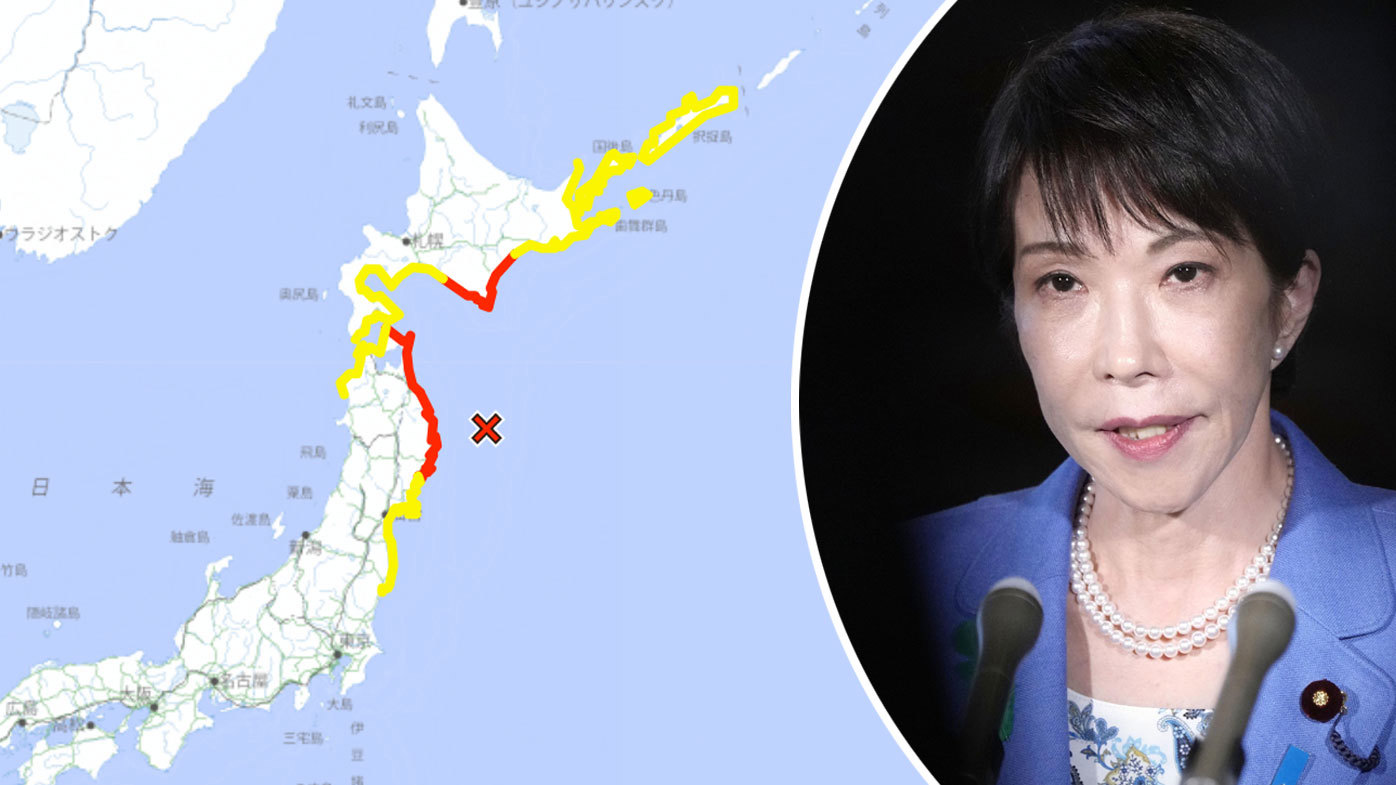
Japan’s bureaucracy just blinked. By issuing its first-ever "mega-quake" advisory, the government didn't just warn the public; it institutionalized a state of permanent anxiety based on a statistical house of cards. The "mega-quake" advisory is a masterpiece of political theater designed to mask a fundamental failure in urban planning and risk communication. While the media treats the Nankai Trough like a ticking time bomb with a visible countdown, the reality of seismic science is far more chaotic, messy, and indifferent to government press releases.
The Nankai Trough isn't a scheduled event. It is a complex subduction zone where the Philippine Sea Plate slides under the Amurian Plate. The "70% to 80% chance within 30 years" figure—tossed around by the Headquarters for Earthquake Research Promotion like gospel—is a product of a specific, highly debated time-dependent model. It assumes earthquakes follow a semi-regular, periodic rhythm. They don't. Geological records suggest these "cycles" are erratic at best and nonexistent at worst. By fixating on a specific "mega-quake," Japan is preparing for the last war while ignoring the guerrilla tactics of nature.
The Flawed Logic Of The Mega-Quake Advisory
The recent 7.1 magnitude quake off Kyushu triggered this advisory. The logic is that one "smaller" quake increases the probability of a massive one. Statistically, this is true in the same way that walking outside increases your chance of being hit by a car. The probability rises from "extremely low" to "slightly less low." Specifically, the chance of a follow-up mega-quake within a week of a magnitude 7 event is estimated at roughly 1 in hundreds.
Yet, the government’s response treated this 0.5% probability as a looming certainty. This is a classic case of availability bias. Because the 2011 Tohoku earthquake was preceded by foreshocks, officials are terrified of being blamed for silence. They have replaced scientific precision with "precautionary" noise. When you cry wolf for a 1-in-400 chance, you don't build resilience; you build fatigue. By the time the actual shift happens, the public will have tuned out the sirens.
The Myth Of Predictability
We need to kill the idea that we can "detect" a mega-quake in advance. Seismology is not meteorology. There are no clouds to track on radar. Despite decades of pouring billions into the DONET and S-net seafloor observation networks, we are no closer to a "prediction" than we were in the 1970s. These sensors are incredible for early warnings—giving people ten seconds to dive under a desk—but they are useless for forecasting.
The obsession with the Nankai Trough ignores the "unknown unknowns." The 1995 Kobe earthquake occurred on a previously mapped but underestimated fault. The 2011 Tohoku quake was significantly larger than what the "consensus" models predicted for that region. When we focus all our national dread on a single trough, we create blind spots. We ignore the inland active faults and the "smaller" 7.0 quakes that can level a city just as effectively as a 9.0 can wash away a coast.
Survival Is Not A Suitcase
The advice given during these advisories is laughably inadequate. "Check your emergency kit. Secure your furniture." This is the disaster-prep equivalent of telling a soldier to make sure his boots are polished before a carpet bombing.
If a magnitude 9.1 event occurs, the energy release is staggering. We are talking about $M_w$ (Moment Magnitude) where:
$$M_w = \frac{2}{3} \log_{10}(M_0) - 10.7$$
The $M_0$ (seismic moment) of a 9.0 is 32 times greater than an 8.0 and 1,000 times greater than a 7.0. No amount of "securing furniture" saves a wooden home built on liquefiable soil in a tsunami inundation zone.
The real conversation—the one the government is too cowardly to have—is about managed retreat. We shouldn't be "preparing" to live in high-risk coastal zones; we should be incentivizing the relocation of critical infrastructure and residential hubs to higher ground. Instead, we spend trillions on sea walls that provide a false sense of security until they are overtopped, as seen in 2011.
The Economic Sabotage of Anxiety
This advisory isn't just a safety warning; it’s an economic disruptor. It causes immediate spikes in panic buying, cancellations in the tourism sector, and supply chain jitters. For a country already battling a stagnant economy and a shrinking population, "official" fear-mongering has a real cost.
I have seen regional businesses lose weeks of revenue because of a "warning" that resulted in nothing but clear skies and quiet earth. When the government issues an advisory based on a 0.5% chance, they are effectively taxing the economy via anxiety. It is a liability-shielding exercise for bureaucrats, not a public service.
Infrastructure Is The Only Truth
Stop looking at the seismic charts and start looking at the building codes. Japan’s real strength isn't its advisory system; it's the Shin-Kensetsu (New Construction) standards. A 1981-or-later building is your best chance of survival. Everything else is secondary.
The focus should be on:
- Aggressive retrofitting: Instead of monitoring the seafloor, subsidize the immediate reinforcement of every pre-1981 structure in the Nankai impact zone.
- Autonomous utility grids: A mega-quake will sever the centralized power and water lines. Resilience isn't a stockpile of bottled water; it's decentralized solar and atmospheric water generators.
- Data-driven evacuation: We have the tech to model tsunami flow in real-time. We should be training AI to direct traffic via smartphones, not relying on 20th-century loudspeakers that no one can hear over the wind.
The Nankai Trough will eventually rupture. It might be tomorrow, or it might be in 2126. Nature doesn't care about your 30-year window. By treating it as an impending "event" that we can somehow anticipate through bureaucratic signals, we are lying to ourselves.
The advisory system is a placebo. It makes the public feel like the government has a handle on the tectonic plates. They don't. No one does. The only honest response to living in Japan is to accept that the ground is a temporary floor. Build for the worst, ignore the "warnings" based on coin-flip probabilities, and stop waiting for the government to tell you when to be afraid. You should have been ready ten years ago.
Burn the emergency kits and rebuild the cities. Everything else is just noise.