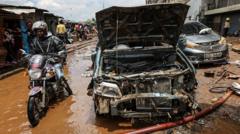
The death toll from the flash floods tearing through Kenya has reached 62, a number that serves as a grim indictment of a capital city designed for a climate and a population that died out forty years ago. Since the heavy rains began in early March 2026, 33 of those fatalities occurred in Nairobi alone. The victims were not just caught in a "natural disaster." They were drowned in drainage channels blocked by plastic waste, electrocuted by sagging power lines in informal settlements, and swept away in vehicles on highways that the government recently "modernized" without accounting for basic hydrology.
This is the second time in three years that the nation has been paralyzed by water. While the Ministry of Interior has deployed multi-agency teams and the Kenya Defence Forces to pull bodies from the Nairobi River, the reality on the ground suggests that the state is merely treating the symptoms of a terminal structural disease. The 62 deaths are the direct result of a collision between intensifying weather and a "concrete jungle" philosophy that treats every square inch of soil as a real estate opportunity rather than a vital drainage basin.
The Engineering Myth of the Modern Highway
Nairobi’s infrastructure is currently a paradox. The city boasts some of the most expensive elevated expressways and bypasses in East Africa, yet the ground level remains a death trap. During the peak of the rainfall on March 7, 2026, major arterial routes like Mombasa Road and the Uhuru Highway became impassable riverbeds.
Engineers have long warned that the rapid "paving over" of the city has created an impervious surface. In a natural environment, the soil acts as a sponge. In Nairobi, every new apartment block in Kilimani or shopping mall in Karen replaces that sponge with concrete. The water has nowhere to go but up. Urban planners like Alfred Omenya have pointed out that even high-end neighborhoods, which were historically safe, now face annual inundation. The city’s drainage infrastructure has remained largely static since the 1980s, while the volume of surface runoff has increased exponentially. When you build a six-lane highway but leave a colonial-era pipe to handle the runoff, you aren't building progress. You are building a canal.
The Riparian Land Grab
The most lethal failures are occurring in the "riparian zones"—the sixty-meter buffer strips along rivers that are legally protected but practically ignored. In settlements like Mathare and Mukuru, thousands of residents live on the literal edge of the Nairobi River. When the banks burst this month, the water didn't just flood homes; it erased them.
However, the blame does not lie solely with the urban poor seeking a place to sleep. The crisis is fueled by a decade of "unchecked development" where wealthy developers have secured approvals to build apartments and commercial hubs directly over old waterways. These structures act as dams. When the water hits an illegal wall, it backflows into the surrounding neighborhoods, often drowning those who had no part in the construction. The government's current response—belatedly "dredging" rivers and talking about 40 percent completion of regeneration projects—is a reactive scramble to fix a problem they signed into existence through years of lax zoning enforcement.
A Failure of Early Warning Systems
Despite the Kenya Meteorological Department issuing a forecast for "above-average" long rains as early as February, the information failed to save lives. There is a profound disconnect between meteorological data and "last-mile" action.
- The Data: Meteorologists predicted 20mm to 50mm of rain per day.
- The Reality: Authorities failed to evacuate high-risk zones before the banks burst.
- The Cost: 4,845 people displaced and 12,000 homes damaged or destroyed within a week.
The state’s reliance on the military for rescue operations highlights an "emergency-mode" posture. We are currently witnessing a cycle where the government waits for the tragedy to occur, deploys the army to look heroic in the mud, and then goes back to business as usual once the sun comes out. True resilience would mean using that same military or civil force to clear 37 identified high-risk zones before the first drop of rain falls.
The Economic Heart Attack
The flooding is not just a humanitarian crisis; it is an economic strangulation. Jomo Kenyatta International Airport, the regional hub for East African trade, saw flights diverted to Mombasa as runways became unsafe. When the "Silicon Savannah" cannot keep its planes in the air or its commuters on the road, the 5.3 percent GDP growth target for 2026 becomes a fantasy.
Small-scale traders in the Central Business District have lost millions in stock to water damage. Agriculture, the backbone of the economy, is facing a double-edged sword: the "Long Rains" were supposed to end a period of food insecurity, but instead, they have washed away topsoil and drowned livestock in the Rift Valley and Eastern regions. The cost of food is expected to spike as supply chains remain severed by washed-out bridges.
The Sponge City Alternative
Kenya is attempting to solve a 21st-century climate reality with 20th-century drainage. The solution isn't just "bigger pipes." It is a radical shift toward the "Sponge City" model. This requires integrating green spaces, permeable pavements, and artificial wetlands into the urban fabric to capture and slow down rainwater.
Instead of canalizing every river into a concrete trough, the city needs to allow rivers to breathe. This means the government must finally find the political will to demolish high-value illegal structures on riparian land, not just the shanties of the poor. It means holding the "multi-agency review systems" accountable for every building permit that ignores hydrological reality.
The 62 people who died this month are a reminder that nature does not care about your property title or your political connections. If you block its path, it will find a new one through your living room. The rain will return in April, and unless the "Nairobi Regeneration" becomes more than a press release, the death toll will only climb.
Kenya must decide if it wants to keep buying body bags or start buying back its floodplains.