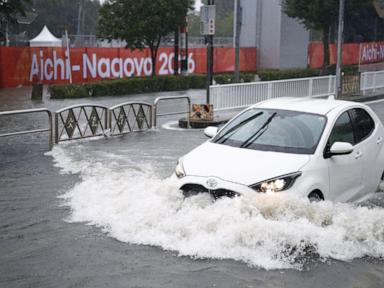
Large-scale multi-sport events function as high-stakes stress tests for regional urban planning, capital expenditure allocation, and environmental engineering. When extreme weather intersects with a host city's preparations, the primary analytical variable shifts from athletic performance to structural resilience. Recent meteorological events surrounding Nagoya, Japan, ahead of its scheduled hosting duties, illustrate the friction between natural hazards and heavy civil engineering investments. Evaluating how venues and competing athletes remain insulated from extensive regional flooding requires moving past binary assessments of safety and into a granular breakdown of hydrological vulnerability, capital asset protection, and municipal contingency design.
The Hydrological Threat Matrix in Aichi Prefecture
Urban drainage systems in central Japan operate under strict engineering parameters designed to handle historical precipitation ceilings. Nagoya sits within the Nobi Plain, a low-lying alluvial basin shaped by the Kiso, Nagara, and Ibi rivers. This geography creates an inherent hydraulic challenge during seasonal typhoon cycles.
When heavy rainfall exceeds standard municipal discharge rates, surface water accumulation threatens subsurface transit networks, low-lying electrical substations, and temporary ground-level structures often utilized during major games. The absence of widespread damage to primary competition facilities during recent high-precipitation episodes points to three underlying structural safeguards:
- Subsurface Retaining Reservoirs: Large-scale underground retention basins capture overflow volume before it breaches urban drainage channels, artificially flattening the peak runoff curve.
- Elevation Redundancy: Critical electrical infrastructure and primary structural foundations within major sporting complexes are engineered above historical flood plain thresholds, mitigating inundation risks during severe riverine swelling.
- Dynamic Pump Station Deployment: Automated sensor arrays trigger high-capacity drainage pumps at key intersections and venue perimeters, neutralizing localized pooling before it compromises structural integrity.
Asset Protection Economics
The economic logic governing Olympic and Asian Games infrastructure prioritizes capital preservation over temporary cosmetic resilience. Venues built or retrograded for regional games represent multi-billion-yen public-private investments. Consequently, risk mitigation strategies follow a strict cost-avoidance framework.
Protecting athletes and venues is not merely an operational preference; it is a financial imperative tied to insurance covenants and municipal bond ratings. When regional flooding occurs without damaging competition sites, the outcome reflects rigorous engineering controls rather than meteorological luck.
Capital allocation for these projects typically splits into two distinct buckets: primary structural hardening and secondary emergency response systems. Hardening involves reinforced concrete bulkheads, waterproofed subterranean cabling, and redundant power grids. These elements carry high initial capital expenditure but near-zero marginal maintenance costs during weather events. Secondary systems, such as deployable flood barriers and mobile pumping units, absorb recurring operational expenditure but provide critical flexibility against unpredictable hydrological anomalies.
Urban Logistics and Athlete Transit Continuity
While structural engineers focus on venue foundations, transportation logicians monitor the secondary vectors of vulnerability. An athletic venue can remain completely dry while the event fails entirely due to severed supply chains and flooded transit arteries.
Nagoya's integrated rail network and elevated expressways form the circulatory system of the upcoming games. During extreme weather, municipal authorities execute pre-planned traffic diversion protocols. These protocols protect athlete transit corridors by intentionally redirecting stormwater overflow into designated agricultural or commercial retention zones. This practice introduces an operational trade-off: safeguarding the transit of elite athletes often requires shifting environmental strain onto surrounding municipal sectors.
The absence of athlete displacement during recent flood events highlights the efficacy of multi-modal transit redundancy. When surface roads experience temporary inundation, underground metro lines and elevated commuter rail corridors maintain operational capacity. This decoupling of transit modes prevents systemic gridlock and ensures that the operational schedule of the games remains insulated from localized water accumulation.
Systemic Vulnerabilities and Long-Term Forecasts
Despite current mitigations, urban planners face compounding challenges driven by shifting climatic baselines. The historical hydrological data used to design Nagoya’s current flood defenses no longer align with contemporary precipitation intensity.
Urban densification increases impervious surface area, accelerating runoff velocity and decreasing the time available for municipal drainage networks to clear excess water. To maintain structural immunity through future event cycles, municipal strategists must transition from reactive flood containment to predictive hydrological modeling.
Future capital investments must pivot toward decentralized green infrastructure. Permeable paving materials, expanded urban wetlands along the Shonai River, and IoT-enabled smart drainage grids will replace reliance on massive concrete reservoirs. The long-term viability of international sporting infrastructure in coastal and alluvial Asian cities depends entirely on this structural evolution. Host cities can no longer rely solely on historical safety margins; they must engineer continuous adaptability into the very fabric of their urban design.
Integrate decentralized sensor networks into all subterranean retention basins immediately to transition the municipal drainage strategy from historical reactive containment to real-time predictive outflow management before the upcoming regional games commence.