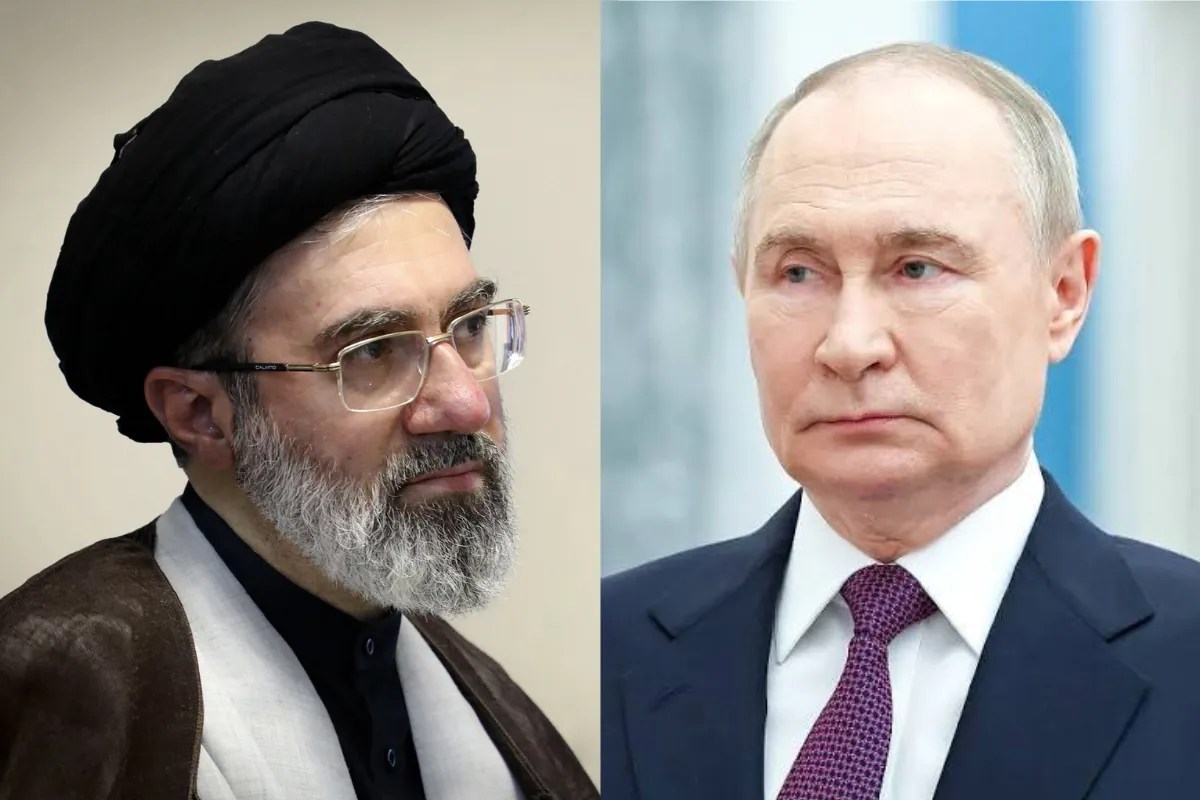
The media is panic-buying a narrative that doesn't exist. Mainstream headlines are screaming about a "new turning point" in a theoretical US-Iran war, pointing frantically to a reported upcoming meeting between Russian President Vladimir Putin and Iran’s Supreme Leader Mojtaba Khamenei. They want you to believe a monolithic, anti-Western axis is cementing a unified military strategy to take down Washington.
It is a comforting bedtime story for defense analysts who prefer simple, binary geopolitics. It is also entirely wrong.
This hyperventilating analysis misses the foundational mechanics of how transactional regimes actually operate. Moscow and Tehran are not ideological soulmates. They are desperate, mutual exploiters trapped in a marriage of convenience where both partners keep one hand on their wallets and the other on a dagger. If you are analyzing this meeting as the birth of a coordinated global military front, you are asking the wrong questions.
The Succession Illusion: Mojtaba is Not a Wartime Commander
Let us correct the first massive misunderstanding. The media treats Mojtaba Khamenei's elevation to Supreme Leader as the arrival of a radical, aggressive wartime chief ready to launch a direct kinetic conflict with the United States.
I have spent years tracking sanction evasion networks and Middle Eastern political structures. The reality inside Tehran is far more fragile than a slick headline suggests. Mojtaba Khamenei’s primary mandate is not global conquest; it is domestic survival. The transition of power in Iran is a delicate domestic balancing act designed to protect the clerical establishment's massive economic empires, specifically the financial portfolios tied to the Islamic Revolutionary Guard Corps (IRGC).
When Mojtaba sits down with Putin, he isn't signing a joint declaration of war against the West. He is looking for regime insurance.
- What the media thinks is happening: Iran is negotiating a joint military offensive with Russia to open a multi-front war against US interests.
- What is actually happening: Iran is begging for advanced Russian air defense systems (like the S-400) and Sukhoi Su-35 fighter jets to secure its own airspace against potential retaliatory strikes, offering cheap, low-tech loitering munitions in exchange.
This is a defensive posture masquerading as aggressive expansion. Iran knows a direct conventional war with the United States would decapitate the regime. Putin knows that entering a direct conflict on Iran's behalf would drain the remaining resources he needs for his own long-term campaign in Eastern Europe.
The Asymmetry of the Russia-Iran Trade
Let’s dismantle the economic fantasy of this alliance. The lazy consensus states that Russia and Iran are building an impenetrable, sanctions-proof economic bloc through bilateral trade and military tech transfers.
Look at the hard data. The total trade volume between Russia and Iran fluctuates around a few billion dollars. To put that in perspective, that is a rounding error compared to Russia’s trade dependencies with China or India.
Russia and Iran are structurally incompatible economic partners. Both are petrostates. Both rely on exporting the exact same commodity: oil. In the global black market, they are not partners; they are fierce competitors undercutting each other’s prices to capture the remaining market share in Asia.
+-----------------------------------+-----------------------------------+
| Media Fantasy                     | Economic Reality                  |
+-----------------------------------+-----------------------------------+
| A unified economic bloc pooling   | Two resource-dependent nations    |
| resources to collapse Western     | cannibalizing each other's oil    |
| sanctions regimes.                | margins in the Asian black market.|
+-----------------------------------+-----------------------------------+
When Iran provides Shahed-type drones to Moscow, it isn't out of geopolitical brotherhood. It is a calculated transaction. Iran exchanges cheap, mass-produced hardware for Russian diplomatic cover at the UN Security Council and access to specialized military components it cannot manufacture domestically.
If you think Putin will risk Russia's critical relationships with wealthy Gulf states like the UAE and Saudi Arabia—nations that inject real liquidity into the global financial system—just to act as Mojtaba Khamenei’s personal shield, you do not understand Russian foreign policy. Moscow plays a balancing game in the Middle East. It will never fully commit to Tehran at the expense of Riyadh or Abu Dhabi.
Dismantling the Flawed Premises
The public discourse surrounding this summit is built on broken assumptions. Let's address the questions people are asking, and expose why the premises themselves are fundamentally broken.
Is Russia going to supply Iran with nuclear technology to fight the US?
This question assumes Russia wants a nuclear-armed Iran. It doesn't. A nuclear-capable Tehran completely alters the security architecture of Russia's southern flank. Putin desires a volatile, distracted West focused on the Middle East, but he does not want an unpredictable, nuclear-armed neighbor that could spark a regional conflagration outside of Moscow's control. Russia will stall, promise, and prolong tech transfers, using them as leverage over Tehran rather than actually delivering the keys to the kingdom.
Will the Putin-Khamenei meeting trigger a global oil supply collapse?
No. The black-market supply chains developed by Iran and adapted by Russia are highly resilient precisely because they operate independently of formal state alliances. They rely on dark fleets, ship-to-ship transfers, and decentralized financial networks using regional currencies. A high-profile meeting between two leaders doesn't optimize these networks; logistics managers, shell companies in Dubai, and shadow banks in East Asia do. The theatrical politics at the top change nothing on the water.
The Cost of the Contrarian Reality
Admitting this truth comes with an uncomfortable downside. If Russia and Iran are not a monolithic block, it means Western policymakers cannot solve the problem with a single, sweeping strategy.
Treating them as a unified axis leads to flawed foreign policy. It forces the West into over-allocating military resources to contain an imagined combined threat, rather than exploiting the deep, systemic fractures that exist between Moscow and Tehran.
Imagine a scenario where the West offers minor sanctions relief to Russia on specific agricultural goods in exchange for Moscow quietly delaying air defense shipments to Tehran. If they were true allies, that deal would fail instantly. In reality, Putin would take that trade in a heartbeat if the domestic pressures inside Russia demanded it.
Tehran knows this. Trust is the rarest commodity in the Kremlin, and it is entirely absent in the supreme leader's compound in Tehran.
Stop reading the sensationalist front pages. Stop believing that a photo opportunity in Moscow or Tehran changes the laws of economic gravity and geopolitical self-interest. Mojtaba Khamenei is fighting for the survival of a dynasty; Vladimir Putin is fighting for the validation of his historical legacy. They will shake hands, they will issue ominous press releases, and then they will immediately go back to checking their radars to see if the other is plotting their downfall.