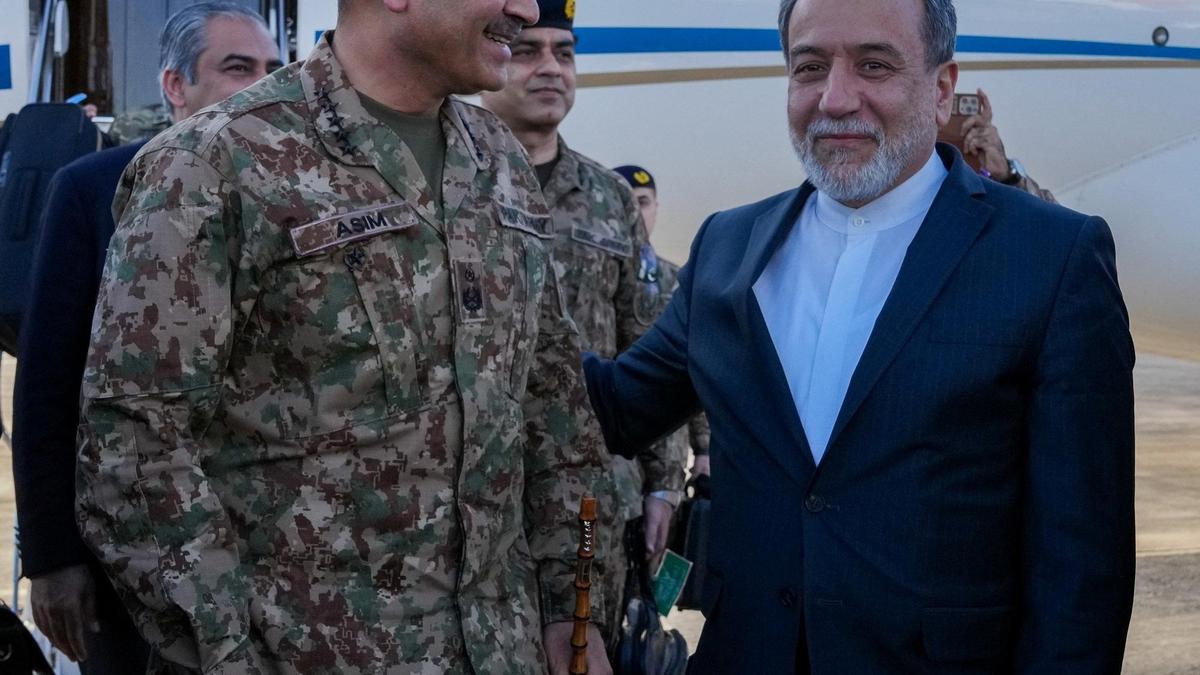
The mainstream media loves a "peace talks" narrative. It is clean. It is hopeful. It is also completely wrong. When General Asim Munir lands in Tehran, the desk-bound analysts at international outlets start typing about regional stability and de-escalation. They see a diplomatic olive branch. I see a cold, calculated re-alignment of security dependencies that has nothing to do with "peace" in the Western, liberal sense of the word.
Stop looking at this through the lens of a handshake. Start looking at it as a transactional pivot in a theater where trust is a liability. The "lazy consensus" suggests Pakistan is playing the role of the regional mediator, trying to keep the Middle East from exploding. The reality? Pakistan is fighting for its own internal relevance in a world where its traditional allies are moving on. Don't forget to check out our earlier article on this related article.
The Myth of the Neutral Mediator
Every major news cycle regarding Pakistan and Iran treats the border as a mere friction point that needs "management." They talk about the Sistan-Baluchestan province as if it is a simple border dispute. It isn't. It is a geostable pressure cooker.
When a military chief leads a delegation, he isn't there to talk about trade routes or cultural exchange. He is there because the civilian diplomatic channels have failed or, more accurately, because they are irrelevant. In the Rawalpindi-Tehran axis, the only currency that matters is kinetic intelligence. If you want more about the history here, Associated Press offers an in-depth breakdown.
The competitor's view is that these talks aim to "foster" (a word I despise for its vagueness) a new era of cooperation. Absolute nonsense. You do not cooperate with a neighbor that has historically provided a sanctuary for the very insurgents you are trying to crush. You negotiate a temporary cessation of hostilities based on mutual exhaustion.
Pakistan is currently grappling with a shattered economy and a resurgence of the TTP (Tehrik-i-Taliban Pakistan) on its western flank. Iran is navigating a post-Raisi transition and constant shadow boxing with Israel. Neither side wants peace; they both want a lower overhead cost for their existing conflicts.
The Intelligence Gap Nobody Mentions
If you want to understand why these talks are happening now, look at the geography of drone strikes, not the text of joint statements. Earlier this year, we saw a rare, direct exchange of fire between these two "brothers." The media called it a "dangerous escalation."
I call it a necessary calibration.
For years, both sides played a game of plausible deniability. "We didn't know the militants were there," they would say. The January missile exchange stripped the mask off. It proved that both capitals have the capability and the will to strike inside the other’s territory. These current talks are not about "brotherhood"; they are about establishing a red-line protocol to ensure that the next time a militant group crosses the line, the response doesn't trigger a full-scale war neither can afford to fund.
The Saudi-China-U.S. Triangle
The analysts miss the most obvious driver of this trip: the shifting tectonic plates of global patronage.
- The Saudi Factor: Pakistan has long been the "security for hire" partner for Riyadh. But MBS is changing the rules. He is modernizing. He is looking for economic returns, not just Sunni solidarity. Pakistan can no longer rely on an endless stream of petrodollars just for existing.
- The Chinese Belt: Beijing is the only one with real skin in the game. The China-Pakistan Economic Corridor (CPEC) is useless if the Gwadar port is constantly under threat from insurgents coming from the Iranian side. China is the silent ghost at this table, likely leaning on both sides to stop the bickering so the freight can move.
- The U.S. Vacuum: Washington has largely checked out of the region, focusing on the Indo-Pacific. This has forced Rawalpindi to realize that no one is coming to save them.
The "nuance" the competitors miss is that this trip is an admission of weakness, not a display of diplomatic strength. It is a recognition that the old guard of Pakistani foreign policy—waiting for a bailout and a directive from a superpower—is dead.
Why Border Security is a Red Herring
"We will secure the border," the joint statements will say. Don't believe them. The 900-kilometer border between Pakistan and Iran is some of the most rugged, ungovernable terrain on the planet. It cannot be secured by a fence or a few more outposts.
The real discussion in Tehran is about Non-State Actor Management.
In my years tracking these security shifts, I’ve seen millions wasted on "border hardening" that does nothing. If you want to stop a group like Jaish al-Adl or the BLA, you don't build a wall. You trade intelligence. You swap names. You hand over the "low-value" assets to keep the "high-value" ones in play.
This isn't a peace treaty. It's a trade agreement where the commodity is human lives and insurgent locations. It’s brutal. It’s cynical. And it’s the only thing that works in this part of the world.
The Economic Mirage
The competitor article probably mentions the Iran-Pakistan gas pipeline. It’s the ultimate zombie project. It has been "just around the corner" for decades. Every time a delegation goes to Tehran, the gas pipeline is trotted out like a prize pony.
It’s a lie.
Pakistan cannot finish that pipeline without triggering U.S. sanctions that would blow its IMF deal out of the water. Iran knows this. Pakistan knows this. They talk about it because it provides a veneer of "economic cooperation" to hide the fact that they are really just talking about who is allowed to kill whom in the border mountains.
Stop Asking if This Brings Peace
The "People Also Ask" sections on search engines are full of questions like: "Will Pakistan and Iran go to war?" or "Is the border safe now?"
These are the wrong questions.
The right question is: "Can Pakistan manage two hostile borders simultaneously?"
The answer is no. With India to the east and a volatile Taliban-led Afghanistan to the north, Pakistan is suffocating. This trip to Iran is a desperate lungful of air. General Munir isn't there to be a statesman. He is there to ensure that the western border stays "quiet enough" so he can focus the military’s dwindling resources elsewhere.
The Hard Truth of Military Diplomacy
We have to stop pretending that military-led diplomacy is a sub-optimal version of civilian diplomacy. In Pakistan’s case, it is the only functional version. When the Army Chief speaks, he is speaking for the entity that owns the land, the industries, and the intelligence apparatus.
The downside? It makes any agreement inherently fragile. It lasts only as long as the current military leadership finds it useful. There is no institutional "buy-in" from the public or the political class. It is a deal between two rooms of men in uniforms.
The Actionable Reality
If you are an investor, a policy wonk, or just a concerned observer, stop waiting for a "Peace Accord."
Instead, watch for these three things:
- Intelligence Sharing Protocols: If we see a sudden uptick in "coordinated" strikes on both sides of the border, the talks were a success.
- The Gwadar-Chabahar Narrative: Look for talk of "twinning" these two rival ports. It’s a classic sign that China has forced a temporary truce.
- Sanction Waivers: Watch if Pakistan suddenly gets a quiet "nod" from Washington to engage more with Iran. That would indicate a massive, behind-the-scenes shift in U.S. regional strategy.
The Munir Doctrine is about survival through tactical concessions. It is a gritty, unromantic attempt to keep a crumbling house from falling over. Calling it "peace talks" is an insult to the complexity of the struggle.
General Munir isn't looking for a Nobel Prize. He’s looking for a way to stop the bleeding. In a region this volatile, that’s as close to a "win" as you’re ever going to get.
Don't mistake a temporary bandage for a cure. The underlying pathology of the Iran-Pakistan relationship—distrust, sectarian tension, and proxy warfare—remains untouched. They’ve just agreed to lower the volume so they can hear the other fires burning.