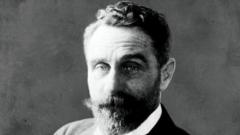
Moving Roger Casement's remains out of Glasnevin Cemetery in Dublin and up to Murlough Bay in County Antrim sounds romantic on paper. Fulfill a dying man's wish. Bring a fallen knight home to the Glens of Antrim coast he loved.
In reality, a second exhumation isn't a simple act of sentiment. It's a collision of border politics, decades-old diplomatic assurances, fragile remains, and a legacy that still divides opinion more than a century after his execution.
Late in October 2026, the Roger Casement Commemoration and Re-interment Association—joined by surviving relative James Casement, funeral directors, and legal representatives—submitted a formal application to Dublin City Council seeking a licence to exhume Casement's body from Glasnevin and rebury him at Murlough Bay. If that succeeds, it will be the second time his bones have been dug up. The first time happened under floodlights behind screens at Pentonville Prison in London in February 1965.
I've spent years reading archival records and political commentary around Irish memory politics, and whenever a revolutionary icon's grave becomes the center of a campaign, the real story lies beneath the headlines. A second exhumation forces Dublin, London, and communities across the island to reopen questions people thought 1965 had settled.
What the New Exhumation Bid Actually Aims to Do
At the heart of the current campaign is a line Casement wrote before his hanging on August 3, 1916: "bury me at Murlough". Supporters of the move argue that his 1965 reburial in Glasnevin Cemetery was shaped by statecraft rather than personal wishes. Back then, Taoiseach Seán Lemass and British Prime Minister Harold Wilson treated the repatriation of Casement's remains as a symbolic gesture ahead of the 1965 Anglo-Irish Free Trade Agreement.
Campaigners say the political climate has shifted since 1965. Co-signing the application with a direct living relative gives the effort moral weight, and proponents frame it as honoring an individual's last request regardless of political flags.
Yet moving a body from a high-profile plot in the Republic of Ireland to a coastal site in Northern Ireland immediately changes the stakes. Glasnevin sits in Dublin, where Casement was given a massive state funeral in 1965. Murlough Bay lies in County Antrim, inside the United Kingdom. Moving him across the border turns a family and commemorative request into a cross-jurisdictional flashpoint.
Why Roger Casement Still Divides Opinion
Part of the friction comes from who Casement was. Few figures in modern British and Irish history lived such a sharp double life.
Born in Dublin in 1864 to a Protestant father and a Catholic mother, he rose through the British consular service. His early-twentieth-century investigations into atrocities in the Congo Free State and the Putumayo rubber region exposed horrific abuses and earned him a knighthood. He became an internationally respected humanitarian who forced empires to confront what was happening on their frontiers.
Then his loyalties turned. Deeply affected by imperialism both abroad and in Ireland, he threw his weight behind Irish independence, sought German backing during the First World War, and became entangled in the run-up to the 1916 Easter Rising. Captured after landing on Banna Strand in County Kerry, he was tried for high treason in London and sentenced to death.
Before the trial, British officials circulated excerpts from the so-called Black Diaries—notebooks containing explicit accounts of homosexual encounters. Historians and forensic examiners have argued for decades over whether those passages were written entirely by Casement, partially interpolated by intelligence operatives, or forged.
For unionists, he remains a convicted traitor who sought aid from Britain's wartime enemy. For Irish nationalists, he's a martyr who gave up rank and life for freedom. For human rights historians, his Congo and Putumayo reports stand alongside his execution as proof of a complicated, tragic conscience.
The Grim Reality of the 1965 Pentonville Exhumation
Anyone picturing a neat ceremonial transfer should look closely at what happened in February 1965. After Casement's execution in 1916, his body had been buried in a quicklime grave inside Pentonville Prison.
When exhumation began on the evening of February 22, 1965, officials worked behind screens at dusk so inmates wouldn't see. Irish embassy official Paul Keating witnessed the operation and sent a detailed report back to Dublin describing how grim the work was. Decades later, declassified archive papers reported by outlets including The Guardian addressed lingering rumors about what was in the coffin and confirmed the harsh conditions of his original burial.
That history matters for any second exhumation. Remains disturbed once and exposed to lime and soil over more than a century aren't simple to move again. A second dig carries practical, forensic, and ethical risks—disturbing a resting place that already underwent one difficult transfer sixty-one years ago.
Diplomatic Assurances From 1965
Former Irish diplomat Ray Bassett pointed out an often-overlooked wrinkle in October 2026: correspondence between Lemass and Wilson in February 1965 touched on understandings around the repatriation. Even when governments insist there was no backroom bargain, diplomatic history leaves paper trails.
If Dublin City Council or Irish authorities must weigh a fresh licence request, they won't just look at local burial rules. They'll have to consider whether any historical understandings with London require consultation or release.
What Could Go Wrong if This Moves Forward
Here's the blunt truth: even a well-intentioned campaign can trigger headaches nobody planned for.
- Local opposition in Antrim or Dublin: Even where organizers say there's no immediate pushback, coastal beauty spots like Murlough Bay come with ecological protections, access questions, and local sensitivities around memorial sites. Meanwhile, some in Dublin view Glasnevin as the proper national resting place for 1916 figures.
- Political point-scoring: In Northern Ireland, almost any symbol tied to 1916 can get pulled into wider constitutional arguments. What starts as honoring a cousin's letter can easily be read by critics as a territorial statement.
- Public health and licensing hurdles: Exhumation licences aren't rubber-stamped. Authorities scrutinize grave stability, public health rules, family consent, and destination site suitability before signing off.
Practical Next Steps If You're Following the Case
If you want to track this story without getting swept up in rumor or outrage, take a few concrete steps:
- Check official licensing updates from Dublin City Council: Watch for formal administrative decisions or public notices rather than relying solely on campaign statements.
- Read primary archival accounts of 1965: Look up diplomatic correspondence and historical analyses of the February 1965 transfer to see how the first exhumation was handled and why Glasnevin was chosen.
- Separate the burial debate from the Black Diaries dispute: Keep the question of Casement's reburial distinct from ongoing arguments over his diaries and treason conviction—conflating them clouds both issues.
Whether Casement stays under the grass at Glasnevin or ever makes the journey north to Murlough Bay comes down to law, diplomacy, and consent. A dead man's wish speaks loudly, yet living institutions decide where history rests.


