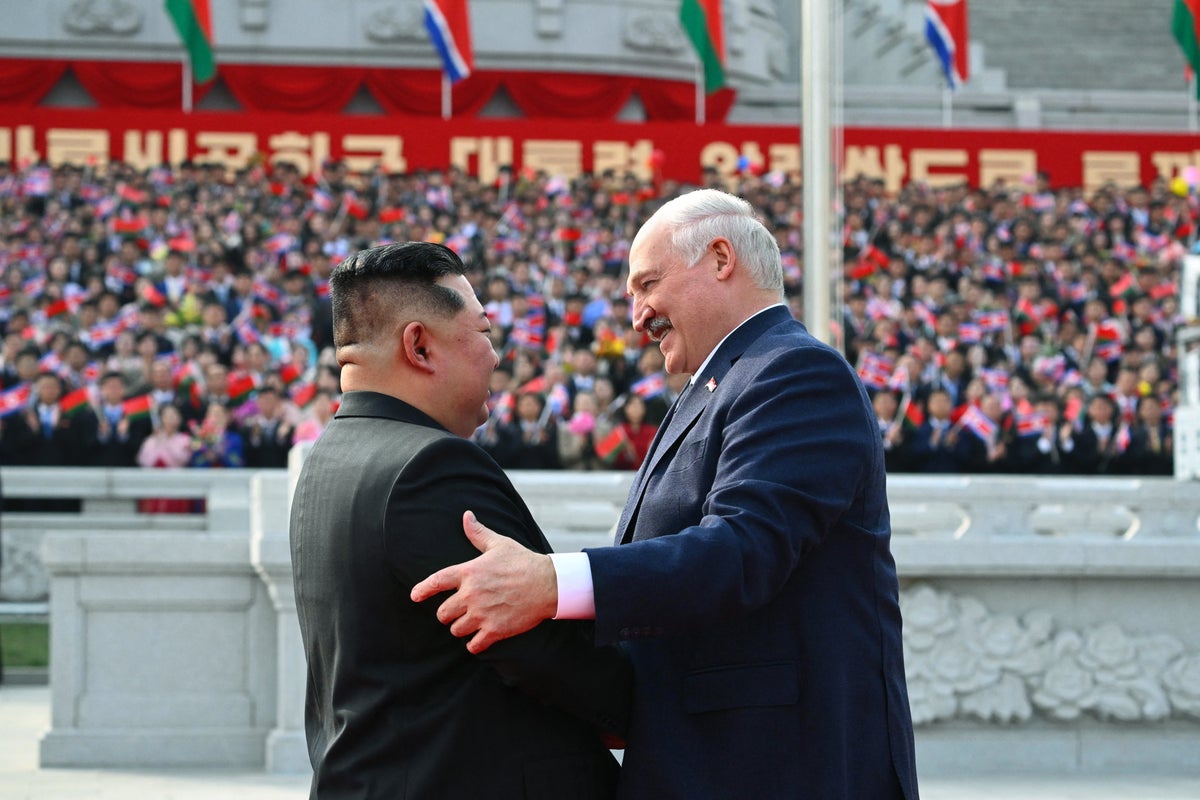
The recent diplomatic convergence between Alexander Lukashenko and Kim Jong Un in Pyongyang is not merely a photo opportunity for two of the world’s most isolated leaders. While the mainstream press focuses on the "fundamental" nature of their new treaty, the real story lies in the construction of a sophisticated, three-way logistical corridor designed to bypass Western trade restrictions. This isn't a friendship based on shared ideology. It is a cold, calculated integration of industrial supply chains intended to keep the Russian war machine fed while insulating Minsk and Pyongyang from the bite of global isolation.
The treaty signed during Lukashenko’s visit marks the first time Belarus and North Korea have formalized a strategic partnership of this magnitude. At its core, the agreement facilitates the exchange of North Korean labor and raw munitions for Belarusian heavy machinery and industrial automation technology. For years, these two nations operated on the fringes of the global economy, occasionally trading through Chinese intermediaries. Now, they are cutting out the middleman. They are building a direct pipeline for sanctioned goods, using Russia as the central clearinghouse.
The Triad of Necessity
To understand why this meeting happened now, we have to look at the map of desperation. Russia needs shells. North Korea has millions of them, but its manufacturing base is aging and inefficient. Belarus, meanwhile, possesses the sophisticated industrial infrastructure—remnants of the Soviet Union’s high-end manufacturing hub—that can modernize North Korean production lines.
By sending Belarusian engineers to Pyongyang, Lukashenko provides Kim with the technical expertise to refine his ballistic missile components and heavy artillery. In return, Belarus gains access to a pool of disciplined, low-cost North Korean labor. This labor is essential for Minsk, which has seen a significant brain drain and workforce shortage since the 2020 protests and the subsequent crackdown.
The exchange creates a closed-loop economy. Russia provides the raw energy and the theater of war; North Korea provides the kinetic volume; Belarus provides the technical refinement and logistical hardware. None of these transactions require a single US dollar or a SWIFT transfer. This is a barter-based shadow economy that the current sanctions regime was never designed to stop.
Bypassing the Silicon Gatekeepers
A major overlooked factor in this treaty is the transfer of "dual-use" technology. While global attention remains fixed on microchips and high-end semiconductors, the war in Ukraine has proven that "middle-tech" is just as vital. Belarus produces some of the world's most durable heavy-duty trucks, tractors, and machining tools. These aren't just for farming. They are the backbone of mobile missile launchers and military transport networks.
North Korea’s indigenous vehicle programs have long struggled with reliability. By integrating Belarusian chassis and engine designs into the North Korean military-industrial complex, the two nations are creating a localized production hub that is immune to Western export controls. They are sharing blueprints for hydraulic systems, optical sensors, and reinforced steel alloys.
This technical collaboration extends into the digital space. Both nations have invested heavily in state-sponsored hacking and cyber-warfare capabilities. Part of the "fundamental" agreement includes cooperation on information security, which is often code for sharing vulnerabilities in Western infrastructure and coordinating on crypto-currency laundering operations. These digital assets provide the hard currency needed to buy the few Western components they cannot yet replicate.
The Labor Trap
The human element of this treaty is perhaps its most grim reality. North Korea has a long history of exporting forced labor to Russian logging camps and Siberian construction sites. The new agreement with Minsk paves the way for North Korean workers to enter Belarusian factories. This is a win-win for the regimes and a nightmare for international labor monitors.
For Kim, sending workers abroad is a primary source of foreign currency, as the state garners upwards of 70% of their wages. For Lukashenko, it provides a workforce that will not strike, will not protest, and will not demand political reform. It is a captive labor force that can be deployed to meet the surging demands of the Russian defense ministry.
The international community has few tools to prevent this. While the UN Security Council has resolutions banning the use of North Korean labor, those resolutions are effectively dead letters. Russia, a permanent member of the Council, has signaled it will no longer enforce these rules. By hosting Kim’s laborers, Belarus is simply following the lead of its primary benefactor in the Kremlin.
Military Integration by Stealth
We should not expect a formal military alliance in the style of NATO. Instead, we are witnessing a modular integration of military capabilities. During the Pyongyang summit, discussions touched on "agricultural cooperation," a classic euphemism in the world of sanctioned states. In reality, this often refers to the chemical industry. The same facilities used to produce fertilizer are easily converted to produce the precursors for explosives and chemical weapons.
Belarus has maintained high standards in chemical engineering and optics. If North Korea can leverage Belarusian lens-grinding technology, the accuracy of their short-range ballistic missiles could improve significantly. This poses a direct threat not just to Seoul and Tokyo, but to the global security balance. It turns a "rogue state" into a sophisticated military exporter.
Furthermore, the treaty allows for the "sharing of experiences in sovereign development." This is political shorthand for survival tactics. Lukashenko has successfully navigated Western sanctions for decades; Kim has done it for his entire life. They are now swapping playbooks on how to hide shipping fleets, how to use shell companies in Southeast Asia, and how to manipulate the international grain market to secure food supplies during shortages.
The Failure of Traditional Diplomacy
The West’s reliance on "maximum pressure" campaigns is hitting a wall of diminishing returns. When you sanction a country into a corner, you eventually strip away its incentive to participate in the global order. Belarus and North Korea have reached that point. They have realized that their combined weaknesses can be forged into a collective strength.
Traditional diplomacy assumes that these leaders care about their reputations or the long-term economic prosperity of their citizens. They don't. They care about regime survival and the maintenance of their security apparatus. This treaty is a survivalist's manifesto. It signals to Washington and Brussels that the "axis of the sanctioned" is no longer a collection of isolated outposts, but a networked front.
The shift in Russian policy has accelerated this. For years, Moscow acted as a semi-responsible stakeholder that at least paid lip service to non-proliferation. That era is over. Putin now views North Korea and Belarus as essential subcontractors. The "fundamental" treaty is the legal framework for this subcontracting. It provides the veneer of statecraft for what is essentially a massive, state-sponsored smuggling operation.
Industrial Consequences
What does this mean for the global market? Specifically, it complicates the supply chain for minerals and rare earth elements. North Korea sits on vast untapped deposits of coal, iron ore, and minerals essential for battery production. Belarus has the heavy mining equipment to extract them. If they can successfully link these resources to the Russian and Chinese markets, they create an alternative supply chain that bypasses Western-controlled ports and financial systems.
This threatens to undermine the effectiveness of Western economic statecraft. If a country can maintain its military and its elite's lifestyle through a shadow network, the threat of being cut off from Western markets loses its power. We are seeing the birth of a parallel global economy—one that is darker, less transparent, and entirely indifferent to international law.
The Strategic Blind Spot
The mistake many analysts make is viewing this as a sign of weakness. They see two desperate men clutching at each other. While there is desperation involved, there is also opportunity. By aligning, they reduce their individual dependence on China. Both Lukashenko and Kim are wary of becoming mere provinces of Beijing. This bilateral agreement gives them a tiny bit of leverage, a way to show that they have other options.
It also serves as a distraction. While the world watches the handshake in Pyongyang, the actual work is being done by mid-level bureaucrats and logistics officers in the port of Rason and the industrial zones of Vitebsk. They are the ones hashing out the shipping manifests and the technical specifications for new drone components.
The treaty is a loud signal for a quiet process. It is the formalization of a reality that has been building since the invasion of Ukraine in February 2022. The walls of the "rules-based international order" are being dismantled brick by brick, and the builders are using Belarusian tools and North Korean labor.
Redefining the Threat
This isn't just a regional issue for Eastern Europe or the Korean Peninsula. It is a global challenge to the concept of economic coercion. If the Belarus-North Korea-Russia triangle succeeds in creating a self-sustaining industrial loop, other sanctioned nations like Iran or Syria will likely seek to join the network.
We are moving toward a world where sanctions are no longer a terminal sentence, but a barrier that can be bypassed with enough technical ingenuity and a complete lack of moral scruples. The treaty signed in Pyongyang is the blueprint for this new reality. It is a document that prioritizes the movement of hardware over the movement of people, and the preservation of power over the principles of peace.
The next time a shipment of "tractors" leaves a Belarusian port for a destination in the Pacific, it won't be for farming. It will be the latest delivery in a supply chain that is redrawing the geopolitical map. The West can no longer afford to treat these meetings as sideshows. They are the main event in a new era of defiant, coordinated survival.
Monitor the movement of the Belarusian 140th Repair Plant's technical staff; their presence in North Korean military zones will be the first concrete indicator that the high-tech transfer has moved from paper to the factory floor.