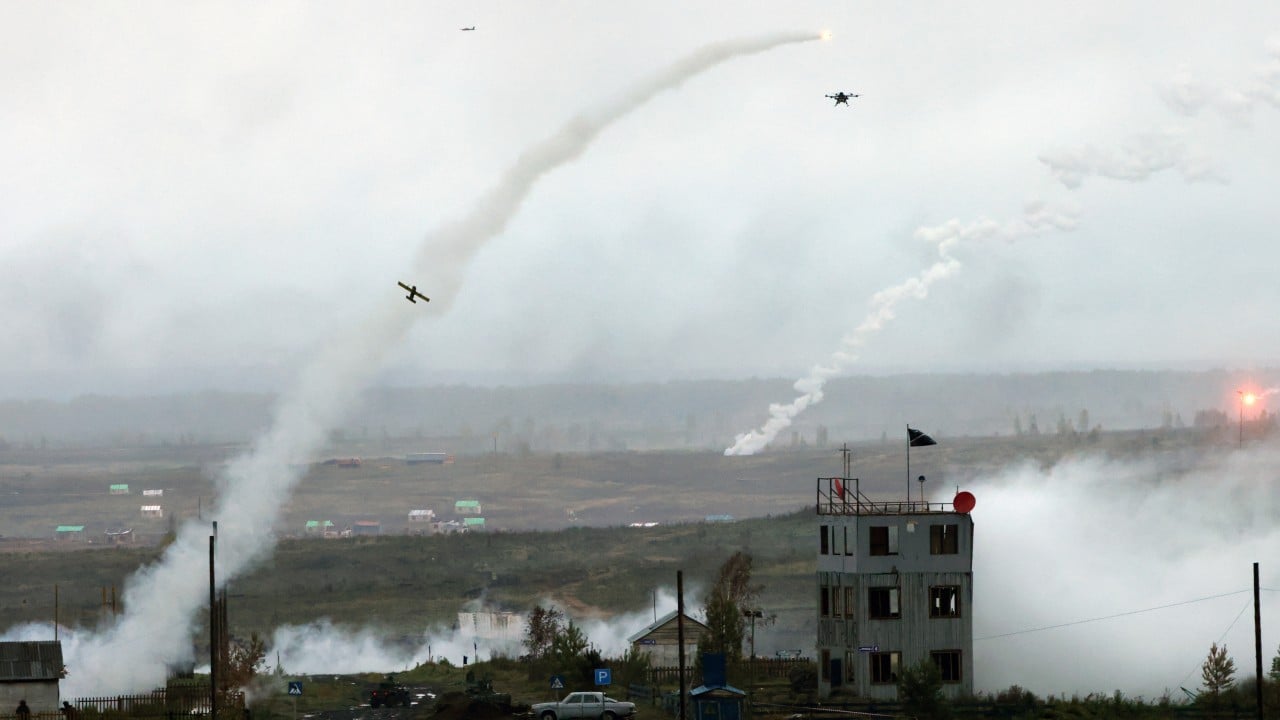
The ground in central Russia shakes beneath tracks forged in two different capitals. Thousands of personnel from the People's Liberation Army march alongside Russian forces in the Tsentr-2026 strategic command exercise, a massive display of force that signals an unvarnished alignment between two nuclear-armed states. Western defense ministries tend to dismiss these maneuvers as choreographed theater designed for domestic television broadcasts. That dismissal is a dangerous miscalculation.
When Beijing dispatches mechanized brigades, command staff, and advanced logistics units halfway across the Eurasian landmass to train under Russian tactical doctrine, something fundamental shifts in modern security calculations. This is not a superficial exchange of diplomatic pleasantries or a token display of flags at a border post. It represents an evolving capability for joint operations between militaries that spent the better of the twentieth century eyeing each other with mutual suspicion.
Strategic alignments of this magnitude do not emerge overnight. They are forged through joint drills, shared data pipelines, and synchronized logistics networks. The Tsentr-2026 exercises serve as the live-fire laboratory where theory meets operational reality. Understanding the true scope of this cooperation requires looking past the propaganda feeds and examining the nuts and bolts of interoperability, command integration, and geopolitical positioning.
The Logistics Problem That Both Militaries Solved
Armies march on their stomachs, but modern armies fight on their supply chains. For decades, military analysts argued that joint operations between Russia and China were impossible because their command structures, communications protocols, and supply standards were fundamentally incompatible. Russian forces rely on distinct radio frequencies, heavy artillery logistics tailored to Soviet-era supply depots, and centralized command hierarchies. The People's Liberation Army operates on heavily digitized, domestically engineered command-and-control frameworks that evolved from different tactical doctrines.
Tsentr-2026 demonstrates how rapidly those barriers are eroding. Engineers and logisticians from both nations have spent years establishing bridgeheads of compatibility. When field commanders share secure data links during a simulated counter-offensive, they are testing automated translation and relay systems designed to bridge the language and technical gap.
This level of operational integration transforms the geopolitical calculus for Western capitals. A military force that can coordinate artillery strikes, air defense umbrellas, and armored surges across a shared front line ceases to be two separate armies acting in parallel. It becomes a unified strategic bloc capable of projecting power across multiple theaters simultaneously.
The integration extends far beyond the ground forces sweating in the dust of central Russian training ranges. Naval coordination in the Pacific and Arctic circles, combined with frequent joint bomber patrols over the Sea of Japan, confirms that this alignment spans all branches of service. Moscow brings decades of combat-tested electronic warfare experience and raw strategic depth, while Beijing contributes industrial manufacturing capacity, advanced electronics, and capital resources that help absorb economic shocks.
Rewriting The Doctrine Of Combined Arms
Modern warfare punishes hesitation. The lessons absorbed from recent conflicts in Eastern Europe have altered how military planners view mass, dispersion, and automated surveillance. During the Tsentr-2026 exercises, observer delegations study how fast units can disperse under drone reconnaissance and how effectively electronic countermeasures can blind incoming precision munitions.
China's military modernizers watch closely as Russian veterans pass down hard-learned lessons regarding trench warfare, electronic jamming, and counter-battery fire. In return, Russian commanders observe the precision, speed, and organizational discipline of Chinese mechanized units utilizing indigenous command vehicles and integrated battlefield management software.
This mutual education accelerates the modernization curves of both armed forces. Western defense budgets are substantial, but procurement cycles are notoriously sluggish. Industrial bases in Europe and North America struggle to scale production of basic artillery shells, let alone advanced guidance chips. Meanwhile, the industrial complex backing the Tsentr-2026 participants operates on wartime pacing, churning out heavy armor, communications gear, and unmanned aerial vehicles at a scale that leaves Western defense planners scrambling.
The strategic implications ripple outward toward regional security architecture in Asia and Europe alike. Neighboring states watch these exercises with profound unease. When two massive military powers harmonize their operational procedures, the buffer zones that historically separated their spheres of influence begin to dissolve. Small nations caught in the geographic crossfire find themselves navigating a diplomatic tightrope with very little room for error.
The Economic Engine Underpinning The Uniforms
Military exercises do not happen in a vacuum. They are funded by billions of dollars in bilateral trade, energy pipelines, and financial transactions designed to bypass Western-led sanctions regimes. The endurance of this military partnership relies entirely on an economic foundation that proved resilient against unprecedented financial isolation.
When Russian oil and gas flow eastward while Chinese manufacturing machinery, microelectronics, and dual-use components flow westward, both economies achieve a degree of insulation. This commercial symbiosis funds the expensive modernization programs on display during maneuvers like Tsentr-2026. Defense spending is no longer a drain on a struggling state budget; it is sustained by robust trade revenues that continue to expand regardless of diplomatic protests from Washington or Brussels.
Financial decoupling strategies implemented by Western nations inadvertently accelerated this integration. By cutting off access to Western banking networks and technology sectors, foreign policy architects pushed Moscow deeper into Beijing's economic orbit. The military cooperation witnessed on the training grounds is the direct output of that forced convergence.
Beyond The Propaganda Lens
It is tempting to write off joint military drills as empty bluster. Governments routinely exaggerate the competence of their armed forces during public demonstrations, and external observers often struggle to separate genuine capability from cosmetic display. Yet seasoned analysts know that watching what militaries practice reveals far more than listening to what politicians declare.
The troops participating in Tsentr-2026 are not marching for the cameras alone. They are testing secure communication frequencies, synchronizing logistics nodes, and ironing out the friction points that inevitably arise when two distinct military cultures attempt to fight as one. Every kilometer of shared operational space diminishes the friction of coalition warfare.
The global security architecture is shifting from a unipolar framework dominated by Western institutions into a hardened, multipolar reality defined by competing blocs. The exercises in central Russia are an unmistakable signpost on that road. As interoperability deepens and industrial output accelerates, the strategic weight of this partnership will continue to exert gravitational pull on global stability, leaving older diplomatic playbooks obsolete and forcing a complete reassessment of how modern power is projected and sustained.