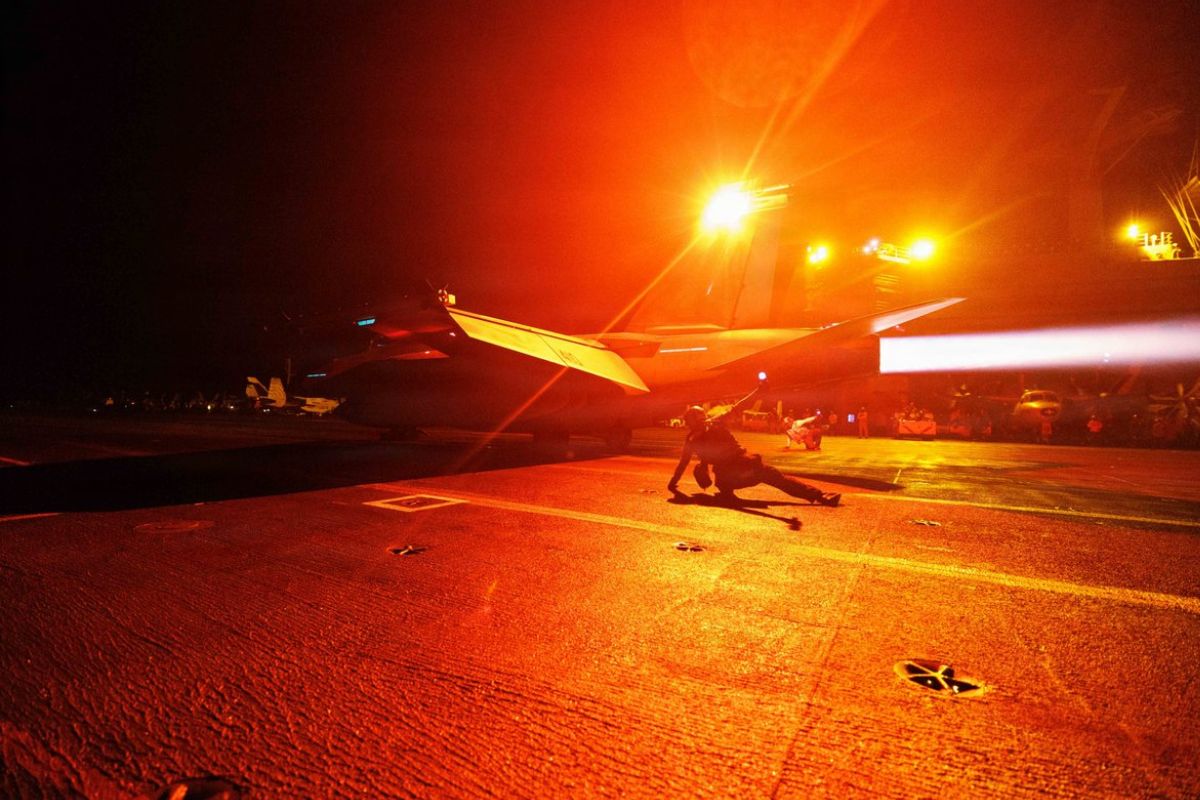
The clock in Washington reads 3:00 PM. In the Jordan desert, it is midnight.
For eight consecutive nights, the silence of the desert has not been broken by the wind, but by the low, rumbling thunder of B-1 bombers and precision-guided munitions. To the casual observer tracking the news from thousands of miles away, these are just headlines. They are data points. They are strategic chess moves mapped out on glowing television screens in comfortable living rooms. But on the ground, the reality is measured in heartbeats, smoke, and the heavy weight of grief.
The catalyst for this relentless week of violence was the sudden, violent shattering of peace at a remote military outpost in Jordan known as Tower 22.
Imagine a young soldier stationed there. Let's call him Specialist Miller—a hypothetical composite of the brave men and women who sign up to serve, leaving behind quiet suburban lives for the harsh, dust-choked reality of the Syrian-Jordanian border. He is thousands of miles from home, drinking stale coffee, thinking about his family, or perhaps staring at a blurred photograph of his partner back in Ohio. Then, the sky falls.
A single one-way attack drone, launched by an Iranian-backed militia group, slips past the base’s air defense systems. The impact is instantaneous. Destructive. Deadly. In that single, chaotic moment, two American soldiers lose their lives. Dozens of others are wounded, their bodies torn by shrapnel and their minds forever altered by the concussive force of the blast.
When the flag-draped coffins arrive back on tarmac in the United States, the political machinery shifts gears. Grief turns into an engine for retaliation. The loss of American life demands an answer, and in the calculus of modern warfare, that answer is delivered in tons of high explosives.
The Eighth Night of Thunder
For eight straight nights, the skies over Iraq and Syria have burned.
The targets are carefully curated, cataloged by intelligence analysts over months of surveillance. Command and control centers. Intelligence headquarters. Rocket storage facilities. Drone supply chains belonging to the Islamic Revolutionary Guard Corps (IRGC) Quds Force and affiliated militia groups. The Pentagon releases statements detailing the precision of the strikes, emphasizing that the United States does not seek a wider conflict in the Middle East.
But precision on a map looks vastly different from precision on the ground.
When a missile strikes a weapons depot, the secondary explosions chain outward. The earth shakes for miles. For the civilians caught in the geographic crossfire—the shopkeepers in western Iraq, the families farming near the Syrian border—the geopolitical justification matters very little. They sleep in their clothes, waiting for the windows to rattle, wondering if the next stray fragment will find their roof.
This is the hidden cost of deterrence. To deter an enemy, you must demonstrate a willingness to destroy. Yet, every explosion creates a vacuum. It clears the rubble but leaves behind a fertile soil of resentment. The cycle feeds itself, hungry for more fuel, moving mechanically from action to reaction.
The Strategy Behind the Smoke
Military analysts speak of these operations with a detached, clinical vocabulary. They talk about "proportional response" and "denying operational capability."
Let us break down what that actually means.
Think of the Iranian-backed militia network as a massive, sprawling corporate franchise. Tehran provides the capital, the proprietary technology—the blueprints for the drones and the guidance systems for the rockets—and the high-level management. The local militias act as the regional branches, executing the strategy on the ground.
By striking eighty-five distinct targets across multiple locations in a matter of days, the US military is attempting to bankrupt the franchise. If you blow up the warehouses, the regional managers cannot supply their workers. If you eliminate the command centers, the communication lines drop dead.
But a franchise can rebuild if the corporate headquarters remains completely untouched.
This is the delicate, terrifying tightrope that policymakers walk. Strike too softly, and you project weakness, inviting more attacks on American outposts like Tower 22. Strike too hard—specifically, strike targets inside Iran’s physical borders—and you ignite a regional firestorm that could swallow the entire Middle East, dragging global economies into a tailspin and costing thousands more lives.
So, the bombers fly at midnight. They strike the proxies to punish the masterminds, a deadly game of signaling played out in fire and steel.
The Human Balance Sheet
It is easy to get lost in the geography of conflict. Al-Qaim, Akashat, the Euphrates River valley—these names sound distant, almost mythical, to those who have never walked their streets.
But the stakes are intimate.
Every mission brief represents a decision that filters down to a human being. A pilot sitting in a cockpit, adjusting their oxygen mask, watching the coordinates lock onto a screen. A militia fighter, perhaps a young man radicalized by years of regional chaos, waiting in a bunker. A mother holding her child tightly in the dark, praying that the roaring overhead passes over her neighborhood.
We often look at international relations as a game played by states, but states are just collections of people driven by fear, pride, and the instinct to survive. When a country's honor or safety is compromised, the response is primal.
The United States entered this specific escalation to avenge two fallen soldiers and protect the thousands of others stationed in precarious outposts across the region. It is a legitimate, necessary duty of a government to protect its citizens. Yet, as the bombs fall for an eighth night, the question shifts from what are we doing? to where does this end?
History shows us that violence in this region rarely has a clean finale. It does not wrap up neatly with a treaty or a clear victory march. It ebbs and flows like the tide, pulling lives out to sea with every retreat.
The desert in Jordan is quiet again as the sun begins to rise, painting the sky in pale shades of orange and amber. The smoke from the latest strikes drifts across the borders, blurring the lines between nations, settling silently over the sand. At Tower 22, the morning shift begins under a heavy, watchful sky, the memory of the fallen lingering in every silent glance between comrades who know that midnight is only a few hours away.