The fork paused halfway to Sarah’s mouth. On the prongs sat a pristine leaf of romaine lettuce, glistening with a light vinaigrette, flecked with cracked pepper. It looked like the absolute picture of health. It was exactly what we are told to eat if we want to live longer, feel better, and take care of our bodies.
She ate it.
Days later, her entire world shrunk to the four walls of a bathroom. Then, to the sterile white curtains of an emergency room cubicle.
What Sarah experienced was not a typical bout of twenty-four-hour food poisoning. It was a hostile takeover. Inside her digestive tract, a microscopic parasite was systematically replicating, tearing through healthy tissue, and triggering an immune response so violent that it left her dehydrated, hollowed out, and terrified.
She is not alone. Across the United States, eighty-six human beings have recently found themselves in identical medical emergencies. They did not eat sketchy street food. They did not consume undercooked meat. They simply ate fresh produce, trusting that the system designed to protect them was doing its job.
According to the Centers for Disease Control and Prevention, a stealthy foodborne parasite is quietly spreading across multiple states. Eighty-six people have been hospitalized so far. That number represents eighty-six empty seats at family dinner tables, eighty-six frantic drives to local hospitals, and eighty-six files stacked on the desks of federal epidemiologists trying to trace a ghost through a vast, tangled agricultural supply chain.
The Illusion of Safety in the Produce Aisle
We have been conditioned to fear the wrong things.
We check the sell-by dates on milk. We use separate cutting boards for raw chicken. We look suspiciously at seafood that smells just a little too much like the ocean. But when we walk into the produce section of a modern grocery store, our guard drops completely. We are greeted by bright lights, misting machines that simulate morning dew, and neat stacks of vibrant greens. It feels alive. It feels pure.
But the reality under the microscope is far more complicated.
Consider how a single leaf of lettuce travels from a field to your kitchen. It is grown in open soil, exposed to the elements, birds flying overhead, and agricultural runoff from nearby livestock operations. It is harvested by human hands, packed into crates, washed in industrial facilities, transported in refrigerated trucks across thousands of miles, and handled by stockers at your local market.
Every single stop along that journey is an opportunity for an unwanted passenger to climb aboard.
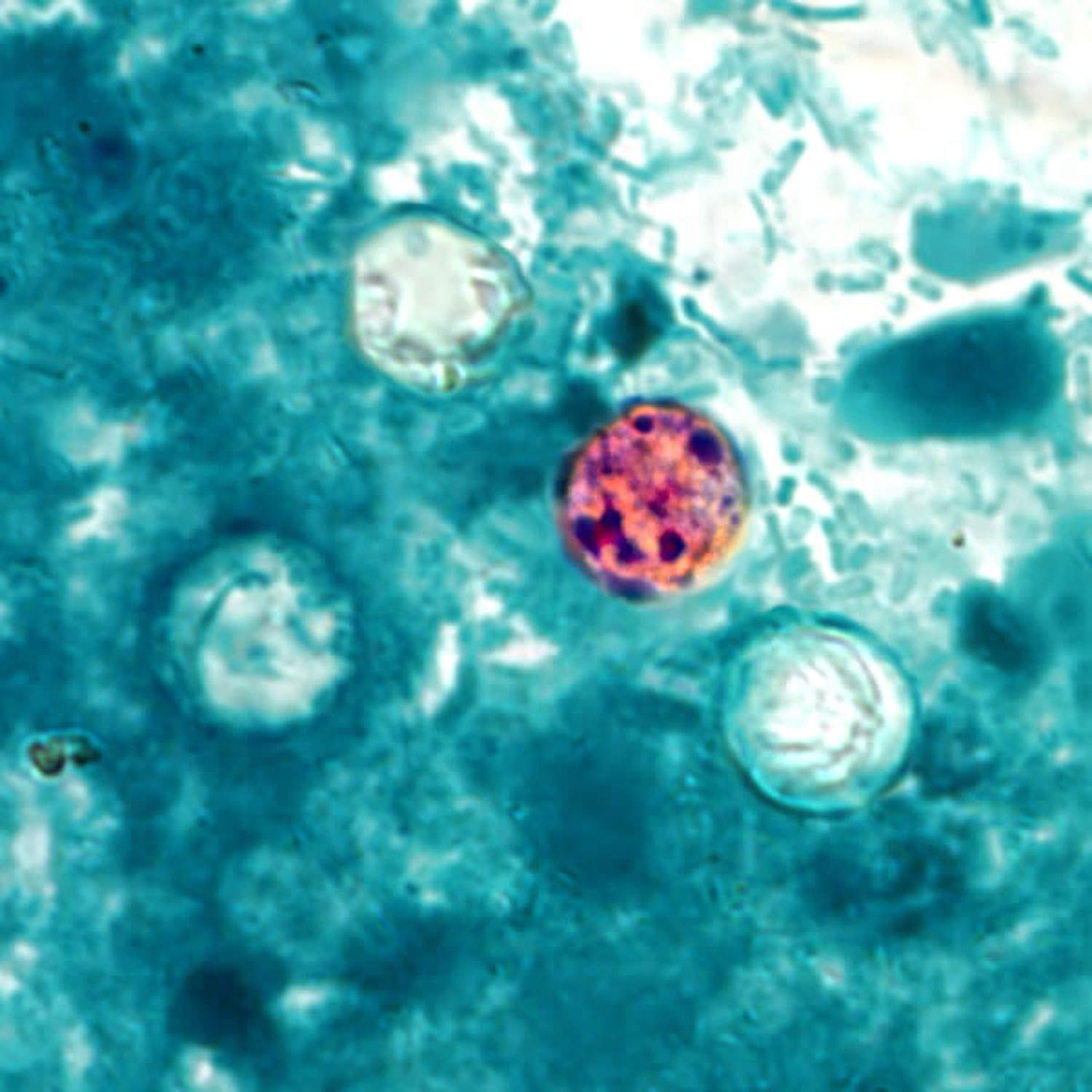
When a parasite like Cyclospora or Cryptosporidium enters this chain, it does not leave a mark. You cannot smell it. You cannot taste it. You cannot see it. A single piece of contaminated fruit or foliage looks identical to a perfectly safe one. Even washing your vegetables thoroughly at home—while highly recommended—is often not enough. These organisms possess a sticky, microscopic outer shell that allows them to cling to the ridges and pores of plant tissue like glue.
They are built to survive.
Inside the Invisible Invasion
To understand why eighty-six people are currently fighting for their health in hospital beds, we have to understand what these parasites actually do once they cross the threshold of the human body.
Let us use a hypothetical scenario to map out the anatomy of an infection. Imagine a healthy forty-year-old man named David. He mixes a fresh berry smoothie before his morning run. He swallows a handful of microscopic parasites hidden on a single raspberry.
At first, nothing happens.
The parasite is an opportunist. It enters the stomach, riding out the wave of powerful gastric acid thanks to its protective cyst wall. It travels down into the small intestine, its preferred habitat. Once there, it wakes up. The cyst bursts open, releasing active organisms that immediately burrow into the delicate, velvety lining of the intestinal wall.
They begin to feed. They begin to multiply.
For the first week, David feels entirely normal. He goes to work, plays with his kids, and plans his weekend. This is the incubation period, the quiet before the storm. But beneath the surface, his cellular architecture is being dismantled.
When the symptoms finally hit, they hit like a physical blow to the chest.
It starts with an unfamiliar, deep fatigue. Then come the cramps—sharp, twisting knots in the abdomen that make it difficult to stand up straight. Within hours, the body attempts to purge the invader. Because the parasite has damaged the cells responsible for absorbing nutrients and water, everything David consumes passes right through him.
The danger shifts from the parasite itself to the sheer velocity of fluid loss.
Days blur together. The fever spikes. Dehydration sets in, drying out the mouth, making the eyes sunken and heavy, and sending the heart into a frantic, rapid rhythm as it struggles to pump a dwindling volume of blood. This is the exact point where a person realizes they cannot manage this at home with sports drinks and rest. This is the moment they pack a bag and head to the emergency room, joining the growing statistics tracked by the CDC.
Tracing a Ghost Across the Continent
When eighty-six people end up in the hospital with the exact same rare parasitic infection, a silent alarm goes off in Atlanta, Georgia.
Medical detectives at the CDC face a monumentally difficult task. If eighty-six people get sick from a local restaurant, the source is relatively easy to find. Shut down the kitchen, test the surfaces, find the contaminated ingredient. But when those eighty-six individuals are scattered across ten, fifteen, or twenty different states, the puzzle becomes dizzyingly complex.
Epidemiologists begin by conducting grueling, hours-long interviews with every single patient.
"What did you eat last Tuesday?"
"Where did you buy your groceries two weeks ago?"
"Did you visit a salad bar? Did you buy pre-washed greens? Did you eat at a casual dining chain?"
Memory is a notoriously fragile thing. Can you remember every single ingredient in every meal you ate fourteen days ago? Most of us cannot. Yet, the answers to these questions are the only breadcrumbs these detectives have to follow.
They look for the overlap. They look for the common denominator.
But the real problem lies elsewhere, buried deep within the mechanics of modern corporate farming. A single distribution center might receive tomatoes, cilantro, or spinach from dozens of different farms across Central America, California, and Arizona. Those products are mixed, packaged, and shipped out to thousands of retail stores. By the time a cluster of human beings falls ill, the specific batch of contaminated produce is long gone from store shelves. It has already been consumed, discarded, or decomposed.
The investigation becomes a race against time to identify the systemic flaw before the next batch of product hits the market.
It is a terrifying reminder of how vulnerable our interconnected world truly is. We enjoy the luxury of eating fresh strawberries in the dead of winter and crisp salads during a heatwave, completely detached from the seasons. But that luxury relies on a global web of transit so vast that a single contaminated irrigation well in one corner of the hemisphere can cause a public health crisis thousands of miles away.
The True Cost of a Modern Luxury
We often talk about food safety in terms of regulations, inspections, and corporate accountability. We look at the charts, we read the recall notices, and we move on with our day.
Consider what happens next for the people behind the numbers.
For the eighty-six individuals hospitalized in this latest outbreak, the consequences stretch far beyond a temporary hospital stay. A severe parasitic infection can wreck the delicate balance of the gut microbiome for months, if not years. Some patients develop post-infectious irritable bowel syndrome, a chronic condition that dictates what they can eat, how they travel, and how they live their daily lives long after the parasite has been cleared from their systems.
There is also a psychological toll.
When the very food that is supposed to nourish you makes you profoundly ill, eating becomes a source of anxiety. Walking down the produce aisle ceases to be a mundane chore; it becomes a mental minefield. You look at a bag of spinach and wonder if it is worth the risk. You question the cleanliness of every restaurant kitchen you look into.
The trust is broken.
Redefining Our Relationship with the Plate
We cannot completely opt out of the agricultural system. We cannot all grow our own food, raise our own livestock, and source our water from private, pristine wells. We have to trust the network that feeds us.
But blind trust is dangerous.
Protecting ourselves requires a shift in how we handle our food at home, moving away from casual complacency toward a more deliberate, mindful approach. It means acknowledging that convenience often comes with hidden baggage. Pre-washed, bagged salads are incredibly convenient, but they also combine greens from multiple fields, vastly increasing the statistical odds of cross-contamination compared to buying a whole head of lettuce and washing the individual leaves yourself.
The current outbreak will eventually peak, the numbers will stabilize, and the CDC will likely track down the specific source of the contamination. The headlines will fade, replaced by the next breaking news cycle.
But somewhere, another microscopic organism is already waiting for its chance to hitch a ride.
The next time you prepare a meal, look closely at the fresh ingredients on your counter. Appreciate the journey they took to reach your kitchen, the hands that picked them, and the miles they traveled. Wash them with care. Treat them with respect. The battle for public health isn't just happening in government laboratories or corporate boardrooms; it is fought every single day, right on the surface of our cutting boards.